PUBLISHER: Mordor Intelligence | PRODUCT CODE: 2124480

PUBLISHER: Mordor Intelligence | PRODUCT CODE: 2124480
Oil & Gas Engineering Services - Market Share Analysis, Industry Trends & Statistics, Growth Forecasts (2026 - 2031)
According to Mordor Intelligence, the oil and gas engineering services market size is expected to grow from USD 58.8 billion in 2025 to USD 62.94 billion in 2026 and is forecast to reach USD 88.47 billion by 2031 at 7.04% CAGR over 2026-2031.
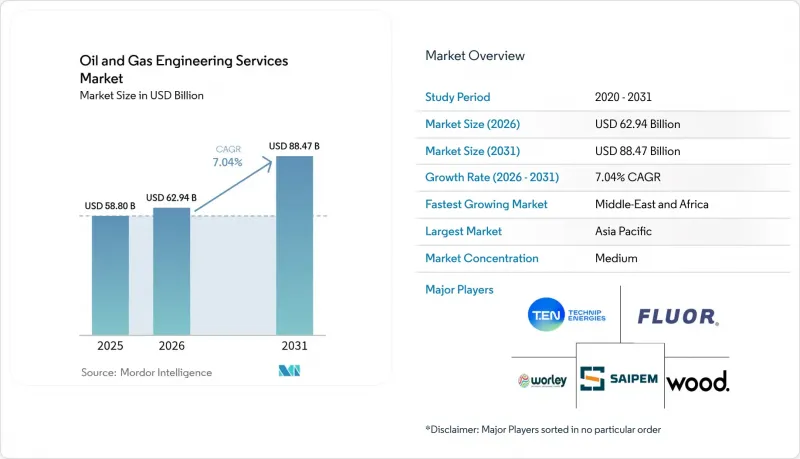
This report is Segmented by Type (Upstream, Midstream, and Downstream), Service Type (Design and Front-End Engineering, Detailed Engineering and EPCm, and More), Application (Exploration and Production, Refining and Petrochemicals, LNG and Gas Processing, and More), and Geography (North America, South America, Europe, and More). The Market Forecasts are Provided in Terms of Value (USD).
Global Oil & Gas Engineering Services Market Trends and Insights
Growing adoption of automation and digital twins
Shell's digital twin for its Prelude FLNG facility reduced project execution time by 18% and saved USD 45 million annually in maintenance, demonstrating the business case for real-time data integration. Asset owners are increasingly specifying digital-twin deliverables at the bidding stage, shifting the service scope toward predictive maintenance and scenario-based optimization. Alignment with API and ISO 55000 standards speeds board approvals and unlocks capital for larger transformation programs. Service providers that have invested in integrated data platforms now win higher-margin outcome-based contracts. This momentum directly feeds into the expanding demand for advanced analytics professionals within the oil and gas engineering services market.
LNG capacity build-out in emerging markets
Africa and Southeast Asia together have more than USD 180 billion in committed LNG projects that require specialized engineering over the next five years. Qatar's North Field expansion alone has issued over USD 25 billion in engineering contracts covering detailed design, fabrication support, and digital integration. Harsh-environment locations increase per-unit engineering intensity by 40% compared to legacy plants, according to the International Energy Agency. Higher complexity translates into premium billing rates, sustaining double-digit growth for LNG-focused service portfolios. The trend anchors robust order backlogs that cushion providers against cyclical dips in upstream spending.
Crude-price cyclicality and cap-ex pull-backs
Oil prices oscillating between USD 70 and USD 95 per barrel in 2024 forced multiple project deferrals, slicing ConocoPhillips' capital budget by USD 1.2 billion and shrinking associated engineering awards by 15%. Operators now stipulate flexible scope clauses that shift risk onto contractors. Firms heavily exposed to mega-projects face lumpy cash flows and must maintain idle capacity during downturns. Smaller, regionally diversified workloads help mitigate revenue volatility; however, balance-sheet resilience remains critical for weathering short-cycle pullbacks within the oil and gas engineering services market.
Other drivers and restraints analyzed in the detailed report include:
- Decarbonisation mandates (CCUS and methane abatement)
- Industry-wide cost optimisation imperatives
- Skilled-labour shortages in specialised disciplines
For complete list of drivers and restraints, kindly check the Table Of Contents.
Segment Analysis
Upstream services held a 41.78% market share of the oil and gas engineering services market in 2025, underscoring the capital-intensive nature of deep-water exploration, unconventional resource development, and enhanced recovery programs. Continuous reservoir appraisal and complex well architectures demand integrated subsurface and surface engineering that few competitors can execute at scale. Upstream workloads also include digital field life-cycle modeling, which informs production optimization and extends contract duration across the development horizon.
The downstream arena, although smaller, is growing faster at 7.82% CAGR as refiners modernize and integrate petrochemicals to maximize margins. Saudi Aramco's USD 20 billion Jazan complex exemplifies the high-value projects driving downstream momentum. Stricter environmental rules raise technology requirements for sulfur removal, flare reduction, and energy efficiency, boosting consulting and execution revenues. Midstream, anchored by LNG facilities and pipelines, captures roughly 27.65%, providing steady income from long-dated infrastructure programs. Together, these dynamics reinforce a balanced opportunity set across the oil and gas engineering services market.
Complete Report Scope:
- By Type
- Upstream
- Midstream
- Downstream
- By Service Type
- Design and Front-End Engineering
- Detailed Engineering and EPCm
- Asset Integrity and Maintenance
- Digital Engineering (BIM, XR, Analytics)
- Consulting and Advisory
- By Application
- Exploration and Production
- Refining and Petrochemicals
- LNG and Gas Processing
- Pipeline and Storage
- By Geography
- North America
- United States
- Canada
- Mexico
- South America
- Brazil
- Argentina
- Rest of South America
- Europe
- Germany
- United Kingdom
- France
- Russia
- Rest of Europe
- Asia-Pacific
- China
- Japan
- India
- South-East Asia
- Rest of Asia-Pacific
- Middle East and Africa
- Middle East
- Saudi Arabia
- United Arab Emirates
- Rest of Middle East
- Africa
- South Africa
- Egypt
- Rest of Africa
- Middle East
- North America
Geography Analysis
The Asia-Pacific region led with 20.95% of global revenue in 2025, driven by massive investments in refining, petrochemicals, and LNG, exceeding USD 150 billion through 2030. China's carbon-neutrality pledge stimulates CCUS engineering demand, while India's downstream build-out drives the design of complex process units.
North America contributed a significant share in 2025. Shale optimization, LNG export terminals, and refinery upgrades, each of which focuses on energy efficiency, remain key drivers. EPA methane rules sharpen demand for emissions-control engineering, and the Permian Basin sustains sizeable brown-field enhancement programs. Canada's oil sands drive carbon-intensity reduction projects that require novel solvent-based extraction methods.
The Middle East and Africa jointly register the sharpest expansion at 8.74% CAGR. Saudi Arabia's NEOM initiative, ADNOC's Ruwais expansion, and Qatar's LNG megaprojects form a multi-year workload pipeline surpassing USD 200 billion. Africa's Coral Sul FLNG and Nigerian deep-water fields open premium opportunities for remote-environment specialists. Europe sustains stable demand through decarbonization retrofits, North Sea field life extension, and renewable integration projects under the European Green Deal framework.
- Wood Group PLC
- Worley Limited
- Technip Energies N.V.
- Fluor Corporation
- Saipem S.p.A.
- KBR Inc.
- Petrofac Limited
- Larsen & Toubro Technology Services Ltd.
- SNC-Lavalin Group Inc. (AtkinsRealis)
- Hatch Ltd.
- WSP Global Inc.
- Tetra Tech Inc.
- Toyo Engineering Corporation
- JGC Holdings Corporation
- McDermott International Ltd.
- Hyundai Engineering Co., Ltd.
- Samsung Engineering Co., Ltd.
- CIMC Raffles Offshore Ltd.
- Mannvit Engineering
- Citec Group Oy Ab
- Arseal Technologies
- QuEST Global Services Pte. Ltd.
- M&H Consulting Engineers LLC
Additional Benefits:
- The market estimate (ME) sheet in Excel format
- 3 months of analyst support
TABLE OF CONTENTS
1 INTRODUCTION
- 1.1 Study Assumptions and Market Definition
- 1.2 Scope of the Study
2 RESEARCH METHODOLOGY
3 EXECUTIVE SUMMARY
4 MARKET LANDSCAPE
- 4.1 Market Overview
- 4.2 Market Drivers
- 4.2.1 Growing adoption of automation and digital twins
- 4.2.2 Industry-wide cost optimisation imperatives
- 4.2.3 Rising brown-field asset life-extension projects
- 4.2.4 LNG capacity build-out in emerging markets
- 4.2.5 Decarbonisation mandates (CCUS and methane abatement)
- 4.2.6 Surge in private upstream investment in Africa
- 4.3 Market Restraints
- 4.3.1 Crude-price cyclicality and cap-ex pull-backs
- 4.3.2 Skilled-labour shortages in specialised disciplines
- 4.3.3 Escalating ESG-driven compliance costs
- 4.3.4 Cyber-security and IP-theft concerns in remote delivery
- 4.4 Impact of Macroeconomic Factors on the Market
- 4.5 Supply-Chain Analysis
- 4.6 Regulatory Landscape
- 4.7 Porter's Five Forces Analysis
- 4.7.1 Bargaining Power of Suppliers
- 4.7.2 Bargaining Power of Buyers
- 4.7.3 Threat of New Entrants
- 4.7.4 Threat of Substitute Products
- 4.7.5 Intensity of Competitive Rivalry
5 MARKET SIZE AND GROWTH FORECASTS (VALUE)
- 5.1 By Type
- 5.1.1 Upstream
- 5.1.2 Midstream
- 5.1.3 Downstream
- 5.2 By Service Type
- 5.2.1 Design and Front-End Engineering
- 5.2.2 Detailed Engineering and EPCm
- 5.2.3 Asset Integrity and Maintenance
- 5.2.4 Digital Engineering (BIM, XR, Analytics)
- 5.2.5 Consulting and Advisory
- 5.3 By Application
- 5.3.1 Exploration and Production
- 5.3.2 Refining and Petrochemicals
- 5.3.3 LNG and Gas Processing
- 5.3.4 Pipeline and Storage
- 5.4 By Geography
- 5.4.1 North America
- 5.4.1.1 United States
- 5.4.1.2 Canada
- 5.4.1.3 Mexico
- 5.4.2 South America
- 5.4.2.1 Brazil
- 5.4.2.2 Argentina
- 5.4.2.3 Rest of South America
- 5.4.3 Europe
- 5.4.3.1 Germany
- 5.4.3.2 United Kingdom
- 5.4.3.3 France
- 5.4.3.4 Russia
- 5.4.3.5 Rest of Europe
- 5.4.4 Asia-Pacific
- 5.4.4.1 China
- 5.4.4.2 Japan
- 5.4.4.3 India
- 5.4.4.4 South-East Asia
- 5.4.4.5 Rest of Asia-Pacific
- 5.4.5 Middle East and Africa
- 5.4.5.1 Middle East
- 5.4.5.1.1 Saudi Arabia
- 5.4.5.1.2 United Arab Emirates
- 5.4.5.1.3 Rest of Middle East
- 5.4.5.2 Africa
- 5.4.5.2.1 South Africa
- 5.4.5.2.2 Egypt
- 5.4.5.2.3 Rest of Africa
- 5.4.5.1 Middle East
- 5.4.1 North America
6 COMPETITIVE LANDSCAPE
- 6.1 Market Concentration
- 6.2 Strategic Moves
- 6.3 Market Share Analysis
- 6.4 Company Profiles (includes Global-level Overview, Market-level Overview, Core Segments, Financials as available, Strategic Information, Market Rank/Share, Products and Services, Recent Developments)
- 6.4.1 Wood Group PLC
- 6.4.2 Worley Limited
- 6.4.3 Technip Energies N.V.
- 6.4.4 Fluor Corporation
- 6.4.5 Saipem S.p.A.
- 6.4.6 KBR Inc.
- 6.4.7 Petrofac Limited
- 6.4.8 Larsen & Toubro Technology Services Ltd.
- 6.4.9 SNC-Lavalin Group Inc. (AtkinsRealis)
- 6.4.10 Hatch Ltd.
- 6.4.11 WSP Global Inc.
- 6.4.12 Tetra Tech Inc.
- 6.4.13 Toyo Engineering Corporation
- 6.4.14 JGC Holdings Corporation
- 6.4.15 McDermott International Ltd.
- 6.4.16 Hyundai Engineering Co., Ltd.
- 6.4.17 Samsung Engineering Co., Ltd.
- 6.4.18 CIMC Raffles Offshore Ltd.
- 6.4.19 Mannvit Engineering
- 6.4.20 Citec Group Oy Ab
- 6.4.21 Arseal Technologies
- 6.4.22 QuEST Global Services Pte. Ltd.
- 6.4.23 M&H Consulting Engineers LLC
7 MARKET OPPORTUNITIES AND FUTURE OUTLOOK
- 7.1 White-space and Unmet-Need Assessment

