PUBLISHER: Mordor Intelligence | PRODUCT CODE: 2113696

PUBLISHER: Mordor Intelligence | PRODUCT CODE: 2113696
Thailand Oil And Gas Upstream - Market Share Analysis, Industry Trends & Statistics, Growth Forecasts (2026 - 2031)
According to Mordor Intelligence, the Thailand oil and gas upstream market size was valued at USD 3.33 billion in 2025 and estimated to grow from USD 3.52 billion in 2026 to reach USD 4.62 billion by 2031, at a CAGR of 5.59% during the forecast period (2026-2031).
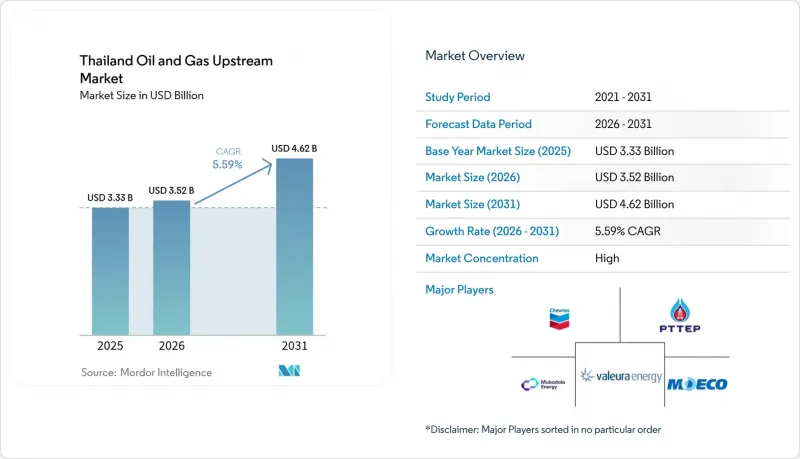
This report is Segmented by Location of Deployment (Onshore and Offshore), Resource Type (Crude Oil and Natural Gas), Well Type (Conventional and Unconventional), and Service (Exploration, Development and Production, and Decommissioning). The Market Sizes and Forecasts are Provided in Terms of Value (USD).
Thailand Oil And Gas Upstream Market Trends and Insights
Ramp-up of Erawan/Bongkot Gas Clusters
PTTEP closed its USD 2.8 billion acquisition of Chevron's domestic portfolio in 2024 and immediately began a drilling and facilities-upgrade campaign aimed at lifting combined output from Erawan and Bongkot to 800 MMSCFD by 2026. Integrated control has trimmed per-unit development costs an estimated 15-20% by sharing compression, processing, and logistics assets across neighboring blocks. Alignment with Thailand's Single Pool Gas Price policy secures predictable long-term margins, enabling enhanced recovery methods in deeper horizons that could stretch field life by up to 10 years. PTTEP's AI & Robotics Ventures unit deploys predictive-maintenance drones and edge-analytics sensors that have already reduced unplanned downtime across both complexes.
24th & 25th Licensing Rounds Plus PSC Overhaul
The 2024 regulatory reboot introduced production-sharing contracts beside legacy concessions, balancing state revenue capture with investor upside. Eight blocks awarded under the 24th round attracted USD 2.1 billion in committed spending, while the 25th round released 16 onshore areas tailored for unconventional techniques. The PSC construct raises government take during price peaks yet cushions operators during troughs, a feature that is especially attractive for tight-margin, marginal fields. Streamlined environmental approvals now include standardized timelines, reducing the average exploration start-up delay by almost 40% compared to the pre-2024 practice.
Declining Output from Mature Shallow-Water Fields
Legacy fields drilled between 1980 and 2010 are exhibiting annual decline rates of 8-12% as reservoir pressure drops. Although water-injection and compression upgrades can soften the descent, cost-effective replacement volumes of 200-300 MMCFD each year are still required merely to maintain a flat supply. Remaining reserves reside in tighter compartments, demanding horizontal wells and selective stimulation, both of which are capital-intensive under today's service-cost inflation.
Other drivers and restraints analyzed in the detailed report include:
- LNG-Price Volatility Pushing Domestic Upstream
- CCS/EGR Pilots Unlocking Stranded Reserves
- Lengthy EIA & Community-Consultation Cycles
For complete list of drivers and restraints, kindly check the Table Of Contents.
Segment Analysis
Offshore acreage accounted for 89.10% of Thailand's oil and gas upstream market size in 2025 and is expected to grow at a 5.78% CAGR through 2031. Production is anchored in shallow Gulf waters, where PTTEP integrates Bongkot, Erawan, and Arthit through cross-field pipelines and shared gas-processing trains, thereby driving down unit operating expenses (opex). Deeper plays now entering appraisal may tilt the Thailand oil and gas upstream market toward subsea completion systems and dynamic positioning rigs, lifting capex requirements yet lengthening asset life.
Onshore prospects, which account for just 10.90% of current output, benefit from the new PSC fiscal regime. Exploration focuses on the Khorat Plateau, where tight-sand formations mirror productive analogs in neighboring countries. While infrastructure lags coastal hubs, modular processing skids and trucked LNG could bridge early commercialization gaps until pipeline connectivity improves.
Natural gas supplied 77.85% of 2025 volumes thanks to power-sector baseload demand and firm offtake contracts with EGAT. The long-term saturation of gas pipelines and processing plants across the Eastern Seaboard solidifies gas as the price setter for competing liquid barrels. Crude's 5.66% CAGR outlook stems from deeper-water finds holding higher oil cuts and from brownfield secondary-recovery programs aimed at lifting aggregate liquids yield. High CO2 ratios in some deep prospects complicate economics, yet upcoming CCS facilities could neutralize these penalties and attract new capital.
Complete Report Scope:
- By Location of Deployment
- Onshore
- Offshore
- By Resource Type
- Crude Oil
- Natural Gas
- By Well Type
- Conventional
- Unconventional
- By Service
- Exploration
- Development and Production
- Decommissioning
List of Companies Covered in this Report:
- PTT Exploration & Production (PTTEP)
- Chevron Thailand E&P
- Valeura Energy
- Mitsui Oil Exploration (MOECO)
- Mubadala Energy Thailand
- Palang Sophon Ltd.
- KrisEnergy
- TotalEnergies SE
- Schlumberger (SLB)
- Halliburton
- Baker Hughes
- Weatherford
- Saipem
- TechnipFMC
- McDermott
- KBR
- Subsea 7
- EMAS Energy Services (Thailand)
- Bangchak Corp. (Upstream JV)
- PT Pertamina (Thai JDA partner)
Additional Benefits:
- The market estimate (ME) sheet in Excel format
- 3 months of analyst support
TABLE OF CONTENTS
1 Introduction
- 1.1 Study Assumptions & Market Definition
- 1.2 Scope of the Study
2 Research Methodology
3 Executive Summary
4 Market Landscape
- 4.1 Market Overview
- 4.2 Market Drivers
- 4.2.1 Ramp-up of Erawan/Bongkot gas clusters
- 4.2.2 24th & 25th Licensing Rounds plus PSC overhaul
- 4.2.3 LNG-price volatility pushing domestic upstream
- 4.2.4 CCS / EGR pilots unlocking stranded reserves
- 4.2.5 AI-augmented re-processing of legacy seismic
- 4.2.6 Modular tie-back of marginal gas pockets
- 4.3 Market Restraints
- 4.3.1 Declining output from mature shallow-water fields
- 4.3.2 Lengthy EIA & community-consultation cycles
- 4.3.3 High-CO2 content in new discoveries
- 4.3.4 Petroleum-engineering talent flight to renewables
- 4.4 Supply-Chain Analysis
- 4.5 Technological Outlook
- 4.6 Regulatory Landscape
- 4.7 Crude-Oil Production & Consumption Outlook
- 4.8 Natural-Gas Production & Consumption Outlook
- 4.9 Unconventional Resources CAPEX Outlook (tight oil, oil sands, deep-water)
- 4.10 Porter's Five Forces
- 4.10.1 Threat of New Entrants
- 4.10.2 Bargaining Power of Suppliers
- 4.10.3 Bargaining Power of Buyers
- 4.10.4 Threat of Substitutes
- 4.10.5 Competitive Rivalry
- 4.11 PESTLE Analysis
5 Market Size & Growth Forecasts
- 5.1 By Location of Deployment
- 5.1.1 Onshore
- 5.1.2 Offshore
- 5.2 By Resource Type
- 5.2.1 Crude Oil
- 5.2.2 Natural Gas
- 5.3 By Well Type
- 5.3.1 Conventional
- 5.3.2 Unconventional
- 5.4 By Service
- 5.4.1 Exploration
- 5.4.2 Development and Production
- 5.4.3 Decommissioning
6 Competitive Landscape
- 6.1 Market Concentration
- 6.2 Strategic Moves (M&A, Partnerships, PPAs)
- 6.3 Market Share Analysis (Market Rank/Share for key companies)
- 6.4 Company Profiles (includes Global level Overview, Market level overview, Core Segments, Financials as available, Strategic Information, Products & Services, and Recent Developments)
- 6.4.1 PTT Exploration & Production (PTTEP)
- 6.4.2 Chevron Thailand E&P
- 6.4.3 Valeura Energy
- 6.4.4 Mitsui Oil Exploration (MOECO)
- 6.4.5 Mubadala Energy Thailand
- 6.4.6 Palang Sophon Ltd.
- 6.4.7 KrisEnergy
- 6.4.8 TotalEnergies SE
- 6.4.9 Schlumberger (SLB)
- 6.4.10 Halliburton
- 6.4.11 Baker Hughes
- 6.4.12 Weatherford
- 6.4.13 Saipem
- 6.4.14 TechnipFMC
- 6.4.15 McDermott
- 6.4.16 KBR
- 6.4.17 Subsea 7
- 6.4.18 EMAS Energy Services (Thailand)
- 6.4.19 Bangchak Corp. (Upstream JV)
- 6.4.20 PT Pertamina (Thai JDA partner)
7 Market Opportunities & Future Outlook
- 7.1 White-space & Unmet-need Assessment

