PUBLISHER: Mordor Intelligence | PRODUCT CODE: 2121501

PUBLISHER: Mordor Intelligence | PRODUCT CODE: 2121501
Vietnam Oil And Gas Upstream - Market Share Analysis, Industry Trends & Statistics, Growth Forecasts (2026 - 2031)
According to Mordor Intelligence, the Vietnam oil and gas upstream market size was valued at USD 2.82 billion in 2025 and estimated to grow from USD 2.98 billion in 2026 to reach USD 3.91 billion by 2031, at a CAGR of 5.57% during the forecast period (2026-2031).
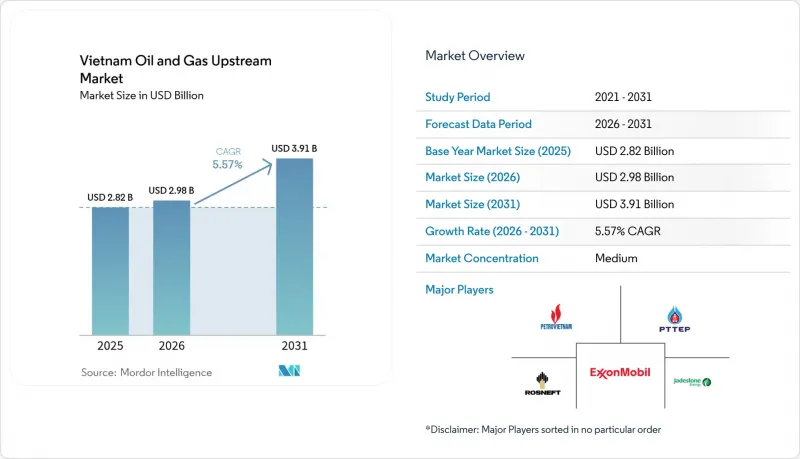
This report is Segmented by Location of Deployment (Onshore and Offshore), Resource Type (Crude Oil and Natural Gas), Well Type (Conventional and Unconventional), and Service (Exploration, Development and Production, and Decommissioning). The Market Sizes and Forecasts are Provided in Terms of Value (USD).
Vietnam Oil And Gas Upstream Market Trends and Insights
Increasing Crude Oil Prices
Brent stability above USD 70 per barrel underpins the redevelopment of mature offshore fields, once hampered by high lifting costs. Operators now sanction enhanced-oil-recovery pilots in fractured reservoirs and justify long-reach sidetracks that increase incremental output without requiring new green-field infrastructure. PetroVietnam's 2025 investment surge underscores renewed confidence in project economics, yet price support alone cannot counterbalance geological depletion. The Vietnam oil and gas upstream market, therefore, relies on both cost discipline and technology adoption to sustain margins.
Rising Domestic Gas Demand for Power
Electricity consumption is growing at an annual rate of 8%, and government policy mandates the retirement of coal between 2030 and 2040, creating an assured outlet for offshore gas. Decree 100/2025 compels power developers to source domestic gas under long-term contracts, stabilizing cash flows for upstream investors. Integrated projects, such as Ca Voi Xanh, exemplify the shift, pairing 3 GW of capacity with dedicated subsea supply and reducing LNG import exposure. The Vietnam oil and gas upstream market, therefore, aligns increasingly with downstream power strategies.
Complex Permitting and Bureaucracy
Multi-agency approvals can stretch final-investment-decision timelines by more than a year, inflating overhead on marginal prospects. High compliance costs weigh heavily on smaller operators in the Vietnam oil and gas upstream market, prompting some to defer projects or seek alliances that share regulatory engagement burdens.
Other drivers and restraints analyzed in the detailed report include:
- New PSC Licensing Rounds
- Digital Subsurface Imaging Adoption
- South China Sea Territorial Disputes
For complete list of drivers and restraints, kindly check the Table Of Contents.
Segment Analysis
Offshore developments generated 77.25% of 2025 revenue and are expected to post a 5.84% CAGR through 2031, underscoring their centrality to the Vietnam oil and gas upstream market. The depths of 50-200 meters in Nam Con Son and Cuu Long host the bulk of the remaining reserves, requiring higher-specification rigs, subsea tie-backs, and floating processing units. Record 3-km horizontal sections drilled with axial-oscillation tools demonstrate how innovation offsets basement hardness.
Growth relies on integrated gas hubs connected to shore-based power plants, which monetize output through first oil capacity payments rather than volatile commodity pricing. First-oil at Dai Hung Phase 3-flowing 6,000 bpd ahead of schedule-illustrates project-management maturation and validates shared-infrastructure models that suppress unit costs. Even so, crew shortages and weather downtime complicate schedules, demanding robust contingency planning across the Vietnam oil and gas upstream industry.
Onshore acreage, constrained by urban expansion and the decline of mature fields, contributes modest and stable volumes but attracts limited new capital. Operators favor low-cost workovers and water-alternating-gas schemes to sustain plateaus; yet, the resource upside remains marginal compared to offshore prospects. Thus, offshore execution excellence will continue to determine value creation within the Vietnam oil and gas upstream market.
Natural gas accounted for 59.65% of 2025 revenue and is forecast to grow at a 6.02% CAGR, solidifying its dominance in the Vietnam oil and gas upstream market. Output is slated to increase from 8 bcm in 2025 to more than 20 bcm by 2034, as Ca Voi Xanh, Block B, and Nam Du/U Minh ramp up production. Gas sale agreements featuring 80 mmcfd take-or-pay terms ensure predictable cash flows and facilitate project financing.
Crude oil, although still essential for refinery feedstock, is facing a gradual decline due to reservoir depletion and limited success in discoveries. Condensate streams linked to gas developments provide high-value naphtha for the petrochemical industry, partly offsetting oil volume erosion. The Vietnam oil and gas upstream industry is increasingly rewarding operators capable of orchestrating entire gas value chains, from subsea wellheads to power-plant burner tips.
Complete Report Scope:
- By Location of Deployment
- Onshore
- Offshore
- By Resource Type
- Crude Oil
- Natural Gas
- By Well Type
- Conventional
- Unconventional
- By Service
- Exploration
- Development and Production
- Decomissioning
List of Companies Covered in this Report:
- Vietnam Oil & Gas Group (PetroVietnam)
- ExxonMobil Corp.
- Japan Drilling Co. Ltd
- Jadestone Energy plc
- Saipem SpA
- Eni SpA
- Essar Oil & Gas E&P Ltd
- ONGC Videsh Ltd
- PTTEP
- TotalEnergies SE
- Rosneft Oil Co.
- Idemitsu Kosan Co.
- Repsol SA
- Murphy Oil Corp.
- KrisEnergy Ltd
- Petronas Carigali
- Soco International
- CNOOC Ltd
- Sinopec (Addax Petroleum)
- PV Gas
Additional Benefits:
- The market estimate (ME) sheet in Excel format
- 3 months of analyst support
TABLE OF CONTENTS
1 Introduction
- 1.1 Study Assumptions & Market Definition
- 1.2 Scope of the Study
2 Research Methodology
3 Executive Summary
4 Market Landscape
- 4.1 Market Overview
- 4.2 Market Drivers
- 4.2.1 Increasing crude-oil prices
- 4.2.2 Rising domestic gas demand for power
- 4.2.3 New PSC licensing rounds
- 4.2.4 Digital subsurface-imaging adoption
- 4.2.5 Incentives for marginal gas fields
- 4.2.6 Export-credit agency funding for deep-water projects
- 4.3 Market Restraints
- 4.3.1 Complex permitting & bureaucracy
- 4.3.2 South-China-Sea territorial disputes
- 4.3.3 Skilled-labour shortages offshore
- 4.3.4 ESG-driven financing constraints
- 4.4 Supply-Chain Analysis
- 4.5 Regulatory Landscape
- 4.6 Technological Outlook
- 4.7 Crude-Oil Production & Consumption Outlook
- 4.8 Natural-Gas Production & Consumption Outlook
- 4.9 Unconventional Resources CAPEX Outlook (tight oil, oil sands, deep-water)
- 4.10 Porter's Five Forces
- 4.10.1 Threat of New Entrants
- 4.10.2 Bargaining Power of Suppliers
- 4.10.3 Bargaining Power of Buyers
- 4.10.4 Threat of Substitutes
- 4.10.5 Competitive Rivalry
- 4.11 PESTLE Analysis
5 Market Size & Growth Forecasts
- 5.1 By Location of Deployment
- 5.1.1 Onshore
- 5.1.2 Offshore
- 5.2 By Resource Type
- 5.2.1 Crude Oil
- 5.2.2 Natural Gas
- 5.3 By Well Type
- 5.3.1 Conventional
- 5.3.2 Unconventional
- 5.4 By Service
- 5.4.1 Exploration
- 5.4.2 Development and Production
- 5.4.3 Decomissioning
6 Competitive Landscape
- 6.1 Market Concentration
- 6.2 Strategic Moves (M&A, Partnerships, PPAs)
- 6.3 Market Share Analysis (Market Rank/Share for key companies)
- 6.4 Company Profiles (includes Global level Overview, Market level overview, Core Segments, Financials as available, Strategic Information, Products & Services, and Recent Developments)
- 6.4.1 Vietnam Oil & Gas Group (PetroVietnam)
- 6.4.2 ExxonMobil Corp.
- 6.4.3 Japan Drilling Co. Ltd
- 6.4.4 Jadestone Energy plc
- 6.4.5 Saipem SpA
- 6.4.6 Eni SpA
- 6.4.7 Essar Oil & Gas E&P Ltd
- 6.4.8 ONGC Videsh Ltd
- 6.4.9 PTTEP
- 6.4.10 TotalEnergies SE
- 6.4.11 Rosneft Oil Co.
- 6.4.12 Idemitsu Kosan Co.
- 6.4.13 Repsol SA
- 6.4.14 Murphy Oil Corp.
- 6.4.15 KrisEnergy Ltd
- 6.4.16 Petronas Carigali
- 6.4.17 Soco International
- 6.4.18 CNOOC Ltd
- 6.4.19 Sinopec (Addax Petroleum)
- 6.4.20 PV Gas
7 Market Opportunities & Future Outlook
- 7.1 White-space & Unmet-Need Assessment
- 7.2 Collaboration with Foreign Companies
- 7.3 Digitalization & Advanced Analytics
- 7.4 Low-carbon & CCS opportunities
- 7.5 Incentives for marginal field development

