PUBLISHER: Mordor Intelligence | PRODUCT CODE: 2116700

PUBLISHER: Mordor Intelligence | PRODUCT CODE: 2116700
Asia Pacific Oil And Gas CAPEX - Market Share Analysis, Industry Trends & Statistics, Growth Forecasts (2026 - 2031)
According to Mordor Intelligence, the Asia Pacific oil and gas CAPEX market size was valued at USD 191.01 billion in 2025 and estimated to grow from USD 199.21 billion in 2026 to reach USD 245.67 billion by 2031, at a CAGR of 4.29% during the forecast period (2026-2031).
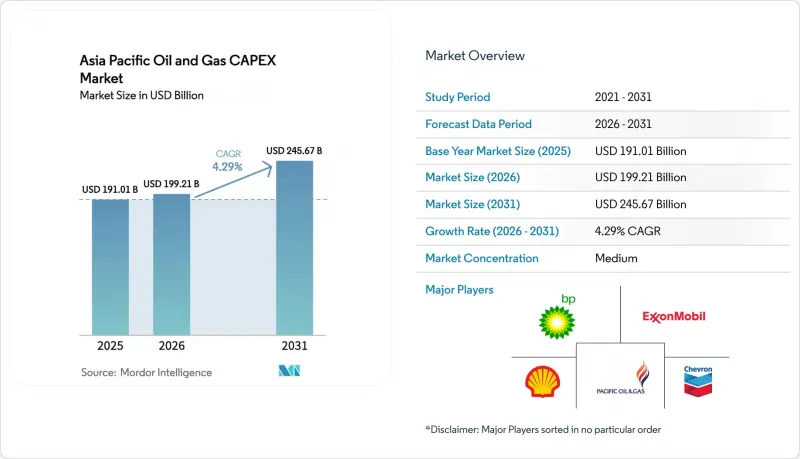
This report is Segmented by Sector (Upstream, Midstream, and Downstream), Location (Onshore and Offshore), Service (Construction, Maintenance and Turn-Around, and Decommissioning), and Geography (China, India, Australia, Indonesia, Malaysia, Thailand, Vietnam, and Rest of Asia-Pacific). The Market Sizes and Forecasts are Provided in Terms of Value (USD).
Asia Pacific Oil And Gas CAPEX Market Trends and Insights
Surging LNG Infrastructure Investments Across Southeast Asia
Indonesian state major Pertamina earmarked USD 20 billion for LNG capacity additions running to 2028, while Petronas committed USD 15 billion to three floating LNG units that will lift Malaysia's exportable gas by mid-decade. Storage, regasification, and shipping assets accompany these upstream builds, driving multi-year contracting opportunities for construction and engineering firms. The investment wave positions Southeast Asian exporters to capture 15-20% of global LNG trade by 2030, insulating them from oil-price volatility and boosting foreign-exchange inflows. Domestic markets also shift away from pipeline gas in favor of flexible LNG imports that back-stop intermittent renewables. The momentum of these schemes directly feeds the Asia Pacific oil and gas CAPEX market, ensuring a sturdy demand floor across the medium term.
Government-Led Hydrogen & CCUS CAPEX Commitments in Australia and Japan
Japan's Green Innovation Fund has earmarked JPY 2 trillion (USD 15 billion) for hydrogen value-chain projects, mirroring Australia's AUD 70 billion (USD 47 billion) allocation aimed at production hubs, transport corridors, and geological storage. The bilateral framework connects Australia's resource endowment with Japanese offtake demand, ensuring bankable offtake against long-dated assets. Public capital absorbs early technology risk, catalyzing private participation and lowering the weighted-average cost of capital, which sustains the Asia Pacific oil and gas CAPEX market even as traditional hydrocarbons plateau. Long-term offtake agreements already under negotiation signal that project pipelines will lengthen well beyond the current forecast period.
Tightened Green-Finance Rules Restricting Fossil-Fuel Project Lending
Singapore's Monetary Authority slashed fossil-fuel lending eligibility by 60% in 2024, and Australia's banks followed suit, lifting borrowing costs for mid-scale upstream ventures by 200-300 basis points Developers either pivot to export-credit agencies or raise mezzanine tranches, delaying final investment decisions and reducing near-term spending in the Asia Pacific oil and gas CAPEX market. Short-cycle projects with visible transition pathways still reach financial close, but high-carbon barrels bear clear funding penalties.
Other drivers and restraints analyzed in the detailed report include:
- National-Oil-Company Push for Deep-Water Gas Projects in China & Malaysia
- IOCs Reallocating Portfolios Toward Low-Cost APAC Plays Amid Middle-East Risk
- Rising EPC Inflation & Local-Content Mandates Inflating Build Costs
For complete list of drivers and restraints, kindly check the Table Of Contents.
Segment Analysis
Upstream commanded 71.25% of the Asia Pacific oil and gas CAPEX market in 2025, reflecting state directives to shore up indigenous supply amid volatile import prices. National oil companies led the way in spending on deep-water gas, shale blocks, and coal-bed methane, leveraging digital drilling and real-time reservoir imaging to boost recovery rates. These outlays keep local content factories busy and generate a continuous flow of contracts for service specialists. Midstream outlays center on brownfield pipeline looping and LNG storage, pairing with upstream developments to assure takeaway capacity.
Downstream expenditure, although comprising a smaller 28.75% share in 2025, is projected to accelerate at a 4.98% CAGR through 2031. Petrochemical integration drives revamp programs that swap simple fuels for higher-margin olefins and aromatics. India's Jamnagar complex and China's Fujian hub typify the shift: once gasoline-centric, the sites now channel incremental cash toward steam crackers and PDH units. Because each retrofit requires compressors, reactors, and automation, downstream continues to pull material volumes into the Asia Pacific oil and gas CAPEX market size tally, despite plateauing fuel demand.
Complete Report Scope:
- By Sector
- Upstream
- Midstream
- Downstream
- By Location
- Onshore
- Offshore
- By Service
- Construction
- Maintenance and Turn-around
- Decommissioning
- By Geography
- China
- India
- Australia
- Indonesia
- Malaysia
- Thailand
- Vietnam
- Rest of Asia-Pacific
List of Companies Covered in this Report:
- BP plc
- Exxon Mobil Corporation
- Shell plc
- Pacific Oil & Gas Ltd
- Chevron Corporation
- TotalEnergies SE
- Oil & Natural Gas Corporation (ONGC)
- China National Petroleum Corporation (CNPC)
- Cairn Oil & Gas (Vedanta Ltd)
- Equinor ASA
- Sinopec (CNPC)
- CNOOC Limited
- Petronas
- Woodside Energy Group Ltd
- Santos Ltd
- Inpex Corporation
- PTTEP
- Reliance Industries Ltd
- Adani Total Gas Ltd
- Saipem SpA
Additional Benefits:
- The market estimate (ME) sheet in Excel format
- 3 months of analyst support
TABLE OF CONTENTS
1 Introduction
- 1.1 Study Assumptions & Market Definition
- 1.2 Scope of the Study
2 Research Methodology
3 Executive Summary
4 Market Landscape
- 4.1 Market Overview
- 4.2 Market Drivers
- 4.2.1 Surging LNG infrastructure investments across Southeast Asia
- 4.2.2 Government-led hydrogen & CCUS CAPEX commitments in Australia and Japan
- 4.2.3 National-oil-company push for deep-water gas projects in China & Malaysia
- 4.2.4 IOCs reallocating portfolios toward low-cost APAC plays amid Middle-East risk
- 4.2.5 Rapid growth of digital-oilfield CAPEX for asset-life extension
- 4.2.6 Modular refinery projects targeting petrochemical-import substitution in India
- 4.3 Market Restraints
- 4.3.1 Tightened green-finance rules restricting fossil-fuel project lending
- 4.3.2 Rising EPC inflation & local-content mandates inflating build costs
- 4.3.3 Accelerating EV uptake dampening long-term refined-products demand
- 4.3.4 Maritime-security risks in the South China Sea delaying offshore FIDs
- 4.4 Supply-Chain Analysis
- 4.5 Regulatory Landscape
- 4.6 Technological Outlook
- 4.7 Crude-Oil Production & Consumption Outlook
- 4.8 Natural-Gas Production & Consumption Outlook
- 4.9 Installed Pipeline Capacity Analysis
- 4.10 Unconventional Resources CAPEX Outlook (tight oil, oil sands, deep-water)
- 4.11 Porters Five Forces
- 4.11.1 Bargaining Power of Suppliers
- 4.11.2 Bargaining Power of Consumers
- 4.11.3 Threat of New Entrants
- 4.11.4 Threat of Substitute Products & Services
- 4.11.5 Intensity of Competitive Rivalry
5 Market Size & Growth Forecasts
- 5.1 By Sector
- 5.1.1 Upstream
- 5.1.2 Midstream
- 5.1.3 Downstream
- 5.2 By Location
- 5.2.1 Onshore
- 5.2.2 Offshore
- 5.3 By Service
- 5.3.1 Construction
- 5.3.2 Maintenance and Turn-around
- 5.3.3 Decommissioning
- 5.4 By Geography
- 5.4.1 China
- 5.4.2 India
- 5.4.3 Australia
- 5.4.4 Indonesia
- 5.4.5 Malaysia
- 5.4.6 Thailand
- 5.4.7 Vietnam
- 5.4.8 Rest of Asia-Pacific
6 Competitive Landscape
- 6.1 Market Concentration
- 6.2 Strategic Moves (M&A, Partnerships, PPAs)
- 6.3 Market Share Analysis (Market Rank/Share for key companies)
- 6.4 Company Profiles (includes Global level Overview, Market level overview, Core Segments, Financials as available, Strategic Information, Products & Services, and Recent Developments)
- 6.4.1 BP plc
- 6.4.2 Exxon Mobil Corporation
- 6.4.3 Shell plc
- 6.4.4 Pacific Oil & Gas Ltd
- 6.4.5 Chevron Corporation
- 6.4.6 TotalEnergies SE
- 6.4.7 Oil & Natural Gas Corporation (ONGC)
- 6.4.8 China National Petroleum Corporation (CNPC)
- 6.4.9 Cairn Oil & Gas (Vedanta Ltd)
- 6.4.10 Equinor ASA
- 6.4.11 Sinopec (CNPC)
- 6.4.12 CNOOC Limited
- 6.4.13 Petronas
- 6.4.14 Woodside Energy Group Ltd
- 6.4.15 Santos Ltd
- 6.4.16 Inpex Corporation
- 6.4.17 PTTEP
- 6.4.18 Reliance Industries Ltd
- 6.4.19 Adani Total Gas Ltd
- 6.4.20 Saipem SpA
7 Market Opportunities & Future Outlook
- 7.1 White-space & Unmet-Need Assessment

