PUBLISHER: Mordor Intelligence | PRODUCT CODE: 2124533

PUBLISHER: Mordor Intelligence | PRODUCT CODE: 2124533
United States Data Center Construction - Market Share Analysis, Industry Trends & Statistics, Growth Forecasts (2026 - 2031)
According to Mordor Intelligence, the United States (US) data center construction market size was valued at USD 14.35 billion in 2025 and is estimated to grow from USD 15.51 billion in 2026 to reach USD 23.74 billion by 2031, at a CAGR of 8.89% during the forecast period (2026-2031).
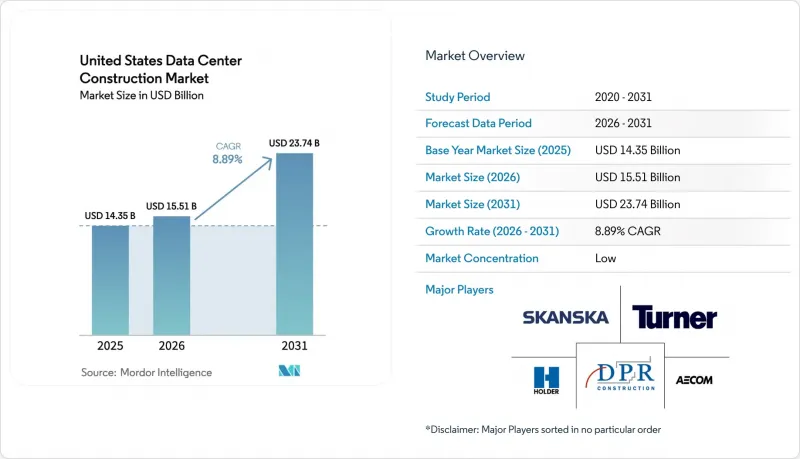
This report is Segmented by Tier Type (Tier 1 and 2, Tier 3, and Tier 4), Data Center Size (Small, Medium, Large, and Hyperscale), Data Center Type (Colocation, Hyperscalers/Cloud Service Providers, and Enterprise and Edge), Infrastructure (Electrical, Mechanical, General Construction, and Services). The Market Forecasts are Provided in Terms of Value (USD).
United States Data Center Construction Market Trends and Insights
Cloud, AI and Big-Data Workload Boom
Generative AI inference clusters have doubled average rack loads, pushing design densities to 15 kilowatts in 2026 and an expected 25 kilowatts by 2028. Operators are retrofitting rear-door heat exchangers and direct-to-chip loops, which add USD 1.5 million to USD 2 million per megawatt to budgets. Amazon Web Services committed USD 11 billion to Pennsylvania sites, and Microsoft reserved USD 80 billion globally for AI-optimized campuses, illustrating hyperscaler capital redeployment. With the United States hosting more than half of the world's hyperscale inventory, demand is bifurcating between 100-megawatt campuses for training and sub-1-megawatt edge nodes for low-latency inference.
Hyperscale Self-Build Pipelines Above 10 GW
Amazon Web Services, Microsoft Azure, Google Cloud, and Meta together hold over 10 gigawatts of active projects. Meta confirmed a USD 10 billion Louisiana campus, and Google added USD 1 billion in Texas expansion, signaling migration to secondary markets where land and utility interconnection costs are up to 60% lower than tier-1 hubs. Hyperscalers now self-perform civil work, hire specialists for mechanical and electrical scopes, and compress schedules from 24 months to 18 months, reducing general-contractor addressable value by roughly 25%.
Power-Grid Interconnection Delays (3-6 Years)
National queues exceed 2,600 gigawatts, stretching median approvals to five years. Dominion Energy alone lists 47 gigawatts of pending data-center load in Northern Virginia. Arizona Public Service froze new data-center hookups in late 2024, redirecting projects to Texas and Ohio. Developers are funding on-site peaker plants and small modular reactors that add USD 3 million to USD 5 million per megawatt but avoid queue risk, while Federal Energy Regulatory Commission reforms, slated for 2027, aim to streamline approvals.
Other drivers and restraints analyzed in the detailed report include:
- AI-Optimized Liquid-Cooling Retrofits Drive Rebuild Spend
- Edge and 5G Densification of Metro Clusters
- Transformer and Switch-Gear Supply-Chain Choke Points
For complete list of drivers and restraints, kindly check the Table Of Contents.
Segment Analysis
Tier 3 sites held 56.43% share in 2025, favored for concurrent maintainability at a 20%-30% cost discount versus Tier 4 designs. However, fault-tolerant Tier 4 builds are on track for a 9.12% CAGR, the fastest within the United States data center construction market size. Banking, healthcare, and government tenants demand 99.995% uptime, prompting colocation operators to retrofit Tier 3 halls with dual utility feeds and 2N uninterruptible power supply racks. Uptime Institute's 2024 survey showed 38% of U.S. builds sought Tier 4 certification, up from 29% in 2022, a jump driven partly by cyber-insurance underwriters.
Colocation leaders Equinix and Digital Realty are layering Tier 4 features onto existing campuses to secure premium workloads, while Amazon Web Services included multiple Tier 4 campuses in its USD 11 billion Pennsylvania program to support GovCloud clients. As more enterprises require fault-tolerant hosting, contractors focused on redundant electrical paths and liquid-cooled backup modules stand to gain the largest share of Tier 4 spending.
Hyperscale campuses above 10 megawatts controlled 64.31% of 2025 build volume and are projected to grow at 9.45% annually, underscoring their weight in the United States data center construction market. Economies of scale in power procurement, modular cooling, and labor reduce per-megawatt costs by as much as 40% against medium-sized halls, prompting cloud providers to favor 100-200 megawatt master-planned sites.
Medium facilities between 1 megawatt and 10 megawatts still serve hybrid colocation tenants but face slower growth as workloads shift to cloud. Small sub-1 megawatt facilities bifurcate into decommissioned enterprise rooms and rising edge nodes. Broadband subsidies and 5G densification make edge builds financially viable in tier-2 and rural metros, a niche where modular specialists like Mortenson and Balfour Beatty deliver turnkey enclosures in under 45 days.
Complete Report Scope:
- By Tier Type
- Tier 1 and 2
- Tier 3
- Tier 4
- By Data Center Size
- Small
- Medium
- Large
- Hyperscale
- By Data Center Type
- Colocation Data Center
- Hyperscalers/Cloud Service Provider (CSPs)
- Enterprise and Edge Data Center
- By Infrastructure
- Electrical Infrastructure
- Power Distribution Solution
- Power Backup Solutions
- Mechanical Infrastructure
- Cooling Systems
- Racks and Cabinets
- Servers and Storage
- Other Mechanical Infrastructure
- General Construction
- Services - Design and Consulting, Integration, Support and Maintenance
- Electrical Infrastructure
List of Companies Covered in this Report:
- AECOM
- Turner Construction
- DPR Construction
- Holder Construction
- Skanska USA
- Whiting-Turner Contracting
- Jacobs Solutions
- Balfour Beatty US
- Gilbane Building Company
- Hensel Phelps
- McCarthy Building Companies
- Brasfield and Gorrie
- JE Dunn Construction
- Mortenson Construction
- Kiewit Corporation
- Fluor Corporation
- Corgan Associates (AEC)
- Black and Veatch
- QTS Construction Services
- PowerHouse Data Centers (Tener Technologies)
Additional Benefits:
- The market estimate (ME) sheet in Excel format
- 3 months of analyst support
TABLE OF CONTENTS
1 INTRODUCTION
- 1.1 Study Assumptions and Market Definition
- 1.2 Scope of the Study
2 RESEARCH METHODOLOGY
3 EXECUTIVE SUMMARY
4 MARKET LANDSCAPE
- 4.1 Market Overview
- 4.2 Market Drivers
- 4.2.1 Cloud, AI and Big-Data Workload Boom
- 4.2.2 Hyperscale Self-Build Pipelines Above 10 GW
- 4.2.3 Edge and 5G Densification of Metro Clusters
- 4.2.4 Federal and State Tax-Incentive Packages
- 4.2.5 AI-Optimised Liquid-Cooling Retrofits Drive Rebuild Spend
- 4.2.6 On-Site Micro-Nuclear SMR Approvals Accelerate Greenfield Sites
- 4.3 Market Restraints
- 4.3.1 Soaring Land Prices Around Tier-1 Metros
- 4.3.2 Power-Grid Interconnection Delays (3-6 Years)
- 4.3.3 Transformer and Switch-Gear Supply-Chain Choke Points
- 4.3.4 ESG-Driven Municipal Moratoria on Water-Intensive Cooling
- 4.4 Industry Supply-Chain Analysis
- 4.5 Regulatory Landscape
- 4.6 Technological Outlook
- 4.7 Porter's Five Forces Analysis
- 4.7.1 Bargaining Power of Suppliers
- 4.7.2 Bargaining Power of Consumers
- 4.7.3 Threat of New Entrants
- 4.7.4 Threat of Substitutes
- 4.7.5 Intensity of Competitive Rivalry
- 4.8 Key Data Center Statistics
- 4.8.1 Exhaustive Data Center Operators in United States (in MW)
- 4.8.2 List of Major Upcoming Data Center Projects in United States (2025-2030)
- 4.8.3 CAPEX and OPEX For United States Data Center Construction
- 4.8.4 Data Center Power Capacity Absorption In MW, United States, 2023 and 2024
- 4.9 Artificial Intelligence (AI) Inclusion in Data Center Construction in United States
- 4.10 Regulatory and Compliance Framework
- 4.11 Impact of Macroeconomic Factors on the Market
5 MARKET SIZE AND GROWTH FORECASTS (VALUE)
- 5.1 By Tier Type
- 5.1.1 Tier 1 and 2
- 5.1.2 Tier 3
- 5.1.3 Tier 4
- 5.2 By Data Center Size
- 5.2.1 Small
- 5.2.2 Medium
- 5.2.3 Large
- 5.2.4 Hyperscale
- 5.3 By Data Center Type
- 5.3.1 Colocation Data Center
- 5.3.2 Hyperscalers/Cloud Service Provider (CSPs)
- 5.3.3 Enterprise and Edge Data Center
- 5.4 By Infrastructure
- 5.4.1 Electrical Infrastructure
- 5.4.1.1 Power Distribution Solution
- 5.4.1.2 Power Backup Solutions
- 5.4.2 Mechanical Infrastructure
- 5.4.2.1 Cooling Systems
- 5.4.2.2 Racks and Cabinets
- 5.4.2.3 Servers and Storage
- 5.4.2.4 Other Mechanical Infrastructure
- 5.4.3 General Construction
- 5.4.4 Services - Design and Consulting, Integration, Support and Maintenance
- 5.4.1 Electrical Infrastructure
6 COMPETITIVE LANDSCAPE
- 6.1 Market Concentration
- 6.2 Strategic Moves
- 6.3 Market Share Analysis
- 6.4 Data Center Infrastructure Investment Based on Megawatt (MW) Capacity, 2024 vs 2030
- 6.5 Data Center Construction Landscape (Key Vendors Listings)
- 6.6 Company Profiles (Includes Global Level Overview, Market Level Overview, Core Segments, Financials as Available, Strategic Information, Market Rank/Share, Products and Services, and Recent Developments)
- 6.6.1 AECOM
- 6.6.2 Turner Construction
- 6.6.3 DPR Construction
- 6.6.4 Holder Construction
- 6.6.5 Skanska USA
- 6.6.6 Whiting-Turner Contracting
- 6.6.7 Jacobs Solutions
- 6.6.8 Balfour Beatty US
- 6.6.9 Gilbane Building Company
- 6.6.10 Hensel Phelps
- 6.6.11 McCarthy Building Companies
- 6.6.12 Brasfield and Gorrie
- 6.6.13 JE Dunn Construction
- 6.6.14 Mortenson Construction
- 6.6.15 Kiewit Corporation
- 6.6.16 Fluor Corporation
- 6.6.17 Corgan Associates (AEC)
- 6.6.18 Black and Veatch
- 6.6.19 QTS Construction Services
- 6.6.20 PowerHouse Data Centers (Tener Technologies)
- 6.7 List of Data Center Construction Companies
7 MARKET OPPORTUNITIES AND FUTURE OUTLOOK
- 7.1 White-Space and Unmet-Need Assessment

