PUBLISHER: Mordor Intelligence | PRODUCT CODE: 2156988

PUBLISHER: Mordor Intelligence | PRODUCT CODE: 2156988
North America Containerized Rail Freight Transport - Market Share Analysis, Industry Trends & Statistics, Growth Forecasts (2026 - 2031)
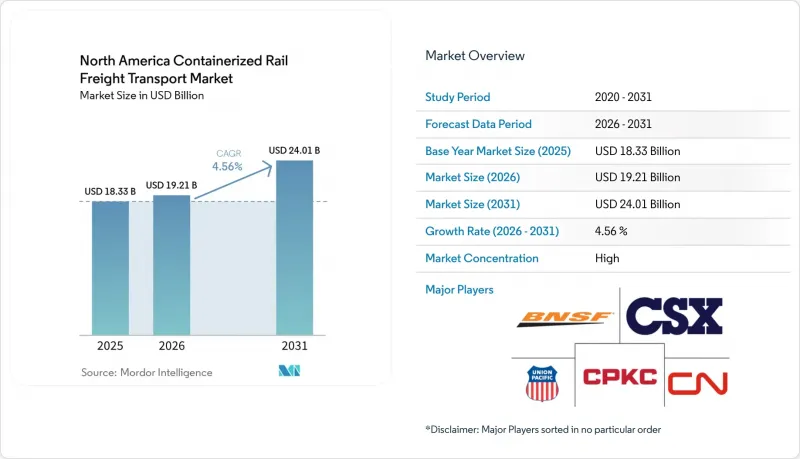
According to Mordor Intelligence, the North America containerized rail freight transport market was valued at USD 18.33 billion in 2025, and is estimated to grow from USD 19.21 billion in 2026 to reach USD 24.01 billion by 2031, at a CAGR of 4.56% during the forecast period (2026-2031).
North America Containerized Rail Freight Transport Market Trends and Insights
Cross-Border Nearshoring and North American Manufacturing Integration
The North America containerized rail freight transport market is being shaped by manufacturing facilities located nearer to the United States customers. United States-Mexico merchandise trade reached USD 872.8 billion in 2025, showing the scale of the commercial relationship served by southern-border freight routes. Monterrey, Saltillo, San Luis Potosi, and the Bajio region sit close to major rail corridors. This alignment makes direct rail connectivity relevant to plant location and inventory planning. CPKC and CSX upgraded the Southeast Mexico Express with a dedicated intermodal train in May 2026. The service links the rail network with a route pattern used by shippers serving Mexico and the United States Southeast.
E-Commerce Replenishment Through Inland Intermodal Hubs
E-commerce replenishment supports rail demand when distribution networks need repeated moves into inland population centers. Norfolk Southern launched its East Edge double-stack service between Chicago and Ayer, Massachusetts, in January 2026 The USD 64 million project supports 9,000-foot double-stacked trains and can handle 200,000 loads each year. This capacity improves the rail option for New England freight that previously relied more heavily on highways. The North America containerized rail freight transport market needs such corridor improvements because hub demand cannot be met by long-haul rail alone. Local drayage, terminal appointments, and warehouse placement remain part of the service equation.
Terminal Congestion and Drayage-Distance Inflation
Terminal congestion can limit the North America containerized rail freight transport market even when line-haul rail capacity is available. Containers need to move through gates, yards, and local drayage networks before rail savings become useful. Longer drayage trips can reduce the value of rail on otherwise suitable routes. Chassis shortages create similar friction because a container cannot leave or enter a terminal without matching equipment. Southern California, Chicago, and southern-border gateways are especially sensitive because they combine heavy volumes with complex transfers. Service reliability suffers when terminal dwell or equipment availability becomes unpredictable.
Other drivers and restraints analyzed in the detailed report include:
- Double-Stack Corridor and Terminal-Capacity Expansion
- Rail Economics on Dense Long-Haul Lanes
- Border, Customs, and Interchange Complexity
For complete list of drivers and restraints, kindly check the Table Of Contents.
Segment Analysis
40-foot containers accounted for 55.56% of the North America containerized rail freight transport market size in 2025 and are forecast to grow at a 6.55% CAGR through 2031. Their position reflects their use in international trade and double-stack rail operations. They fit the operating model used on transcontinental and cross-border container lanes. These routes can support regular train schedules and high equipment utilization. Ocean-linked freight also supports demand for this format at major ports and inland gateways. The North America containerized rail freight transport market uses this standard size, where scale and stacking efficiency are important.
40-foot units are useful when shippers need a format compatible with port movements and inland rail distribution. Their role is strongest where rail terminals handle consistent volumes. Container availability and return patterns still influence equipment decisions. 20-foot containers continue to serve heavier or specialized freight. 45-foot and 53-foot containers are more relevant where domestic cubic capacity is the priority. The North America containerized rail freight transport market will retain several formats because shippers balance standardization, weight, and space needs.
General containers held 84.53% of the North America containerized rail freight transport market share in 2025, and refrigerated containers are forecast to grow at a 7.69% CAGR through 2031. They serve a broad range of dry manufactured goods, consumer products, and container-compatible materials. Their growth is linked to the demand for controlled transport of perishable and pharmaceutical goods. CPKC reported stronger intermodal revenue in the second quarter of 2026, with revenue per carload also increasing. The North America containerized rail freight transport market has scope for cold-chain services when transit quality meets product requirements.
Refrigerated intermodal requires containers, terminals, power access, inspections, and monitoring practices that are not needed for dry freight. This makes asset availability a meaningful constraint for the segment. Cross-border pharmaceutical logistics also requires reliable documentation and temperature control. Rail can become more suitable when service design reduces repeated border processes. General containers will remain the larger category because dry freight has a wider cargo base. The North America containerized rail freight transport market is likely to see refrigerated growth without a comparable shift in the overall container mix.
Complete Report Scope:
- By Container Size
- 20-Foot Containers
- 40-Foot Containers
- Other Container Sizes
- By Container Type
- General Container
- Refrigerated Containers
- By Shipment Flow
- Domestic
- Intenration / Cross-Border
- By Shipment Type
- Full Container Load (FCL)
- Less-than-Container Load (LCL)
- By Cargo Type
- FMCG and Retail
- Manufacturing and Automotive
- Healthcare and Pharmaceuticals
- Electronics and Electrical Equipment
- Industrial Chemicals and Raw Materials
- Others
- By Country
- Canada
- Mexico
- United States
- Rest of North America
List of Companies Covered in this Report:
- BNSF Railway Company
- Union Pacific Railroad Company
- Canadian National Railway Company
- Canadian Pacific Kansas City Limited
- CSX Transportation, Inc.
- Norfolk Southern Railway Company
- GMexico Transportes, S.A.B. de C.V.
- J.B. Hunt Transport Services, Inc.
- Hub Group, Inc.
- Schneider National, Inc.
- STG Logistics
- C.H. Robinson Worldwide, Inc.
- Knight-Swift Transportation Holdings Inc.
- Matson Logistics, Inc.
- IMC Logistics
- Odyssey Logistics & Technology Corporation
- NFI Industries
- Werner Enterprises, Inc.
- Landstar System, Inc.
- COFC Logistics LLC
- COSCO SHIPPING Logistics (North America) Inc.
- LOTTE Global Logistics North America Inc.
Additional Benefits:
- The market estimate (ME) sheet in Excel format
- 3 months of analyst support
TABLE OF CONTENTS
1 INTRODUCTION
- 1.1 Study Assumptions and Market Definition
- 1.2 Scope of the Study
2 RESEARCH METHODOLOGY
3 EXECUTIVE SUMMARY
4 MARKET LANDSCAPE
- 4.1 Market Overview and Importance of Containerized Rail Freight Transportation
- 4.2 Market Drivers
- 4.2.1 Cross-Border Nearshoring and North American Manufacturing Integration
- 4.2.2 E-Commerce Replenishment Through Inland Intermodal Hubs
- 4.2.3 Double-Stack Corridor and Terminal-Capacity Expansion
- 4.2.4 Rail Economics on Dense Long-Haul Lanes
- 4.2.5 Cold-Chain and Temperature-Controlled Intermodal Adoption
- 4.2.6 Single-Line Canada-United States-Mexico Connectivity
- 4.3 Market Restraints
- 4.3.1 Terminal Congestion and Drayage-Distance Inflation
- 4.3.2 Chassis Imbalances and Equipment Availability
- 4.3.3 Service-Reliability Variability Versus Trucking
- 4.3.4 Border, Customs, and Interchange Complexity
- 4.4 Value Chain and Distribution Channel Architecture Analysis
- 4.5 Regulatory Landscape
- 4.6 Technology and Operational Developments
- 4.7 Containerized Rail Freight Network and Infrastructure Analysis
- 4.8 Rail Freight Cost and Pricing Analysis
- 4.9 Porter's Five Forces Analysis
- 4.9.1 Threat of New Entrants
- 4.9.2 Bargaining Power of Buyers and Consumers
- 4.9.3 Bargaining Power of Suppliers
- 4.9.4 Threat of Substitute Services
- 4.9.5 Intensity of Competitive Rivalry
5 MARKET SIZE AND GROWTH FORECASTS
- 5.1 By Container Size
- 5.1.1 20-Foot Containers
- 5.1.2 40-Foot Containers
- 5.1.3 Other Container Sizes
- 5.2 By Container Type
- 5.2.1 General Container
- 5.2.2 Refrigerated Containers
- 5.3 By Shipment Flow
- 5.3.1 Domestic
- 5.3.2 Intenration / Cross-Border
- 5.4 By Shipment Type
- 5.4.1 Full Container Load (FCL)
- 5.4.2 Less-than-Container Load (LCL)
- 5.5 By Cargo Type
- 5.5.1 FMCG and Retail
- 5.5.2 Manufacturing and Automotive
- 5.5.3 Healthcare and Pharmaceuticals
- 5.5.4 Electronics and Electrical Equipment
- 5.5.5 Industrial Chemicals and Raw Materials
- 5.5.6 Others
- 5.6 By Country
- 5.6.1 Canada
- 5.6.2 Mexico
- 5.6.3 United States
- 5.6.4 Rest of North America
6 COMPETITIVE LANDSCAPE
- 6.1 Market Concentration
- 6.2 Strategic Moves
- 6.3 Market Share Analysis
- 6.4 Company Profiles (includes Global Level Overview, Market Level Overview, Core Segments, Financials as available, Strategic Information, Geographic Coverage, Products and Services, Recent Developments)
- 6.4.1 BNSF Railway Company
- 6.4.2 Union Pacific Railroad Company
- 6.4.3 Canadian National Railway Company
- 6.4.4 Canadian Pacific Kansas City Limited
- 6.4.5 CSX Transportation, Inc.
- 6.4.6 Norfolk Southern Railway Company
- 6.4.7 GMexico Transportes, S.A.B. de C.V.
- 6.4.8 J.B. Hunt Transport Services, Inc.
- 6.4.9 Hub Group, Inc.
- 6.4.10 Schneider National, Inc.
- 6.4.11 STG Logistics
- 6.4.12 C.H. Robinson Worldwide, Inc.
- 6.4.13 Knight-Swift Transportation Holdings Inc.
- 6.4.14 Matson Logistics, Inc.
- 6.4.15 IMC Logistics
- 6.4.16 Odyssey Logistics & Technology Corporation
- 6.4.17 NFI Industries
- 6.4.18 Werner Enterprises, Inc.
- 6.4.19 Landstar System, Inc.
- 6.4.20 COFC Logistics LLC
- 6.4.21 COSCO SHIPPING Logistics (North America) Inc.
- 6.4.22 LOTTE Global Logistics North America Inc.
7 MARKET OPPORTUNITIES AND FUTURE OUTLOOK
- 7.1 White-Space and Unmet-Need Assessment
8 APPENDIX

