PUBLISHER: Mordor Intelligence | PRODUCT CODE: 2187205

PUBLISHER: Mordor Intelligence | PRODUCT CODE: 2187205
Bottled Water - Market Share Analysis, Industry Trends & Statistics, Growth Forecasts (2027 - 2032)
According to Mordor Intelligence, the bottled water market size is expected to grow from USD 312.4 billion in 2026 to USD 333.4 billion in 2027 and is forecast to reach USD 454.2 billion by 2032 at 6.38% CAGR over 2027-2032.
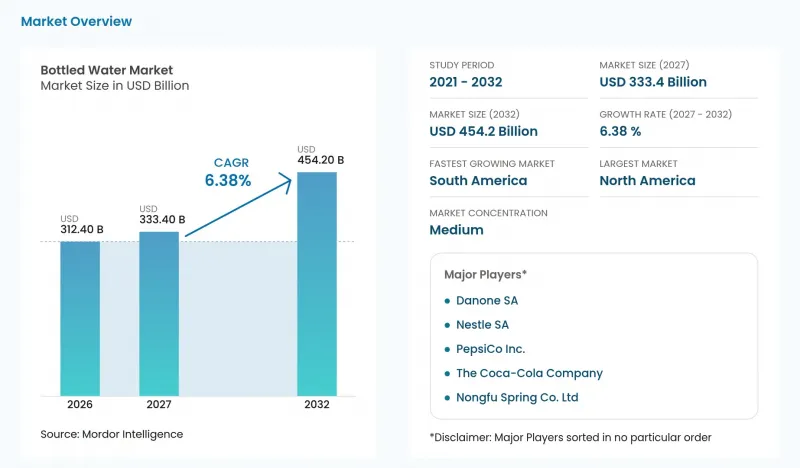
This report is segmented by Product Type (Still Water, Functional/Flavored Water, and more), Packaging Material (PET Bottles, Glass Bottles, and more), Pricing (Mass and Premium/Luxury), Distribution Channel (Off-trade and On-trade), and Geography (North America, Asia-Pacific, and more). The market forecasts are provided in terms of value (USD), based on availability.
Global Bottled Water Market Trends and Insights
Premiumization and "permissible indulgence" positioning
Premium positioning gives water producers a way to compete through differentiated brands and a more valuable product mix. Nestle SA reported high single-digit growth for S.Pellegrino waters across geographies in Q2 2026. It also said retail performance in its combined Waters & Premium Beverages segment benefited from premium mix and innovation during that quarter. Together, these results support a commercial role for premium offerings within both a named water brand and a broader beverage portfolio. For suppliers pursuing this strategy, brand development and assortment design can influence the composition of sales. Selling a richer premium mix can support retail revenue without making higher bottle volumes the only growth mechanism.
Innovative packaging solutions for convenience and environmental impact
Packaging development gives water brands a way to change the bottle's material composition alongside the drink's identity. In 2025, Danone SA's Volvic natural mineral-water brand made all its plastic bottle bodies in Europe from 100% recycled PET. Caps and labels were excluded from that figure. Recycled resin lets the bottle's material composition become a visible product attribute within a plastic-bottle format. Because the 100% figure excludes caps and labels, the recycled-content attribute describes the bottle body rather than the whole pack.
Microplastic and nanoplastic health concerns
Particle-related health concerns can make finished-product assurance more important for suppliers of plastic-packaged water. In a 2025 study in Central Appalachia, bottled-water samples had statistically higher median microplastic concentrations than in-home water samples (p = 0.001). The study noted that human health effects of microplastic ingestion were still being investigated. A source-led premium offer may therefore require reassurance about the finished drink, extending the commercial task beyond source identity. Uncertainty about the complete product can also introduce friction into repeat purchases for everyday hydration. The remaining burden is to justify the water-and-package proposition together, which can make a source-quality promise alone less persuasive.
Other drivers and restraints analyzed in the detailed report include:
- Growing on-the-go hydration in emerging megacities
- Adoption of advanced purification and bottling technologies
- Anti-single-use-plastic legislation momentum
For complete list of drivers and restraints, kindly check the Table Of Contents.
Segment Analysis
Still water accounted for a 72.61% share of the bottled water market size in 2026. Nongfu Spring Co. Ltd reported that revenue from packaged drinking-water products increased 2.1% in H1 2026 compared with H1 2025. Those products contributed 32.4% of the company's total revenue in H1 2026. Group revenue rose 16% in the same period, so packaged drinking water grew far more slowly than the company as a whole and its weight in group revenue fell.
Functional/flavored water is the fastest-growing segment, forecast at a 7.85% CAGR over 2027-2032. PepsiCo Inc. reported that Propel delivered volume and net revenue growth and gained value and volume share within Enhanced Water in North America in Q2 2026. The brand's electrolyte-enhanced-water role gives it a specific functional identity within that business. An added functional proposition can give suppliers a basis for differentiation around a defined hydration use, broadening the reason to choose a water product. Propel's estimated annual retail sales of more than USD 1 billion show an electrolyte-enhanced water reaching scale as a distinct line.
PET bottles represented a 60.69% bottled water market share in 2026. The International Bottled Water Association reported that single-serve PET bottles accounted for a preliminary 70% of U.S. bottled-water market volume in 2025. The largest segment's commercial base also creates exposure to package-level change. Because that format carries most U.S. volume, a change in material requirements would reach established sales rather than only new-format launches.
Glass bottles are the fastest-growing segment, forecast at an 8.45% CAGR over 2027-2032. BE WTR reported launching its Singapore BiG400 facility for reusable glass bottles in May 2025 with stated annual capacity of 2.5 million bottles of still and sparkling water. Aluminum cans gained a resealable-water example in April 2026 when L.A. Libations introduced water using Re:Lid USA's closure, designed for up to 14 resealings, initially at Gelson's Markets in Southern California. The reported circular glass model supports repeated bottle service, while Re:Lid's closure makes one can reclosable, separating return-and-refill operations from convenience within a single package.
Complete Report Scope:
- By Product Type
- Still Water
- Sparkling Water
- Functional/Flavored Water
- By Packaging Material
- PET Bottles
- Glass Bottles
- Aluminum Cans and Bottles
- Others
- By Pricing
- Mass
- Premium/Luxury
- By Distribution Channel
- On-trade
- Off-trade
- Supermarkets/Hypermarkets
- Convenience/Grocery Stores
- Home and Office Space
- Online Retail
- Other Off-trade channels
- By Geography
- North America
- United States
- Canada
- Mexico
- Rest of North America
- Europe
- Germany
- United Kingdom
- Italy
- France
- Spain
- Netherlands
- Poland
- Belgium
- Sweden
- Rest of Europe
- Asia-Pacific
- China
- India
- Japan
- Australia
- Indonesia
- South Korea
- Thailand
- Singapore
- Rest of Asia-Pacific
- South America
- Brazil
- Argentina
- Colombia
- Chile
- Peru
- Rest of South America
- Middle East and Africa
- South Africa
- Saudi Arabia
- United Arab Emirates
- Nigeria
- Egypt
- Morocco
- Turkey
- Rest of Middle East and Africa
- North America
Geography Analysis
North America accounted for a 27.93% share of the bottled water market size in 2026. In the broader U.S. bottled-water category, including water delivered in 3- and 5-gallon jugs, the International Bottled Water Association reported retail sales above USD 51.3 billion in 2025, up 1.5% from 2024. The association also reported average U.S. consumption of 47.7 gallons per person in 2025 for that broad category. That scale makes recurring hydration occasions commercially important, giving suppliers an established consumption base around which to develop distinct water brands and routes to consumers.
South America is the fastest-growing geography, forecast at a 9.55% CAGR over 2027-2032. Across its division in Brazil, Argentina, Colombia, and Uruguay, Coca-Cola FEMSA reported 80.5 million unit cases of water in the first half of 2026, versus 76.3 million in the first half of 2025. That category included flavored water, excluded packages above 5 liters, and defined a unit case as 192 ounces of finished beverage. Coca-Cola Andina also commissioned a mineral-water line at Duque de Caxias in Brazil in the second half of 2025. Dedicated mineral-water capacity can complement bottlers' existing water distribution, making local production capability an additional route for serving the region's expansion.
In Europe, EU law reserves "spring water" for drinking water in its natural state and bottled at source, subject to exploitation, microbiological, labeling, and drinking-water-quality requirements and to limits on treatment. Natural Mineral Waters Europe's 2026 industry report put natural mineral and spring waters at 97% of packaged water sold in Europe. In Asia-Pacific, China's packaged-water industry faced sharply rising PET bottle-resin costs in H1 2026, while industry profits rose 2% year over year. In the Middle East and Africa, Tibah Airports offers travelers 5-liter Zamzam-water bottles outside Medina airport's Hajj terminal in Saudi Arabia, requiring a valid passport, one bottle per purchase, and separate carriage from checked baggage. Source identity therefore matters to EU suppliers serving Europe's dominant natural-water categories, while China's costs and Medina's controls affect production economics and transaction size.
- Nestle SA
- Danone SA
- The Coca-Cola Company
- PepsiCo Inc.
- Nongfu Spring Co. Ltd
- Suntory Holdings Ltd
- Primo Brands Corporation
- Fiji Water Company LLC
- Bisleri International Pvt Ltd
- VOSS of Norway ASA
- Hint Inc
- JUST Goods, Inc. (Just Water)
- Wahaha Group Co. Ltd
- CENTR Brands Corporation (Centr)
- Disruptive Beverages Inc. (Ayala's Herbal Water)
- Keurig Dr Pepper (Bai, Core Hydration)
- Crag Spring Water
- Callaway Blue Spring Water
- Vitamin Well
- Saratoga Springs Water
Additional Benefits:
- The market estimate (ME) sheet in Excel format
- 3 months of analyst support
TABLE OF CONTENTS
1 INTRODUCTION
- 1.1 Study Assumptions and Market Definition
- 1.2 Scope of the Study
2 RESEARCH METHODOLOGY
3 EXECUTIVE SUMMARY
4 MARKET LANDSCAPE
- 4.1 Market Overview
- 4.2 Market Drivers
- 4.2.1 Premiumization and "permissible indulgence" positioning
- 4.2.2 Innovative packaging solutions for convenience and environmental impact
- 4.2.3 Growing on-the-go hydration in emerging megacities
- 4.2.4 Adoption of advanced purification and bottling technologies
- 4.2.5 Deep-aquifer sourcing in water-stressed regions
- 4.2.6 Expansion of the tourism and hospitality sector
- 4.3 Market Restraints
- 4.3.1 Microplastic and nanoplastic health concerns
- 4.3.2 Anti-single-use-plastic legislation momentum
- 4.3.3 Carbon-footprint labeling and scope-3 scrutiny
- 4.3.4 Strict government bans and penalties
- 4.4 Industry Value Chain Analysis
- 4.5 Regulatory Landscape
- 4.6 Technological Outlook
- 4.7 Porter's Five Forces Analysis
- 4.7.1 Threat of New Entrants
- 4.7.2 Bargaining Power of Suppliers
- 4.7.3 Bargaining Power of Buyers
- 4.7.4 Threat of Substitutes
- 4.7.5 Competitive Rivalry
- 4.8 Consumer Behavior Analysis
5 MARKET SIZE AND GROWTH FORECASTS (VALUE)
- 5.1 By Product Type
- 5.1.1 Still Water
- 5.1.2 Sparkling Water
- 5.1.3 Functional/Flavored Water
- 5.2 By Packaging Material
- 5.2.1 PET Bottles
- 5.2.2 Glass Bottles
- 5.2.3 Aluminum Cans and Bottles
- 5.2.4 Others
- 5.3 By Pricing
- 5.3.1 Mass
- 5.3.2 Premium/Luxury
- 5.4 By Distribution Channel
- 5.4.1 On-trade
- 5.4.2 Off-trade
- 5.4.2.1 Supermarkets/Hypermarkets
- 5.4.2.2 Convenience/Grocery Stores
- 5.4.2.3 Home and Office Space
- 5.4.2.4 Online Retail
- 5.4.2.5 Other Off-trade channels
- 5.5 By Geography
- 5.5.1 North America
- 5.5.1.1 United States
- 5.5.1.2 Canada
- 5.5.1.3 Mexico
- 5.5.1.4 Rest of North America
- 5.5.2 Europe
- 5.5.2.1 Germany
- 5.5.2.2 United Kingdom
- 5.5.2.3 Italy
- 5.5.2.4 France
- 5.5.2.5 Spain
- 5.5.2.6 Netherlands
- 5.5.2.7 Poland
- 5.5.2.8 Belgium
- 5.5.2.9 Sweden
- 5.5.2.10 Rest of Europe
- 5.5.3 Asia-Pacific
- 5.5.3.1 China
- 5.5.3.2 India
- 5.5.3.3 Japan
- 5.5.3.4 Australia
- 5.5.3.5 Indonesia
- 5.5.3.6 South Korea
- 5.5.3.7 Thailand
- 5.5.3.8 Singapore
- 5.5.3.9 Rest of Asia-Pacific
- 5.5.4 South America
- 5.5.4.1 Brazil
- 5.5.4.2 Argentina
- 5.5.4.3 Colombia
- 5.5.4.4 Chile
- 5.5.4.5 Peru
- 5.5.4.6 Rest of South America
- 5.5.5 Middle East and Africa
- 5.5.5.1 South Africa
- 5.5.5.2 Saudi Arabia
- 5.5.5.3 United Arab Emirates
- 5.5.5.4 Nigeria
- 5.5.5.5 Egypt
- 5.5.5.6 Morocco
- 5.5.5.7 Turkey
- 5.5.5.8 Rest of Middle East and Africa
- 5.5.1 North America
6 COMPETITIVE LANDSCAPE
- 6.1 Market Concentration
- 6.2 Strategic Moves
- 6.3 Market Share Analysis
- 6.4 Company Profiles (includes Global level Overview, Market level overview, Core Segments, Financials as available, Strategic Information, Market Rank/Share for key companies, Products and Services, and Recent Developments)
- 6.4.1 Nestle SA
- 6.4.2 Danone SA
- 6.4.3 The Coca-Cola Company
- 6.4.4 PepsiCo Inc.
- 6.4.5 Nongfu Spring Co. Ltd
- 6.4.6 Suntory Holdings Ltd
- 6.4.7 Primo Brands Corporation
- 6.4.8 Fiji Water Company LLC
- 6.4.9 Bisleri International Pvt Ltd
- 6.4.10 VOSS of Norway ASA
- 6.4.11 Hint Inc
- 6.4.12 JUST Goods, Inc. (Just Water)
- 6.4.13 Wahaha Group Co. Ltd
- 6.4.14 CENTR Brands Corporation (Centr)
- 6.4.15 Disruptive Beverages Inc. (Ayala's Herbal Water)
- 6.4.16 Keurig Dr Pepper (Bai, Core Hydration)
- 6.4.17 Crag Spring Water
- 6.4.18 Callaway Blue Spring Water
- 6.4.19 Vitamin Well
- 6.4.20 Saratoga Springs Water
7 MARKET OPPORTUNITIES AND FUTURE OUTLOOK
- 7.1 White-Space and Unmet-Need Assessment

