PUBLISHER: Mordor Intelligence | PRODUCT CODE: 2187334

PUBLISHER: Mordor Intelligence | PRODUCT CODE: 2187334
Indonesia Bottled Water - Market Share Analysis, Industry Trends & Statistics, Growth Forecasts (2027 - 2032)
According to Mordor Intelligence, the Indonesia bottled water market size is expected to increase from USD 4.17 billion in 2026 to USD 4.44 billion in 2027 and reach USD 5.91 billion by 2032, growing at a CAGR of 5.87% over 2027-2032.
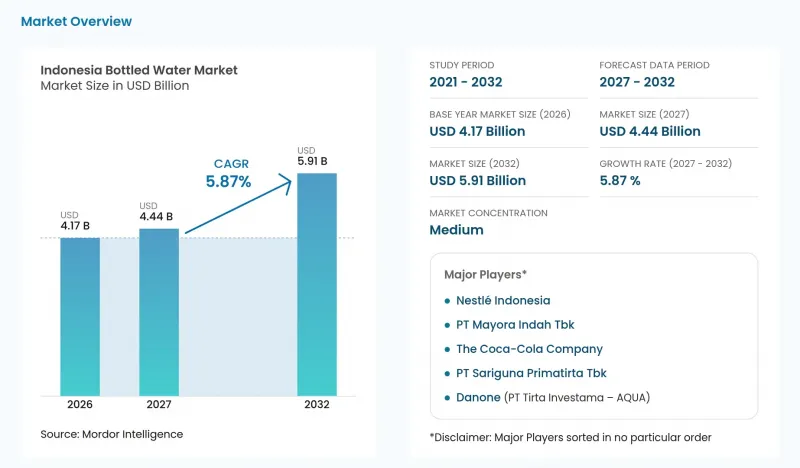
This report is segmented by Product Type (Still Water, Functional Water, and more), Packaging Material (PET Bottles, Glass Bottles, and more), Pricing (Mass and Premium/Luxury), Distribution Channel (Off-trade and On-trade), and Geography (Java, Sumatra, and more). The market forecasts are provided in terms of value (USD), based on availability.
Indonesia Bottled Water Market Trends and Insights
Growth of premium and functional bottled water products
Nihon Trim, the reporting issuer for PT Super Wahana Tehno, identifies PT Super Wahana Tehno as a leading alkaline-drinking-water company in Indonesia. It reported that the operator's bottled-water business as a whole recorded net sales growth of 39.2% year over year in April-June 2026. The issuer attributed that growth to stronger television and social-media advertising and promotional measures aimed at expanding market share. The result connects a differentiated water business with investment in reaching consumers, giving functional positioning a route to wider recognition. Nihon Trim also described rising health awareness supported by higher Indonesian incomes. Rising health awareness and incomes leave alkaline-water suppliers room to sell a health-oriented proposition through broader consumer communication.
Innovative packaging solutions for convenience and environmental impact
In July 2026, AQUA said all its 19-liter bottled-water products used reusable bottles. Its distribution system collected empty containers from customers and returned them to factories for cleaning, sanitization, and refill. That operating loop connects package recovery with the next filling cycle and gives reuse a specific role in supplying household water. In the same profile, AQUA said AQUA LIFE packaging was made entirely from recycled plastic processed into food-grade material using advanced recycling technology. The 2 approaches let AQUA offer household refills and recycled-content bottles through different packaging systems, broadening the formats in which it can serve water buyers.
Microplastic and nanoplastic health concerns
Microplastic detection creates a product-quality challenge for bottled water sold on a purity proposition. In 2025, laboratory testing at the Faculty of Public Health, Universitas Muslim Indonesia, in Makassar found microplastics in all 4 tested local bottled-water samples, averaging 0.028 particles/mL. The finding makes particle content a specific concern for those sampled products. A producer seeking to substantiate a particle-related purity claim needs evidence about its own finished water. At a June 2026 bottled-water oversight hearing, Indonesia's food and drug regulator BPOM said it would develop microplastic testing standards and methods. Meeting that need adds testing work for the producer before the claim can accompany a sale.
Other drivers and restraints analyzed in the detailed report include:
- Rapid urbanization is boosting on-the-go hydration needs
- Adoption of advanced purification and bottling technologies
- Water scarcity and sustainability issues
For complete list of drivers and restraints, kindly check the Table Of Contents.
Segment Analysis
Still water was the largest segment, accounting for 87.98% of the market in 2026. A June 2026 survey of outlet perceptions across 10 Indonesian locations found that 589 of 1,033 respondents named AQUA their best-selling mineral-water brand. This provides a retail-facing demand context for ordinary mineral water, with the brand's perceived performance rooted in existing store activity. With AQUA named best-selling by most surveyed outlets, a competing still-water label must earn space where an established mineral-water brand already anchors store sales.
Functional water is the fastest-growing segment, with a forecast CAGR of 8% over 2027-2032. Nihon Trim reported that PT Super Wahana Tehno's Indonesian bottled-water business as a whole recorded net-sales growth of 29.2% year over year in the fiscal year from April 1, 2025, to March 31, 2026. An expanding alkaline-water operator provides a growth example for differentiated hydration. Since April 21, 2025, BPOM has required an Indonesian National Standard (SNI) certificate for high-pH packaged-water registration and classified that registration as medium-high risk. This qualification covers high-pH water with or without added oxygen, while alkaline positioning gives suppliers a water characteristic around which to pursue additional drinking-water demand.
PET bottles were the largest segment, with 88.57% of the market in 2026. In January 2025, AQUA agents in Denpasar, Bali, described sales of reusable PET water gallons as promising and consumer interest as high. They suggested that a clean, transparent appearance might attract buyers and described the containers as less easily broken. The account gives packaging visibility a customer-facing role within the water proposition, alongside the container's physical function. AQUA agents can demonstrate those PET-gallon attributes during a sale, making the package itself part of the case for choosing their water.
Glass bottles are the fastest-growing segment, with a forecast CAGR of 7.55% over 2027-2032. At the 2025 Bali Arts Festival in Denpasar, vendors were directed to sell non-plastic packaged water. One food vendor reported selling 2 crates a day, or 48 glass bottles of 350-milliliter mineral water. The venue's rule made glass a qualifying serving format and gave vendors a specific reason to stock it. Vendor orders for events that require non-plastic water packaging are the route to this demand.
Complete Report Scope:
- By Product Type
- Still Water
- Sparkling Water
- Functional Water
- Flavored Water
- By Packaging Material
- PET Bottles
- Glass Bottles
- Aluminum Cans and Bottles
- Others
- By Pricing
- Mass
- Premium/Luxury
- By Distribution Channel
- On-trade
- Off-trade
- Supermarkets/Hypermarkets
- Convenience/Grocery Stores
- Home and Office Space
- Online Retail
- Other Off-trade channels
- By Geography
- Java
- Sumatra
- Kalimantan
- Sulawesi
- Rest of Indonesia
List of Companies Covered in this Report:
- Danone (PT Tirta Investama - AQUA)
- PT Mayora Indah Tbk
- PT Sariguna Primatirta Tbk
- Nestle Indonesia
- The Coca-Cola Company
- PT Indofood CBP Sukses Makmur Tbk
- Fraser & Neave Ltd
- PT Pristine Prima Indonesia
- PT Tirta Fresindo Jaya
- Asahi Group - Vittoria Sparkling
- PT Super Wahana Tehno
- PT ABC President Indonesia
- PT Nojorono Pratama
- PT Wings Food
- PT Tempo Scan Pacific
- PT Akasha Wira International
- PT Aetra Air Jakarta (Private-label)
- PT Langgeng Sukmasejati
- PT Namasindo Plas
- PT Sutindo Chemical Indonesia
Additional Benefits:
- The market estimate (ME) sheet in Excel format
- 3 months of analyst support
TABLE OF CONTENTS
1 INTRODUCTION
- 1.1 Study Assumptions and Market Definition
- 1.2 Scope of the Study
2 RESEARCH METHODOLOGY
3 EXECUTIVE SUMMARY
4 MARKET LANDSCAPE
- 4.1 Market Overview
- 4.2 Market Drivers
- 4.2.1 Growth of premium and functional bottled water products
- 4.2.2 Innovative packaging solutions for convenience and environmental impact
- 4.2.3 Rapid urbanization is boosting on-the-go hydration needs
- 4.2.4 Adoption of advanced purification and bottling technologies
- 4.2.5 Increasing health consciousness with a shift from sugary drinks
- 4.2.6 Expansion of the tourism and hospitality sector
- 4.3 Market Restraints
- 4.3.1 Microplastic and nanoplastic health concerns
- 4.3.2 Water scarcity and sustainability issues
- 4.3.3 Price sensitivity and intense competition
- 4.3.4 Strict regulatory compliance and costs
- 4.4 Industry Value Chain Analysis
- 4.5 Regulatory Landscape
- 4.6 Technological Outlook
- 4.7 Porter's Five Forces Analysis
- 4.7.1 Threat of New Entrants
- 4.7.2 Bargaining Power of Suppliers
- 4.7.3 Bargaining Power of Buyers
- 4.7.4 Threat of Substitutes
- 4.7.5 Competitive Rivalry
- 4.8 Consumer Behavior Analysis
5 MARKET SIZE AND GROWTH FORECASTS (VALUE)
- 5.1 By Product Type
- 5.1.1 Still Water
- 5.1.2 Sparkling Water
- 5.1.3 Functional Water
- 5.1.4 Flavored Water
- 5.2 By Packaging Material
- 5.2.1 PET Bottles
- 5.2.2 Glass Bottles
- 5.2.3 Aluminum Cans and Bottles
- 5.2.4 Others
- 5.3 By Pricing
- 5.3.1 Mass
- 5.3.2 Premium/Luxury
- 5.4 By Distribution Channel
- 5.4.1 On-trade
- 5.4.2 Off-trade
- 5.4.2.1 Supermarkets/Hypermarkets
- 5.4.2.2 Convenience/Grocery Stores
- 5.4.2.3 Home and Office Space
- 5.4.2.4 Online Retail
- 5.4.2.5 Other Off-trade channels
- 5.5 By Geography
- 5.5.1 Java
- 5.5.2 Sumatra
- 5.5.3 Kalimantan
- 5.5.4 Sulawesi
- 5.5.5 Rest of Indonesia
6 COMPETITIVE LANDSCAPE
- 6.1 Market Concentration
- 6.2 Strategic Moves
- 6.3 Market Share Analysis
- 6.4 Company Profiles (includes Global level Overview, Market level overview, Core Segments, Financials as available, Strategic Information, Market Rank/Share for key companies, Products and Services, and Recent Developments)
- 6.4.1 Danone (PT Tirta Investama - AQUA)
- 6.4.2 PT Mayora Indah Tbk
- 6.4.3 PT Sariguna Primatirta Tbk
- 6.4.4 Nestle Indonesia
- 6.4.5 The Coca-Cola Company
- 6.4.6 PT Indofood CBP Sukses Makmur Tbk
- 6.4.7 Fraser & Neave Ltd
- 6.4.8 PT Pristine Prima Indonesia
- 6.4.9 PT Tirta Fresindo Jaya
- 6.4.10 Asahi Group - Vittoria Sparkling
- 6.4.11 PT Super Wahana Tehno
- 6.4.12 PT ABC President Indonesia
- 6.4.13 PT Nojorono Pratama
- 6.4.14 PT Wings Food
- 6.4.15 PT Tempo Scan Pacific
- 6.4.16 PT Akasha Wira International
- 6.4.17 PT Aetra Air Jakarta (Private-label)
- 6.4.18 PT Langgeng Sukmasejati
- 6.4.19 PT Namasindo Plas
- 6.4.20 PT Sutindo Chemical Indonesia
7 MARKET OPPORTUNITIES AND FUTURE OUTLOOK
- 7.1 White-Space and Unmet-Need Assessment

