PUBLISHER: Mordor Intelligence | PRODUCT CODE: 1907332

PUBLISHER: Mordor Intelligence | PRODUCT CODE: 1907332
Paper Packaging - Market Share Analysis, Industry Trends & Statistics, Growth Forecasts (2026 - 2031)
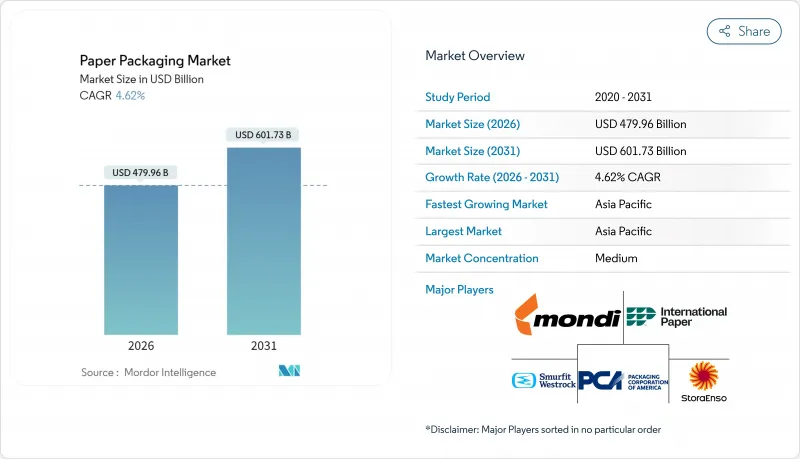
The paper packaging market was valued at USD 458.8 billion in 2025 and estimated to grow from USD 479.96 billion in 2026 to reach USD 601.73 billion by 2031, at a CAGR of 4.62% during the forecast period (2026-2031).
This expansion is propelled by environmental regulations that reward recyclable substrates, the continued rise of online retail, and rapid progress in bio-based barrier coatings that let paper compete with plastics on moisture and grease resistance. Producers benefit from Extended Producer Responsibility fee schedules that lower compliance costs for fiber-based materials relative to multilayer plastics. At the same time, investments in nano-cellulose technology promise PFAS-free performance that aligns with looming U.S. and EU chemical phase-outs. Supply-side flexibility, powered by digital printing and smaller batch economics, is enabling converters to serve short-run, highly customized campaigns at attractive margins, expanding addressable volume for the paper packaging market.
Global Paper Packaging Market Trends and Insights
Development of Barrier-Coated Paperboard Solutions Drive Premium Applications
Advanced water-, oxygen-, and grease-barrier coatings based on bio-polymers and nano-cellulose are elevating paper's performance while preserving its recyclability. Laboratory trials show that cellulose nanofibril coatings can reduce oxygen transmission by more than 90% and double folding endurance compared with uncoated board. The U.S. Food & Drug Administration confirmed that grease-proofing agents containing PFAS have exited the food-contact market, shifting demand toward safer chemistries. In Europe, several converters are fast-tracking industrial runs of boric-acid-cross-linked poly(vinyl alcohol) coatings that deliver robust water vapor protection and meet compostability standards. As brand owners pursue plastic replacement without compromising shelf life, premium barrier-coated board is becoming the default for ready-to-eat foods, frozen meals, and personal-care gift packs, boosting value growth in the paper packaging market.
E-Commerce Corrugated Demand Surge Reshapes Production Priorities
Global online retail continues to outperform brick-and-mortar channels, and each parcel requires protective, stackable outer packaging that can withstand automated handling. Corrugated cases now account for an estimated 80% of e-commerce shipments, cementing their role as the workhorse for last-mile logistics. Asian mega-markets led by China and India added double-digit billions of parcels in 2024, prompting box-plant expansions and high-speed digital print lines dedicated to web-shop volumes. The production mix is shifting toward lightweight fluting profiles that cut freight costs yet retain compression strength, and integrated producers are prioritizing incremental containerboard tonnage over graphic paper grades to keep pace with e-commerce pull-through. This demand foundation underpins steady volume growth for the paper packaging market in both mature and emerging economies.
Deforestation Scrutiny Challenges Traditional Supply-Chain Structures
The EU Deforestation Regulation obliges importers to demonstrate plot-level traceability for all wood-based inputs by the end of 2025. U.S. Kraft pulp, representing 60% of EU specialty-grade imports, must now carry geo-coordinates verified by third parties. Implementing satellite monitoring and chain-of-custody audits raises procurement costs and risks of shipment delays. Smaller mills lacking sophisticated data systems may cede share to vertically integrated majors with certified forests, altering competitive balances within the paper packaging market. Over time, tighter provenance rules could squeeze supply and curb the sector's growth potential in markets that rely on imported fiber.
Other drivers and restraints analyzed in the detailed report include:
- Brand-Owner Migration Toward Mono-Material Packaging Architectures
- Extended Producer Responsibility Mandates Accelerate Market Transformation
- Volatile Recycled-Fiber Pricing Creates Margin Compression Pressures
For complete list of drivers and restraints, kindly check the Table Of Contents.
Segment Analysis
Containerboard held a 54.12% paper packaging market share in 2025, supported by deep corrugated infrastructure and its central role in e-commerce shipping. Meanwhile, cartonboard is registering a 7.05% CAGR, the fastest among fiber grades. The paper packaging market size for cartonboard applications is projected to rise, reflecting premium penetration in food and personal-care sleeves. Converters are refitting idle graphic-paper machines with coating heads suited to Solid Bleached Sulfate and Folding Boxboard production, improving asset utilization. Folding Boxboard's compatibility with high-definition digital print elevates shelf appeal, while dispersion-barrier upgrades enable chilled-food entry. At the same time, containerboard producers are investing in lightweight kraftliner to cut shipping mass, enhancing sustainability credentials. Virgin-recycled blends optimize strength-to-weight ratios and keep containerboard competitive, ensuring it remains the volume backbone of the paper packaging market.
Cartonboard's growth profile attracts capital for rapid European and North American capacity expansions, with start-ups exceeding 1 million tons by 2026. Food-contact certification and pharmaceutical clean-room compliance boost value per ton, particularly for solid-bleached grades. Regulatory bans on black plastics in several EU countries redirect premium confectionery and cosmetic packs to white cartonboard formats, lifting demand further. Performance-enhancing additives such as nano-clays deliver moisture barriers without compromising recyclability, reducing reliance on plastic films. As retail brands demand mono-material packs that convey quality and sustainability, cartonboard emerges as the prime beneficiary within the paper packaging market.
Corrugated boxes occupied 61.48% of the paper packaging market in 2025 owing to their unmatched protective strength and versatility across shipping, industrial, and grocery channels. Folding cartons, however, are forecast to outpace overall growth, expanding at a 5.12% CAGR on the back of personalized graphics, quick-response seasonal campaigns, and smaller lot sizes. Digital printheads integrated into die-cutters reduce changeover times, paving the way for mass-customization without costly inventories. Premium beauty, nutraceuticals, and plant-based foods all favor folding cartons for their aesthetic flexibility and shelf-ready formats.
Corrugated producers respond with inside-print and high-color capabilities to keep hold of branding real estate, but folding cartons maintain an edge in tactile finishes and embossing. Consumer-electronics accessories increasingly shift from plastic clamshells to reinforced cartons married with molded-fiber inserts, capturing sustainability-minded shoppers. Novel tear-strip opening features borrowed from flexible pouches further boost convenience. These design and technology advances underpin steady share migration within the broader paper packaging market.
The Paper Packaging Market Report is Segmented by Grade (Cartonboard [Solid Bleached Sulphate, and More], and Containerboard [White-Top Kraftliner, and More]), Product (Folding Cartons, Corrugated Boxes, and More), End-User Industry (Food, Beverage, Healthcare, Personal Care, Household Care, and More), Packaging Format (Rigid, Semi-Rigid, Flexible, and More), and Geography. The Market Forecasts are Provided in Terms of Value (USD).
Geography Analysis
Asia-Pacific led the paper packaging market with a 47.62% revenue share in 2025 and is projected to record a 5.51% CAGR to 2031. Rapid urbanization, expanding middle-class purchasing power, and large-scale food-delivery ecosystems underpin fiber demand in South and Southeast Asia. Regional players leverage cost-efficient integrated mills that pair plantation forests with in-house converting, shortening lead times for export-oriented customers. Local governments incentivize sustainable-pack investments through duty rebates on energy-efficient machinery, further accelerating capacity additions.
North America remains an innovation nucleus, driving digital-print adoption and spearheading nano-cellulose pilot commercialization. Tightening landfill legislation in several states spurs demand for curbside-recyclable packs, bolstering domestic containerboard offtake. The United States also benefits from abundant softwood resources, ensuring steady virgin-fiber availability to blend with imported OCC. Meanwhile, Europe's stringent recyclability targets and EPR rollouts create a predictable policy environment that favors continuous equipment upgrades. German and Scandinavian mills transition from fossil to biomass boilers, reducing Scope 1 emissions and sharpening cost competitiveness despite high energy prices.
Latin America and the Middle East and Africa collectively hold modest shares today, yet both regions register above-global average growth. Brazilian pulp producers integrate downstream into cartonboard to mitigate commodity cycles, while Gulf Cooperation Council economies add corrugated capacity to serve expanding e-commerce hubs. Africa's underdeveloped collection network hinders recycled-fiber supply, but international development programs are funding pilot materials-recovery facilities, laying groundwork for future circularity. Collectively, these regional trajectories reinforce the diversified demand base that supports the long-term resilience of the paper packaging market.
- International Paper Company
- Smurfit Westrock plc
- Mondi plc
- Packaging Corporation of America
- Stora Enso Oyj
- Graphic Packaging International, LLC
- Nippon Paper Industries Co. Ltd.
- Sonoco Products Company
- Oji Holdings Corporation
- Georgia-Pacific LLC
- Nine Dragons Paper Holdings
- Lee & Man Paper Manufacturing
- Sappi Limited
- Ilim Group
- Klabin S.A.
- Asia Pulp & Paper (APP)
Additional Benefits:
- The market estimate (ME) sheet in Excel format
- 3 months of analyst support
TABLE OF CONTENTS
1 INTRODUCTION
- 1.1 Study Assumptions and Market Definition
- 1.2 Scope of the Study
2 RESEARCH METHODOLOGY
3 EXECUTIVE SUMMARY
4 MARKET LANDSCAPE
- 4.1 Market Overview
- 4.2 Market Drivers
- 4.2.1 Development of barrier-coated paperboard solutions
- 4.2.2 Rise in e-commerce corrugated demand
- 4.2.3 Brand-owner shift toward mono-material packs
- 4.2.4 Extended Producer Responsibility (EPR) mandates
- 4.2.5 Nano-cellulose barrier breakthroughs
- 4.2.6 Converting-plant on-site digital printing economics
- 4.3 Market Restraints
- 4.3.1 Deforestation and fibre-supply scrutiny
- 4.3.2 Volatile recycled-fibre pricing
- 4.3.3 PFAS "forever-chemicals" phase-out costs
- 4.3.4 Limited recovery logistics in emerging markets
- 4.4 Industry Value Chain Analysis
- 4.5 Regulatory Landscape
- 4.6 Technological Outlook
- 4.7 Porter's Five Forces Analysis
- 4.7.1 Bargaining Power of Suppliers
- 4.7.2 Bargaining Power of Buyers
- 4.7.3 Threat of New Entrants
- 4.7.4 Threat of Substitutes
- 4.7.5 Intensity of Competitive Rivalry
- 4.8 Global Recovered Paper Production Statistics
- 4.8.1 Recovered Paper - Production Quantity
- 4.8.2 Recovered Paper - Import Value and Quantity
- 4.8.3 Recovered Paper - Export Value and Quantity
- 4.8.4 Recovered Paper Production - Leading Countries
- 4.9 Cartonboard EXIM Scenario
- 4.9.1 Exports (Value and Volume)
- 4.9.2 Imports (Value and Volume)
5 MARKET SIZE AND GROWTH FORECASTS (VALUE)
- 5.1 By Grade
- 5.1.1 Cartonboard
- 5.1.1.1 Solid Bleached Sulphate (SBS)
- 5.1.1.2 Solid Unbleached Sulphate (SUS)
- 5.1.1.3 Folding Boxboard (FBB)
- 5.1.1.4 Coated Recycled Board (CRB)
- 5.1.1.5 Uncoated Recycled Board (URB)
- 5.1.1.6 Other Cartonboard Grades
- 5.1.2 Containerboard
- 5.1.2.1 White-top Kraftliner
- 5.1.2.2 Other Kraftliners
- 5.1.2.3 White-top Testliner
- 5.1.2.4 Other Testliners
- 5.1.2.5 Semi-chemical Fluting
- 5.1.2.6 Recycled Fluting
- 5.1.1 Cartonboard
- 5.2 By Product
- 5.2.1 Folding Cartons
- 5.2.2 Corrugated Boxes
- 5.2.3 Other Products
- 5.3 By End-User Industry
- 5.3.1 Food
- 5.3.2 Beverage
- 5.3.3 Healthcare
- 5.3.4 Personal Care
- 5.3.5 Household Care
- 5.3.6 Electrical and Electronics
- 5.3.7 Other End-User Industries
- 5.4 By Packaging Format
- 5.4.1 Rigid (Corrugated, Solid Board)
- 5.4.2 Semi-rigid (Folding Cartons)
- 5.4.3 Flexible Paper (Sachets, Wraps)
- 5.4.4 Molded Fibre and Pulp
- 5.5 By Geography
- 5.5.1 North America
- 5.5.1.1 United States
- 5.5.1.2 Canada
- 5.5.1.3 Mexico
- 5.5.2 South America
- 5.5.2.1 Brazil
- 5.5.2.2 Argentina
- 5.5.2.3 Rest of South America
- 5.5.3 Europe
- 5.5.3.1 United Kingdom
- 5.5.3.2 Germany
- 5.5.3.3 France
- 5.5.3.4 Italy
- 5.5.3.5 Spain
- 5.5.3.6 Russia
- 5.5.3.7 Rest of Europe
- 5.5.4 Asia Pacific
- 5.5.4.1 China
- 5.5.4.2 Japan
- 5.5.4.3 India
- 5.5.4.4 South Korea
- 5.5.4.5 Australia
- 5.5.4.6 Rest of Asia Pacific
- 5.5.5 Middle East and Africa
- 5.5.5.1 Middle East
- 5.5.5.1.1 United Arab Emirates
- 5.5.5.1.2 Saudi Arabia
- 5.5.5.1.3 Turkey
- 5.5.5.1.4 Rest of Middle East
- 5.5.5.2 Africa
- 5.5.5.2.1 South Africa
- 5.5.5.2.2 Nigeria
- 5.5.5.2.3 Rest of Africa
- 5.5.5.1 Middle East
- 5.5.1 North America
6 COMPETITIVE LANDSCAPE
- 6.1 Market Concentration
- 6.2 Strategic Moves
- 6.3 Market Share Analysis
- 6.4 Company Profiles (includes Global level Overview, Market level overview, Core Segments, Financials as available, Strategic Information, Market Rank/Share, Products and Services, Recent Developments)
- 6.4.1 International Paper Company
- 6.4.2 Smurfit Westrock plc
- 6.4.3 Mondi plc
- 6.4.4 Packaging Corporation of America
- 6.4.5 Stora Enso Oyj
- 6.4.6 Graphic Packaging International, LLC
- 6.4.7 Nippon Paper Industries Co. Ltd.
- 6.4.8 Sonoco Products Company
- 6.4.9 Oji Holdings Corporation
- 6.4.10 Georgia-Pacific LLC
- 6.4.11 Nine Dragons Paper Holdings
- 6.4.12 Lee & Man Paper Manufacturing
- 6.4.13 Sappi Limited
- 6.4.14 Ilim Group
- 6.4.15 Klabin S.A.
- 6.4.16 Asia Pulp & Paper (APP)
7 MARKET OPPORTUNITIES AND FUTURE OUTLOOK
- 7.1 White-space and Unmet-Need Assessment

