
PUBLISHER: Mordor Intelligence | PRODUCT CODE: 1911423

PUBLISHER: Mordor Intelligence | PRODUCT CODE: 1911423
Europe Used Car - Market Share Analysis, Industry Trends & Statistics, Growth Forecasts (2026 - 2031)
The Europe used car market is expected to grow from USD 59.12 billion in 2025 to USD 61.7 billion in 2026 and is forecast to reach USD 76.43 billion by 2031 at 4.37% CAGR over 2026-2031.
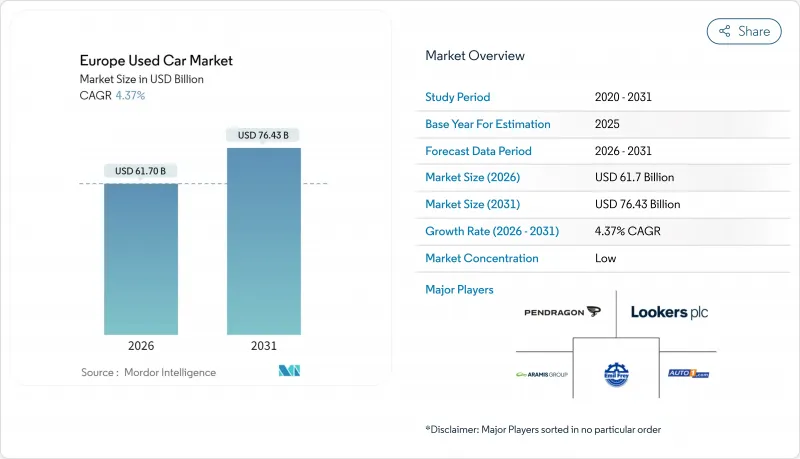
Digital marketplaces, OEM-backed certified pre-owned (CPO) programs, and embedded finance solutions together accelerate demand by improving price transparency, trust, and affordability. Cross-border inventory flows unlock incremental volume as diesel phase-out policies in Western Europe redirect vehicles to Central and Eastern Europe. The mid-age supply wave of 3 to 5-year-old ex-lease cars balances out persistent shortages of younger stock, while battery-electric vehicles (BEVs) add a fast-growing premium layer despite valuation uncertainty. Competitive intensity is rising as traditional dealers, digital disruptors, and OEM captive channels pursue omnichannel models that blend online research with showroom or delivery hand-offs, reshaping margins and customer ownership cycles.
Europe Used Car Market Trends and Insights
Surge in OEM-Backed Certified Pre-Owned (CPO) Programs
OEM CPO schemes inject manufacturer warranties, refurbishment standards, and digital booking tools into the resale journey, positioning near-new cars as credible substitutes for new models. Strong residuals and higher per-unit profitability motivate brands to mainstream CPO in core planning. Consumer awareness, however, remains muted; ongoing education initiatives by dealer councils in Germany and the UK aim to translate technical coverage into clearer value messaging. Effective programs also loop owners back into authorized service lanes, reinforcing accessory and maintenance revenue streams across the ownership lifecycle.
Rising Supply of Ex-Lease Vehicles (3-5-Year Bracket) Driven by Fleet Electrification Mandates
The influx of off-lease vehicles, particularly in the 3-5 year bracket, is reshaping inventory dynamics across Europe, creating both challenges and opportunities for market participants. Fleet electrification mandates are accelerating this trend, with corporate fleets cycling through vehicles more rapidly to meet sustainability targets and take advantage of evolving technology. This supply surge is particularly pronounced in markets with strong leasing penetration, such as Germany and the Netherlands, where leasing remains a key acquisition method for battery electric vehicles (BEVs).
Persisting Odometer Fraud Undermining Buyer Trust
Odometer fraud continues to plague the European used car market, eroding consumer confidence and depressing values across affected segments. This practice, where vehicle mileage is artificially reduced to increase selling prices, costs European consumers billions annually and disproportionately impacts cross-border transactions where verification is more challenging.The problem is particularly acute in Eastern Europe, Italy, and Spain, where regulatory enforcement varies significantly. While digital solutions like blockchain-based vehicle history records show promise, implementation remains fragmented across the continent.
Other drivers and restraints analyzed in the detailed report include:
- Growth of Pure-Play Online Marketplaces Increasing Digital Penetration
- Elevated New-Car Prices from WLTP/Euro-7 Compliance Widening Price Gap to Used
- Slow EV Battery-Health Standardisation Depressing Residual Values of Used BEVs
For complete list of drivers and restraints, kindly check the Table Of Contents.
Segment Analysis
SUV/MUV models commanded 33.78% of the Europe used car market size in 2025, reflecting consumer appetite for versatility and higher seating positions even after fuel-cost pressures peaked. BEV-compatible SUVs now exit lease pools in greater numbers, which underpins a 9.67% CAGR outlook. Sedans continue to slide as urban congestion charges penalise longer body formats. Hatchbacks retain loyalty inside dense city cores among price-sensitive first-time buyers.
Dynamic residuals encourage franchised dealers in France and Spain to dedicate rooftop space to mid-spec crossovers, while LCV uptake remains steady in service-oriented SMEs. Euro 6-compliant vans trade at 12% premiums inside low-emission zones, highlighting a bifurcation between compliant and non-compliant workhorses. Southern Europe leans even harder into SUVs; Portugal's demand for sub-compact crossovers such as the Peugeot 2008 grows by double digits.
Diesel vehicles captured 41.52% of the Europe used car market share in 2025, down from previous highs as clean-air measures rise. Though starting small, battery electric vehicles are advancing at 17.95% CAGR as early adopter fleets de-risk technology fears by releasing documented vehicles. Petrol maintains relevance in countries with nascent charging grids, while HEV and PHEV bridge compliance and range concerns.
Cross-border arbitrage channels diesel cars from France and Germany into Bulgaria and Romania, prolonging lifecycle yields. Meanwhile, BEV bargains appear in the Netherlands, where resale subsidies tighten. Transparency around battery state of health remains a gating factor, yet growth in verification kits is expected to unlock further liquidity after Euro 7 implementation.
Independent traders, private classifieds, and micro-dealerships still account for 54.60% of the volume, but organized players scale quicker at 6.18% CAGR as investors back data-rich marketplaces. The top five retailers account for only 6% of B2C transactions, signalling ample consolidation headroom. OEM-sponsored CPO outlets add inventory discipline, bundled service plans, and financing that resonate with risk-averse shoppers.
The Europe used car market rewards platforms able to syndicate stock, automate reconditioning, and guarantee title. In Poland, bundled transport and taxation services enable organised sellers to undercut fragmented rivals on cross-border purchases, boosting trust and repeat business.
The Europe Used Car Market Report is Segmented by Vehicle Type (Hatchback, Sedan, and More), Fuel Type (Gasoline, Diesel, and More), Vendor Type (Organized and Unorganized), Sales Channel (Offline and Online), Vehicle Age (0 To 2 Years, 3 To 5 Years, and More), Ownership Count (Single-Owner Vehicles and More), Price Band, Financing Type, and Country. The Market Forecasts are Provided in Terms of Value (USD) and Volume (Units).
List of Companies Covered in this Report:
- Auto1 Group SE
- Emil Frey AG
- BCA Marketplace (Constellation Automotive)
- Pendragon PLC
- Aramis Group SA
- Lookers PLC
- Autorola A/S
- Arnold Clark Automobiles Ltd
- Sytner Group Ltd
- Cazoo Group Ltd
- CarNext B.V.
- Inchcape PLC
- Hedin Mobility Group
- Heycar (Mobility Trader GmbH)
- Penske Automotive Group/CarShop
- ALD Automotive and LeasePlan
- Groupe Renault Retail Group
- Bilia AB
- Motorpoint Group PLC
- Vertu Motors PLC
Additional Benefits:
- The market estimate (ME) sheet in Excel format
- 3 months of analyst support
TABLE OF CONTENTS
1 Introduction
- 1.1 Scope of the Study
2 Research Methodology
3 Executive Summary
4 Market Landscape
- 4.1 Market Drivers
- 4.1.1 Surge in OEM-Backed Certified Pre-Owned (CPO) Programs
- 4.1.2 Rising Supply of Ex-Lease Vehicles (3-5-Year Bracket) Driven by Fleet Electrification Mandates
- 4.1.3 Growth of Pure-Play Online Marketplaces Increasing Digital Penetration
- 4.1.4 Elevated New-Car Prices from WLTP/Euro-7 Compliance Widening Price Gap to Used
- 4.1.5 Accelerated Diesel Phase-Out Policies Boosting Cross-Border Trade Flows
- 4.1.6 Embedded Finance/BNPL Solutions Improving Affordability for First-Time Buyers
- 4.2 Market Restraints
- 4.2.1 Persisting Odometer Fraud Undermining Buyer Trust
- 4.2.2 Fragmented Tax and Registration Rules Hampering Seamless Secondary Trade
- 4.2.3 Slow EV Battery-Health Standardisation Depressing Residual Values of Used BEVs
- 4.2.4 Quality and Reliability Concerns in Older-Age Vehicles
- 4.3 Value/Supply-Chain Analysis
- 4.4 Regulatory Outlook
- 4.4.1 Euro-7 EU Battery Regulation VAT margin scheme revisions
- 4.5 Technological Outlook
- 4.5.1 AI-driven vehicle grading * Digital twins for re-marketing * OTA warranty analytics
- 4.6 Porter's Five Forces
- 4.6.1 Bargaining Power of Suppliers
- 4.6.2 Bargaining Power of Buyers
- 4.6.3 Threat of New Entrants
- 4.6.4 Threat of Substitutes
- 4.6.5 Intensity of Competitive Rivalry
5 Market Size and Growth Forecasts (Value (USD) and Volume (Units))
- 5.1 By Vehicle Type
- 5.1.1 Sedan
- 5.1.2 SUV/MUV
- 5.1.3 Hatchback
- 5.2 By Fuel Type
- 5.2.1 Gasoline
- 5.2.2 Diesel
- 5.2.3 Battery Electric Vehicle (BEV)
- 5.2.4 Hybrid and Plug-in Hybrid (HEV/PHEV)
- 5.2.5 Others (LPG, CNG, Bio-fuel)
- 5.3 By Vendor Type
- 5.3.1 Organized
- 5.3.2 Unorganized
- 5.4 By Sales Channel
- 5.4.1 Offline
- 5.4.2 Online
- 5.5 By Vehicle Age
- 5.5.1 0 to 2 Years
- 5.5.2 3 to 5 Years
- 5.5.3 6 to 8 Years
- 5.5.4 More Than 9 Years
- 5.6 By Ownership Count
- 5.6.1 Single-Owner Vehicles
- 5.6.2 Multi-Owner Vehicles
- 5.7 By Price Band (USD)
- 5.7.1 Less than 10k
- 5.7.2 10k to 20k
- 5.7.3 20k to 30k
- 5.7.4 More than 30k
- 5.8 By Financing Type
- 5.8.1 Financed Purchase
- 5.8.2 Outright Purchase
- 5.9 By Country
- 5.9.1 Germany
- 5.9.2 United Kingdom
- 5.9.3 France
- 5.9.4 Italy
- 5.9.5 Spain
- 5.9.6 Russia
- 5.9.7 Netherlands
- 5.9.8 Sweden
- 5.9.9 Poland
- 5.9.10 Rest of Europe
6 Competitive Landscape
- 6.1 Strategic Moves (M&A, Fund-Raises, Fleet Partnerships)
- 6.2 Market Share Analysis
- 6.3 Company Profiles (Includes Global Level Overview, Market Level Overview, Core Segments, Financials as Available, Strategic Information, Market Rank/Share for Key Companies, Products and Services, SWOT Analysis, and Recent Developments)
- 6.3.1 Auto1 Group SE
- 6.3.2 Emil Frey AG
- 6.3.3 BCA Marketplace (Constellation Automotive)
- 6.3.4 Pendragon PLC
- 6.3.5 Aramis Group SA
- 6.3.6 Lookers PLC
- 6.3.7 Autorola A/S
- 6.3.8 Arnold Clark Automobiles Ltd
- 6.3.9 Sytner Group Ltd
- 6.3.10 Cazoo Group Ltd
- 6.3.11 CarNext B.V.
- 6.3.12 Inchcape PLC
- 6.3.13 Hedin Mobility Group
- 6.3.14 Heycar (Mobility Trader GmbH)
- 6.3.15 Penske Automotive Group/CarShop
- 6.3.16 ALD Automotive and LeasePlan
- 6.3.17 Groupe Renault Retail Group
- 6.3.18 Bilia AB
- 6.3.19 Motorpoint Group PLC
- 6.3.20 Vertu Motors PLC
7 Market Opportunities and Future Outlook

