PUBLISHER: Mordor Intelligence | PRODUCT CODE: 2116368

PUBLISHER: Mordor Intelligence | PRODUCT CODE: 2116368
France Automotive Engine Oils - Market Share Analysis, Industry Trends & Statistics, Growth Forecasts (2026 - 2031)
According to Mordor Intelligence, the France automotive engine oils market size is expected to grow from 216.90 million liters in 2025 to 212.93 million liters in 2026 and is forecast to reach 194.15 million liters by 2031 at -1.83% CAGR over 2026-2031.
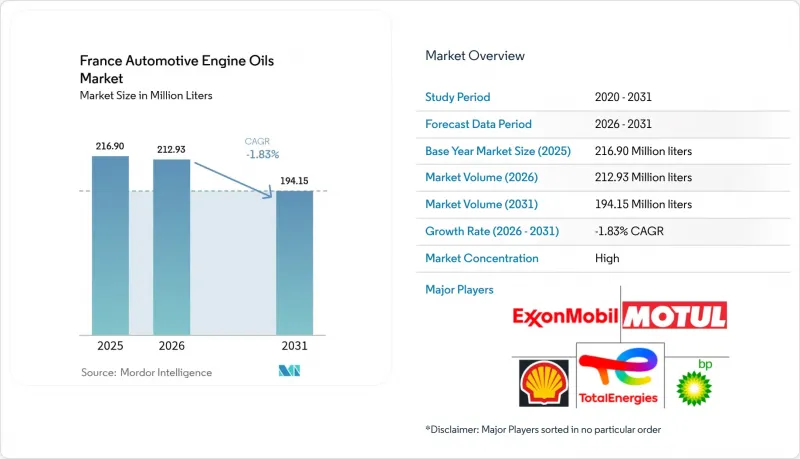
This report is Segmented by Product Type (Passenger Car Motor Oil (0W-XX, 5W-XX, 10W-XX, 15W-XX, Monogrades, and Other Grades), Heavy Duty Motor Oil (0W-XX, 5W-XX, 10W-XX, 15W-XX, Monogrades, and Other Grades), and Motorcycle Engine Oil (0W-XX, 5W-XX, 10W-XX, and More)), Base Stock (Mineral, Synthetic, Semi-Synthetic, and Bio-Based). Market Forecasts are Provided in Terms of Volume (Litres).
France Automotive Engine Oils Market Trends and Insights
Ageing Vehicle Parc Prolongs Maintenance Demand
France's passenger cars have an average service life of 11.5 years, keeping a large share of petrol and diesel engines on the road well past the typical OEM warranty window. Nearly half the fleet falls within the 8-15-year band, a mileage bracket that typically requires at least one oil change per year. Rural and peri-urban drivers tend to retain ICE vehicles longer due to limited public charging infrastructure and lower disposable income, thereby sustaining base-load demand for mineral and semi-synthetic PCMO. Extended vehicle ownership also fuels demand for viscosity grades engineered for older engines, with the ACEA 2024 sequences introducing higher oxidative stability thresholds that favor premium synthetics. Consequently, while overall liters ebb, the market still records predictable maintenance cycles that partially buffer rapid EV substitution.
OEM-Driven Low-Viscosity Synthetic Shift (Euro 6/7)
Euro 7 brings real-driving-emission compliance from 2025 for new vehicle types, pushing factory-fill standards toward 0W-20 and, in diesel passenger applications, 5W-30 ACEA C5 or C6 categories. French OEMs under the Stellantis umbrella have already transitioned many of their new gasoline models to low-viscosity fill, a trend mirrored in the aftermarket through dealer and quick-service channels. Synthetic oils meeting these newer sequences deliver extended intervals of 20,000-30,000 km, enabling oil marketers to offset lower units with premium positioning. ATIEL's Code of Practice ties product approvals to rigorous quality audits, fostering a high barrier to entry that favors established blenders. Over the medium term, low-viscosity uptake is forecast to increase the synthetic share of the French automotive engine oils market.
EV Parc Expansion Cutting ICE-Oil Volumes
New registrations of battery-electric vehicles are increasing, and government policy aims for 66% market penetration by 2030. Urban low-emission zones (ZFE) covering Paris, Lyon, and Marseille already impose access restrictions on older diesel models, accelerating ICE scrappage. The volume erosion is particularly acute in ride-sharing and last-mile delivery segments, which collectively log high mileage but adopt EVs the fastest to capture total-cost-of-ownership gains. As charging infrastructure expands along national highways, the adoption of medium-duty commercial vehicles accelerates, creating a second-order drag on heavy-duty engine oils.
Other drivers and restraints analyzed in the detailed report include:
- E-Commerce and Organized After-Sales Channels
- Passenger-Car Oil Resilience Versus Other Lubes
- Long-Drain Synthetic Oils Lower Liter Turnover
For complete list of drivers and restraints, kindly check the Table Of Contents.
Segment Analysis
Passenger car motor oil accounted for 62.05% of the France automotive engine oils market share in 2025. The segment nevertheless registers the steepest absolute volume decline as EV uptake accelerates in urban zip codes. Heavy-duty motor oil exhibits a more moderate contraction, despite rising hybrid and light-commercial vehicle adoption. Long-haul trucking retains diesel propulsion pending the development of infrastructure for hydrogen or high-capacity charging. Motorcycle engine oil exhibits the most resilient trajectory, shrinking at only a -1.64% CAGR, cushioned by the recreational riding culture and lower regulatory urgency to electrify two-wheelers. Within PCMO, 0W-30 and 5W-30 synthetics are gaining market share as the Euro 7 implementation nears, squeezing legacy 10W-40 mineral volumes. Connected-vehicle data platforms increasingly tailor oil-change alerts, nudging consumer behavior toward "service when needed," rather than calendar-based routines, thereby reshaping short-chain retail traffic patterns.
Continued PCMO dominance also derives from policy delays on used-car electrification. Second-hand ICE imports from Southern European neighbors supply rural dealerships, extending the lifecycle of older engines that still rely on mid-SAP blends. However, once true pricing parity arrives for BEVs in the late 2020s, analysts expect a sharper PCMO downshift, compelling suppliers to diversify into transmission fluids, EV coolants, and ancillary driveline lubricants to stabilize their revenue. Synthetic PCMO premiumization mitigates the blow, lifting revenue per unit despite contracting volumes, an adaptation visible in TotalEnergies' Rubia and Quartz EV3R ranges, which incorporate regenerated base oil to meet sustainability metrics.
Complete Report Scope:
- By Product Type
- Passenger Car Motor Oil (PCMO)
- 0W-XX
- 5W-XX
- 10W-XX
- 15W-XX
- Monogrades
- Other Grades
- Heavy Duty Motor Oil (HDMO)
- 0W-XX
- 5W-XX
- 10W-XX
- 15W-XX
- Monogrades
- Other Grades
- Motorcycle Engine Oil (MCO)
- 0W-XX
- 5W-XX
- 10W-XX
- 15W-XX
- Monogrades
- Other Grades
- Passenger Car Motor Oil (PCMO)
- By Base Stock
- Mineral
- Synthetic
- Semi-Synthetic
- Bio-Based
List of Companies Covered in this Report:
- BP p.l.c.
- Chevron Corporation
- Eni SpA
- Exxon Mobil Corporation
- FUCHS
- Gulf Oil International Ltd
- IGOL
- Liqui Moly
- Lukoil
- Motul
- PETRONAS Lubricants International
- Shell plc
- SK Enmove co. Ltd
- TotalEnergies
- Wolf Oil Corporation
Additional Benefits:
- The market estimate (ME) sheet in Excel format
- 3 months of analyst support
TABLE OF CONTENTS
1 Introduction
- 1.1 Study Assumptions and Market Definition
- 1.2 Scope of the Study
2 Research Methodology
3 Executive Summary
4 Market Landscape
- 4.1 Market Overview
- 4.2 Market Drivers
- 4.2.1 Ageing vehicle parc prolongs maintenance demand
- 4.2.2 OEM-driven low-viscosity synthetic shift (Euro 6/7)
- 4.2.3 E-commerce and organised after-sales channels
- 4.2.4 Passenger-car oil resilience vs other lubes
- 4.2.5 Connected oil-analysis and smart-tank services
- 4.3 Market Restraints
- 4.3.1 EV parc expansion cutting ICE-oil volumes
- 4.3.2 Long-drain synthetic oils lower litre turnover
- 4.3.3 Counterfeit / private-label dilution in retail
- 4.4 Value Chain and Distribution Channel Analysis
- 4.5 Porter's Five Forces
- 4.5.1 Threat of New Entrants
- 4.5.2 Bargaining Power of Suppliers
- 4.5.3 Bargaining Power of Buyers
- 4.5.4 Threat of Substitutes
- 4.5.5 Industry Rivalry
- 4.6 Regulatory Framework
- 4.7 Automotive Industry Trends
5 Market Size and Growth Forecasts (Volume)
- 5.1 By Product Type
- 5.1.1 Passenger Car Motor Oil (PCMO)
- 5.1.1.1 0W-XX
- 5.1.1.2 5W-XX
- 5.1.1.3 10W-XX
- 5.1.1.4 15W-XX
- 5.1.1.5 Monogrades
- 5.1.1.6 Other Grades
- 5.1.2 Heavy Duty Motor Oil (HDMO)
- 5.1.2.1 0W-XX
- 5.1.2.2 5W-XX
- 5.1.2.3 10W-XX
- 5.1.2.4 15W-XX
- 5.1.2.5 Monogrades
- 5.1.2.6 Other Grades
- 5.1.3 Motorcycle Engine Oil (MCO)
- 5.1.3.1 0W-XX
- 5.1.3.2 5W-XX
- 5.1.3.3 10W-XX
- 5.1.3.4 15W-XX
- 5.1.3.5 Monogrades
- 5.1.3.6 Other Grades
- 5.1.1 Passenger Car Motor Oil (PCMO)
- 5.2 By Base Stock
- 5.2.1 Mineral
- 5.2.2 Synthetic
- 5.2.3 Semi-Synthetic
- 5.2.4 Bio-Based
6 Competitive Landscape
- 6.1 Market Concentration
- 6.2 Strategic Moves
- 6.3 Market Share (%)/Ranking Analysis
- 6.4 Company Profiles (includes Global level Overview, Market level overview, Core Segments, Financials as available, Production Capacity, Strategic Information, Market Rank/Share for key companies, Products and Services, and Recent Developments)
- 6.4.1 BP p.l.c.
- 6.4.2 Chevron Corporation
- 6.4.3 Eni SpA
- 6.4.4 Exxon Mobil Corporation
- 6.4.5 FUCHS
- 6.4.6 Gulf Oil International Ltd
- 6.4.7 IGOL
- 6.4.8 Liqui Moly
- 6.4.9 Lukoil
- 6.4.10 Motul
- 6.4.11 PETRONAS Lubricants International
- 6.4.12 Shell plc
- 6.4.13 SK Enmove co. Ltd
- 6.4.14 TotalEnergies
- 6.4.15 Wolf Oil Corporation
7 Market Opportunities and Future Outlook
- 7.1 White-space and Unmet-need Assessment
8 Key Strategic Questions for CEOs

