PUBLISHER: Mordor Intelligence | PRODUCT CODE: 2116382

PUBLISHER: Mordor Intelligence | PRODUCT CODE: 2116382
India Automotive Engine Oils - Market Share Analysis, Industry Trends & Statistics, Growth Forecasts (2026 - 2031)
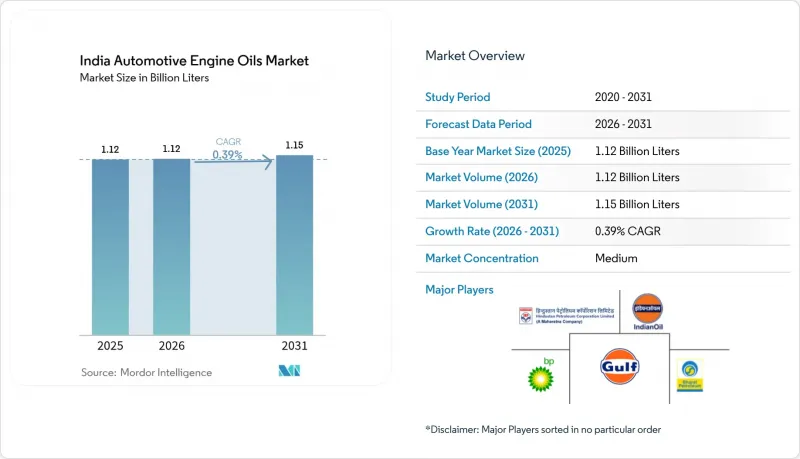
According to Mordor Intelligence, the India automotive engine oils market size was valued at 1.12 Billion Liters in 2025 and estimated to grow from 1.12 Billion Liters in 2026 to reach 1.15 Billion Liters by 2031, at a CAGR of 0.39% during the forecast period (2026-2031).
This report is Segmented by Resin Type (Passenger Car Motor Oil, Heavy Duty Motor Oil, and Motorcycle Engine Oil), Base Stock (Mineral, Synthetic, Semi-Synthetic, and Bio-Based). The Market Forecasts are Provided in Terms of Volume (Litres).
India Automotive Engine Oils Market Trends and Insights
BS-VI Stage-2 Norms Driving Shift to Premium Low-Viscosity Oils
The April 2023 onset of Real Driving Emissions testing forced OEMs to adopt low-SAPS oils that protect after-treatment systems under real-world conditions. Synthetic and semi-synthetic grades now dominate factory-fill bids as mineral formulations struggle with tighter oxidation limits and deposit control. Fleet operators accept the 30-50% price premium because extended drains lower downtime and cut maintenance spend. Refiners have upgraded additive packages, positioning low-viscosity 5W-30 and 0W-20 grades for modern petrol and diesel platforms. Central Pollution Control Board audits reinforce compliance, making this regulatory push an irreversible driver of premiumization across the India automotive engine oil market.
Rapid CNG-Vehicle Growth and Higher-Temperature Lube Demand
India's CNG fleet expansion in buses, taxis, and light-duty trucks raises lubricant operating temperatures, accelerating polymer shear and nitration. Premium CNG-specific oils priced 15-20% above diesel equivalents deliver the higher thermal stability and valve-seat protection these engines require. The north-centric refueling network sparks regional demand clusters where distributors prioritize CNG variants. Government targets that elevate CNG to 15% of all transport fuel by 2030 underpin steady volume growth, cushioning suppliers from BEV cannibalization in urban freight.
Accelerating BEV and e-2W Penetration Eroding Engine-Oil Volume
FAME-II incentives and cheaper lithium-ion packs accelerate electric two-wheeler adoption, displacing motorcycles that currently anchor growth in the India automotive engine oil market. Each e-scooter eliminates 800-900 milliliters of annual oil demand, and adoption is clustering in Bengaluru, Chennai, and Pune before cascading into smaller cities. Heavy-duty electrification is slower, yet every BEV truck removes up to 40 liters per drain, magnifying the long-term drag on volume.
Other drivers and restraints analyzed in the detailed report include:
- E-commerce Last-Mile Fleets Shortening Drain-Interval Cycles
- Scrappage-Policy Led Spike in Factory-Fill Demand (2026-28)
- Extended-Drain Synthetic Oils Cutting Per-Vehicle Consumption
For complete list of drivers and restraints, kindly check the Table Of Contents.
Segment Analysis
Passenger Car Motor Oil posted the largest 2025 share at 51.94% of the India automotive engine oil market share, thanks to an expanding passenger-vehicle parc and slower EV uptake in midsize cars. Multigrade 5W-30 and 5W-40 synthetics now anchor OEM factory fills, while 15W-40 mineral grades linger in older compact cars across non-metro regions. Motorcycle Engine Oil, benefiting from India's 25-million-unit annual two-wheeler production, delivered the fastest 0.53% CAGR through 2031. OEM-driven viscosity shifts toward 10W-30 and 10W-40 synthetics improve cold-start protection and clutch performance, supporting premiumization. Heavy Duty Motor Oil maintains volume stability by servicing long-haul diesel and emerging CNG trucks. Despite synthetic penetration, older mineral 20W-40 monogrades remain relevant among price-sensitive owner-drivers.
OEMs and refill brands are refining additive chemistries to secure API SP and JASO MA2 credentials, positioning for tighter emission and fuel-economy norms. Product portfolios therefore straddle premium synthetics for modern vehicles and affordable mineral lines for legacy fleets, allowing suppliers to protect share across income segments.
Complete Report Scope:
- By Resin Type
- Passenger Car Motor Oil (PCMO)
- 0W-XX
- 5W-XX
- 10W-XX
- 15W-XX
- Monogrades
- Other Grades
- Heavy Duty Motor Oil (HDMO)
- 0W-XX
- 5W-XX
- 10W-XX
- 15W-XX
- Monogrades
- Other Grades
- Motorcycle Engine Oil (MCO)
- 0W-XX
- 5W-XX
- 10W-XX
- 15W-XX
- Monogrades
- Other Grades
- Passenger Car Motor Oil (PCMO)
- By Base Stock
- Mineral
- Synthetic
- Semi-Synthetic
- Bio-Based
List of Companies Covered in this Report:
- APAR Industries Limited
- Bharat Petroleum Corporation Limited
- BP plc
- Chevron Alkhalij
- Exxon Mobil Corporation
- FUCHS
- Gulf Oil International
- Hindustan Petroleum Corporation Limited
- Idemitsu Lubricants India Pvt Ltd
- Indian Oil Corporation Limited
- Liqui Moly
- LUKOIL
- Morris Lubricants India
- Motul
- PETRONAS Lubricants International
- Saudi Arabian Oil Co.
- Savita Oil Technologies Limited
- Shell Plc
- TotalEnergies
- Veedol Corporation Limited
Additional Benefits:
- The market estimate (ME) sheet in Excel format
- 3 months of analyst support
TABLE OF CONTENTS
1 Introduction
- 1.1 Study Assumptions and Market Definition
- 1.2 Scope of the Study
2 Research Methodology
3 Executive Summary
4 Market Landscape
- 4.1 Market Overview
- 4.2 Market Drivers
- 4.2.1 Rising passenger-vehicle and two-wheeler parc expansion
- 4.2.2 Rapid CNG-vehicle growth and higher-temperature lube demand
- 4.2.3 BS-VI Stage-2 norms driving shift to premium low-viscosity oils
- 4.2.4 E-commerce last-mile fleets shortening drain-interval cycles
- 4.2.5 Scrappage-policy led spike in factory-fill demand (2026-28)
- 4.3 Market Restraints
- 4.3.1 Accelerating BEV and e-2W penetration eroding engine-oil volume
- 4.3.2 Extended-drain synthetic oils cutting per-vehicle consumption
- 4.3.3 Telematics-based condition monitoring reducing oil changes
- 4.4 Value Chain and Distribution Channel Analysis
- 4.5 Porter's Five Forces
- 4.5.1 Threat of New Entrants
- 4.5.2 Bargaining Power of Suppliers
- 4.5.3 Bargaining Power of Buyers
- 4.5.4 Threat of Substitutes
- 4.5.5 Industry Rivalry
- 4.6 Regulatory Framework
- 4.7 Automotive Industry Trends
5 Market Size and Growth Forecasts (Volume)
- 5.1 By Resin Type
- 5.1.1 Passenger Car Motor Oil (PCMO)
- 5.1.1.1 0W-XX
- 5.1.1.2 5W-XX
- 5.1.1.3 10W-XX
- 5.1.1.4 15W-XX
- 5.1.1.5 Monogrades
- 5.1.1.6 Other Grades
- 5.1.2 Heavy Duty Motor Oil (HDMO)
- 5.1.2.1 0W-XX
- 5.1.2.2 5W-XX
- 5.1.2.3 10W-XX
- 5.1.2.4 15W-XX
- 5.1.2.5 Monogrades
- 5.1.2.6 Other Grades
- 5.1.3 Motorcycle Engine Oil (MCO)
- 5.1.3.1 0W-XX
- 5.1.3.2 5W-XX
- 5.1.3.3 10W-XX
- 5.1.3.4 15W-XX
- 5.1.3.5 Monogrades
- 5.1.3.6 Other Grades
- 5.1.1 Passenger Car Motor Oil (PCMO)
- 5.2 By Base Stock
- 5.2.1 Mineral
- 5.2.2 Synthetic
- 5.2.3 Semi-Synthetic
- 5.2.4 Bio-Based
6 Competitive Landscape
- 6.1 Market Concentration
- 6.2 Strategic Moves
- 6.3 Market Share (%)/Ranking Analysis
- 6.4 Company Profiles (includes Global level Overview, Market level overview, Core Segments, Financials as available, Production Capacity, Strategic Information, Market Rank/Share for key companies, Products and Services, and Recent Developments)
- 6.4.1 APAR Industries Limited
- 6.4.2 Bharat Petroleum Corporation Limited
- 6.4.3 BP plc
- 6.4.4 Chevron Alkhalij
- 6.4.5 Exxon Mobil Corporation
- 6.4.6 FUCHS
- 6.4.7 Gulf Oil International
- 6.4.8 Hindustan Petroleum Corporation Limited
- 6.4.9 Idemitsu Lubricants India Pvt Ltd
- 6.4.10 Indian Oil Corporation Limited
- 6.4.11 Liqui Moly
- 6.4.12 LUKOIL
- 6.4.13 Morris Lubricants India
- 6.4.14 Motul
- 6.4.15 PETRONAS Lubricants International
- 6.4.16 Saudi Arabian Oil Co.
- 6.4.17 Savita Oil Technologies Limited
- 6.4.18 Shell Plc
- 6.4.19 TotalEnergies
- 6.4.20 Veedol Corporation Limited
7 Market Opportunities and Future Outlook
- 7.1 White-space and Unmet-need Assessment
8 Key Strategic Questions for CEOs

