PUBLISHER: Mordor Intelligence | PRODUCT CODE: 2116377

PUBLISHER: Mordor Intelligence | PRODUCT CODE: 2116377
Germany Automotive Engine Oils - Market Share Analysis, Industry Trends & Statistics, Growth Forecasts (2026 - 2031)
According to Mordor Intelligence, the Germany automotive engine oils market size was valued at 274.26 Million liters in 2025 and estimated to decline from 271.22 Million liters in 2026 to reach 256.53 Million liters by 2031, at a CAGR of -1.11% during the forecast period (2026-2031).
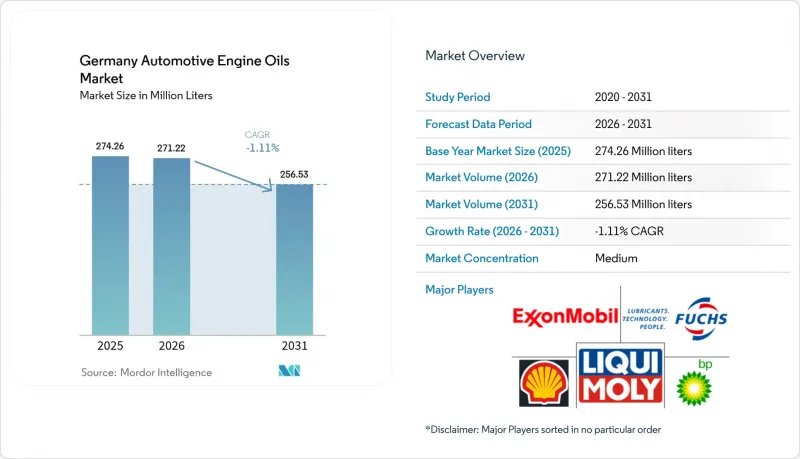
This report is Segmented by Product Type (Passenger Car Motor Oil (0W-XX, 5W-XX, 10W-XX, 15W-XX, Monogrades, and Other Grades); Heavy Duty Motor Oil (0W-XX, 5W-XX, 10W-XX, 15W-XX, Monogrades, and Other Grades); Motorcycle Engine Oil (0W-XX, 5W-XX, 10W-XX, and More) )and Base Stock (Mineral, Synthetic, Semi-Synthetic, and Bio-Based). The Market Forecasts are Provided in Terms of Volume (Litres).
Germany Automotive Engine Oils Market Trends and Insights
Euro-7 Fuel-Economy Push Accelerates Low-Viscosity Synthetic Adoption
Euro-7 tailpipe standards reduce particulate and NOx emissions, prompting OEMs to prescribe 0W-20 and even 0W-16 lubricants that minimize internal friction and meet on-road emissions verification requirements. New ACEA sequences aligned with these limits ensure that the German automotive engine oil market remains anchored to synthetic chemistries, despite a decline in unit volume. Mercedes-Benz MB 229.71 and BMW Longlife-22FE++ are now mandatory for post-2025 hybrid gasoline models, each requiring ultra-stable low-SAPS formulations. Lubricant blenders that already hold these approvals can charge a premium because replicating the testing protocol costs several million euros and takes 18 months. Euro-7 thus converts regulation into a margin growth lever inside the Germany automotive engine oils market, reinforcing a shift from selling liters to selling lifecycle performance credentials. The upside is most visible in dealership channels, where OEM-specific oils already account for more than two-thirds of synthetic PCMO throughput.
Ageing German Car Parc Lifts Maintenance and Top-Up Demand
Germany's average light-vehicle age reached 9.5 years in 2025, a full year higher than in 2020, lengthening ownership cycles and expanding aftermarket opportunities. Older engines typically experience higher blow-by and gasket seepage, which raises mid-interval top-up requirements and necessitates the use of viscosity grades such as 5W-30, which are suited to legacy Euro-5 fleets. Workshops report that cars older than eight years require an additional 0.4 liters of make-up oil between scheduled services, which partially compensates for the volume dip induced by the uptake of battery-electric vehicles. Commercial vans and rigid trucks exhibit a similar pattern, with fleet managers extending replacement timelines to hedge against uncertainty in residual value. This demography underpins steady demand in the German automotive engine oils market for high-mileage formulations featuring seal conditioners and detergency boosters. Suppliers with bundled filter-and-oil service kits have leveraged the trend, raising per-visit revenue even as visit frequency stabilizes.
EU Refinery Rationalisation Swings Base-Oil Availability and Price
Shell will repurpose its Wesseling site to focus on Group III production from late 2025, trimming Group I and tightening short-chain supply. BP is reducing Gelsenkirchen crude runs to lower carbon intensity, thereby shrinking local vacuum gas-oil streams that feed base-oil hydrotreaters. Spot Group III prices dipped in early 2025; however, smaller blenders report difficulty in locking multi-year contracts, thereby elevating supply-chain risk. Import reliance has risen to of German base-oil demand, exposing buyers to freight volatility through ARA hubs. Large integrated majors preserve margins by using internal transfer pricing, while independent lubricators face a cost pass-through lag that compresses EBITDA. Capacity shifts, therefore, act as a structural drag on the German automotive engine oils market during the forecast horizon.
Other drivers and restraints analyzed in the detailed report include:
- OEM Long-Drain Approvals Stimulate Premium Oil Upgrades
- Bio-Based and Re-Refined Oils Gain Traction Post-VerpackG 2025 Amendment
- Counterfeit Oils on Online Marketplaces Erode Brand Trust
For complete list of drivers and restraints, kindly check the Table Of Contents.
Segment Analysis
Passenger Car Motor Oil accounted for 62.35% of the German automotive engine oil market in 2025, reflecting Germany's historic car-centric mobility infrastructure and well-developed dealership maintenance network. EV uptake, led by premium brands, is starting to erode aggregate PCMO demand; yet, the sub-segment still secures a share of the German automotive engine oils market, particularly for high-temperature, turbocharged gasoline engines that require low-SAPS 0W-20 formulations. Motorcycle Engine Oil, though much smaller in volume, will post the mildest volume decline at a -0.95% CAGR because leisure riding culture, particularly in Bavaria and Baden-Wurttemberg, sustains ICE two-wheelers well into the 2030s. Heavy-duty motor oil demand remains linked to freight-corridor activity on Germany's Autobahn network, where fleet telematics favor extended-drain 10W-30 CK-4 formulations with mild HTHS retention for Euro VI diesel engines. The German automotive engine oil market, therefore, exhibits a two-speed profile: conventional PCMO grades in older sedans contract sharply, while OEM-specific synthetics for luxury hybrids capture a resilient wallet share.
Fleet managers prioritize fuel economy and downtime reduction, prompting HDMO suppliers to adopt FA-4 5W-30 blends that deliver fuel savings in long-haul operations. Meanwhile, MCO marketers utilize extended shelf-life monoesters to increase average selling prices at retail. OEM-filled hybrid models, such as the Mercedes-Benz GLC 400e, require dual-purpose formulations that control LSPI and maintain catalyzer protection, giving German integrators early-mover leverage. Across every product bracket, the German automotive engine oils market rewards chemistry capable of meeting both Euro-7 after-treatment durability and customer perception of premium brand value.
Complete Report Scope:
- By Product Type
- Passenger Car Motor Oil (PCMO)
- 0W-XX
- 5W-XX
- 10W-XX
- 15W-XX
- Monogrades
- Other Grades
- Heavy Duty Motor Oil (HDMO)
- 0W-XX
- 5W-XX
- 10W-XX
- 15W-XX
- Monogrades
- Other Grades
- Motorcycle Engine Oil (MCO)
- 0W-XX
- 5W-XX
- 10W-XX
- 15W-XX
- Monogrades
- Other Grades
- Passenger Car Motor Oil (PCMO)
- By Base Stock
- Mineral
- Synthetic
- Semi-Synthetic
- Bio-Based
List of Companies Covered in this Report:
- ADDINOL
- AVISTA OIL
- BP Plc
- Chevron Corporation
- ENI
- Exxon Mobil Corporation
- FUCHS
- LIQUI MOLY
- Lukoil
- Motul
- PETRONAS Lubricants International
- Ravensberger Schmierstoffvertrieb GmbH
- Repsol
- ROWE MINERALOLWERK GMBH
- SCT Lubricants
- Shell plc
- TotalEnergies
Additional Benefits:
- The market estimate (ME) sheet in Excel format
- 3 months of analyst support
TABLE OF CONTENTS
1 Introduction
- 1.1 Study Assumptions and Market Definition
- 1.2 Scope of the Study
2 Research Methodology
3 Executive Summary
4 Market Landscape
- 4.1 Market Overview
- 4.2 Market Drivers
- 4.2.1 Euro-7 fuel-economy push accelerates low-viscosity synthetic adoption
- 4.2.2 Ageing German car parc lifts maintenance and top-up demand
- 4.2.3 OEM long-drain approvals stimulate premium oil upgrades
- 4.2.4 Bio-based and re-refined oils gain traction post-VerpackG 2025 amendment
- 4.2.5 B2B2C e-commerce platforms reshape workshop procurement
- 4.3 Market Restraints
- 4.3.1 EU refinery rationalisation swings base-oil availability and price
- 4.3.2 2025 German Chemicals Tax lifts additive costs
- 4.3.3 Counterfeit oils on online marketplaces erode brand trust
- 4.4 Value Chain and Distribution Channel Analysis
- 4.5 Porter's Five Forces
- 4.5.1 Threat of New Entrants
- 4.5.2 Bargaining Power of Suppliers
- 4.5.3 Bargaining Power of Buyers
- 4.5.4 Threat of Substitutes
- 4.5.5 Industry Rivalry
- 4.6 Regulatory Framework
- 4.7 Automotive Industry Trends
5 Market Size and Growth Forecasts (Volume)
- 5.1 By Product Type
- 5.1.1 Passenger Car Motor Oil (PCMO)
- 5.1.1.1 0W-XX
- 5.1.1.2 5W-XX
- 5.1.1.3 10W-XX
- 5.1.1.4 15W-XX
- 5.1.1.5 Monogrades
- 5.1.1.6 Other Grades
- 5.1.2 Heavy Duty Motor Oil (HDMO)
- 5.1.2.1 0W-XX
- 5.1.2.2 5W-XX
- 5.1.2.3 10W-XX
- 5.1.2.4 15W-XX
- 5.1.2.5 Monogrades
- 5.1.2.6 Other Grades
- 5.1.3 Motorcycle Engine Oil (MCO)
- 5.1.3.1 0W-XX
- 5.1.3.2 5W-XX
- 5.1.3.3 10W-XX
- 5.1.3.4 15W-XX
- 5.1.3.5 Monogrades
- 5.1.3.6 Other Grades
- 5.1.1 Passenger Car Motor Oil (PCMO)
- 5.2 By Base Stock
- 5.2.1 Mineral
- 5.2.2 Synthetic
- 5.2.3 Semi-Synthetic
- 5.2.4 Bio-Based
6 Competitive Landscape
- 6.1 Market Concentration
- 6.2 Strategic Moves
- 6.3 Market Share (%)/Ranking Analysis
- 6.4 Company Profiles (includes Global level Overview, Market level overview, Core Segments, Financials as available, Production Capacity, Strategic Information, Market Rank/Share for key companies, Products and Services, and Recent Developments)
- 6.4.1 ADDINOL
- 6.4.2 AVISTA OIL
- 6.4.3 BP Plc
- 6.4.4 Chevron Corporation
- 6.4.5 ENI
- 6.4.6 Exxon Mobil Corporation
- 6.4.7 FUCHS
- 6.4.8 LIQUI MOLY
- 6.4.9 Lukoil
- 6.4.10 Motul
- 6.4.11 PETRONAS Lubricants International
- 6.4.12 Ravensberger Schmierstoffvertrieb GmbH
- 6.4.13 Repsol
- 6.4.14 ROWE MINERALOLWERK GMBH
- 6.4.15 SCT Lubricants
- 6.4.16 Shell plc
- 6.4.17 TotalEnergies
7 Market Opportunities and Future Outlook
- 7.1 White-space and Unmet-need Assessment
8 Key Strategic Questions for CEOs

