PUBLISHER: Mordor Intelligence | PRODUCT CODE: 2116370

PUBLISHER: Mordor Intelligence | PRODUCT CODE: 2116370
North America Automotive Engine Oils - Market Share Analysis, Industry Trends & Statistics, Growth Forecasts (2026 - 2031)
According to Mordor Intelligence, the North America automotive engine oils market size is expected to grow from 2.80 Billion Liters in 2025 to 2.79 Billion Liters in 2026 and is forecast to reach 2.73 Billion Liters by 2031 at -0.45% CAGR over 2026-2031.
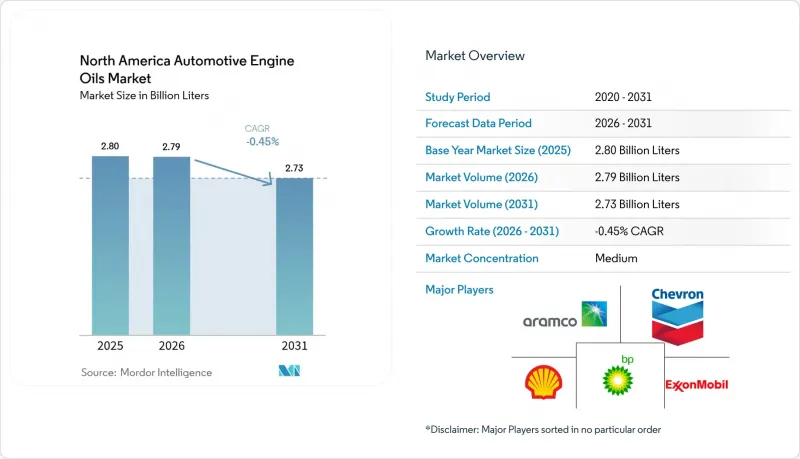
This report is Segmented by Product Type (Passenger Car Motor Oil, Heavy Duty Motor Oil, and Motorcycle Engine Oil), Base Stock (Mineral, Synthetic, Semi-Synthetic, and Bio-Based), and Geography (United States, Canada, and Mexico). The Market Forecasts are Provided in Terms of Volume (Litres).
North America Automotive Engine Oils Market Trends and Insights
Tightening CAFE and GHG Regulations Drive Premium Oil Demand
The Environmental Protection Agency's Phase 3 greenhouse-gas program compels OEMs to cut heavy-duty CO2 by roughly 50% by 2045, prompting lubricant makers to commercialize lower-viscosity PC-12 heavy-duty oils in 2026 that can unlock up to 3% fuel savings in fleet trials. Similar efficiency imperatives under ILSAC GF-7 for passenger cars are driving demand for 0W-16 and 0W-20 synthetics, which offer improved high-temperature shear stability. Field data from CITGARD tests confirm a 2.1% fuel-economy gain when fleets switch from 15W-40 to optimized 10W-30 formulations. As state and federal carbon-reduction policies converge, the regulatory cascade secures a durable premium segment, even as aggregate volumes decline. Blenders able to validate performance under the American Petroleum Institute's new durability tests are positioned to capture share.
OEM Factory-Fill Synthetic Adoption Reshapes Product Mix
North American vehicle makers are embedding synthetic specifications in factory fill to meet warranty extensions and thermal load demands in turbocharged engines. General Motors' dexos1 Gen3 specification imposes tighter sludge and LSPI limits, effectively standardizing the use of full synthetic 0W-20 or 5W-30 in new cars. In the heavy-duty sector, leading truck OEMs are now approving 10W-30 FA-4 oils, which is accelerating aftermarket acceptance. ExxonMobil forecasts 80% growth in high-value performance lubricants by 2030 and is expanding PAO output to support OEM partnerships. Synthetics command a higher price-mix even as drain intervals lengthen, cushioning revenue decline for suppliers with advanced base-stock capacity.
Accelerating BEV and Hybrid Penetration Reduces Oil Demand
Plug-in sales reached new highs in 2024, and the Department of Energy projects 55 million EVs by 2032, displacing a substantial fraction of oil consumption. Hybrids still require lubricant, but at lower volumes because engines operate intermittently and at optimized loads. State-level zero-emission mandates-California's Advanced Clean Cars II being a notable example-further compress the serviceable market. While new fluids for e-axles and thermal management emerge, fill-for-life designs and smaller sump volumes render these a fraction of traditional demand.
Other drivers and restraints analyzed in the detailed report include:
- Rising Average Vehicle Age Boosts Aftermarket Consumption
- Growing Ride-Hailing and Last-Mile Delivery Miles
- Extended OEM Drain-Interval Recommendations
For complete list of drivers and restraints, kindly check the Table Of Contents.
Segment Analysis
Passenger car motor oil currently accounts for 62.75% of the total volume, yet the adoption of electric vehicles sets the segment on a downward slope. The North America automotive engine oils market recorded its peak PCMO consumption during 2019-2024, after which volumes started to shrink as battery-only cars expanded their share. Despite that contraction, synthetics aligned with ILSAC GF-7 continue to capture market share, allowing suppliers to defend their revenue. OEM factory-fill mandates for Dexos1 Gen3 and GF-7 spark stronger pull-through at dealerships, while quick-lube chains upsell 0W-20 full synthetic oils to maintain ticket size.
Heavy-duty motor oil ranks second by liters and benefits from freight growth, even as efficiency programs temper volume. Fleet pilots have shown that switching to new FA-4 10W-30 oils can unlock fuel-economy gains of 1-4%, supporting price premiums. Over the forecast period, motorcycle engine oil is expected to slip least, with a -0.35% CAGR, owing to the growing popularity of electric motorcycles, scooters, and e-bikes. Improvements in battery life, charging infrastructure, and overall performance have made electric two-wheelers a more affordable, practical, and attractive option for consumers.
Complete Report Scope:
- By Product Type
- Passenger Car Motor Oil (PCMO)
- 0W-XX
- 5W-XX
- 10W-XX
- 15W-XX
- Monogrades
- Other Grades
- Heavy Duty Motor Oil (HDMO)
- 0W-XX
- 5W-XX
- 10W-XX
- 15W-XX
- Monogrades
- Other Grades
- Motorcycle Engine Oil (MCO)
- 0W-XX
- 5W-XX
- 10W-XX
- 15W-XX
- Monogrades
- Other Grades
- Passenger Car Motor Oil (PCMO)
- By Base Stock
- Mineral
- Synthetic
- Semi-Synthetic
- Bio-Based
- By Geography
- United States
- Canada
- Mexico
List of Companies Covered in this Report:
- AMSOIL INC.
- BP plc
- Chevron Corporation
- CITGO Petroleum Lubricants
- Exxon Mobil Corporation
- FUCHS
- HollyFrontier (Petro-Canada Lubricants)
- Idemitsu Lubricants America
- Kendall Motor Oil
- LIQUI MOLY
- Lucas Oil Products, Inc.
- Motul
- Phillips 66 Lubricants
- Shell plc
- TotalEnergies
- Saudi Arabian Oil Co.
Additional Benefits:
- The market estimate (ME) sheet in Excel format
- 3 months of analyst support
TABLE OF CONTENTS
1 Introduction
- 1.1 Study Assumptions and Market Definition
- 1.2 Scope of the Study
2 Research Methodology
3 Executive Summary
4 Market Landscape
- 4.1 Market Overview
- 4.2 Market Drivers
- 4.2.1 Tightening CAFE and GHG regulations driving demand for low-viscosity, high-performance oils
- 4.2.2 OEM factory-fill shift toward synthetics and 0W-XX grades
- 4.2.3 Rising average vehicle age boosting aftermarket oil consumption
- 4.2.4 Growing ride-hailing and last-mile delivery fleet miles
- 4.2.5 ESG-driven uptake of re-refined base-oil blends
- 4.3 Market Restraints
- 4.3.1 Accelerating BEV and hybrid penetration lowering oil demand
- 4.3.2 Extended OEM drain-interval recommendations
- 4.3.3 Supply-chain pressure on API Group III/IV base stocks
- 4.4 Value Chain and Distribution Channel Analysis
- 4.5 Porter's Five Forces
- 4.5.1 Threat of New Entrants
- 4.5.2 Bargaining Power of Suppliers
- 4.5.3 Bargaining Power of Buyers
- 4.5.4 Threat of Substitutes
- 4.5.5 Industry Rivalry
- 4.6 Regulatory Framework
- 4.7 Automotive Industry Trends
5 Market Size and Growth Forecasts (Volume)
- 5.1 By Product Type
- 5.1.1 Passenger Car Motor Oil (PCMO)
- 5.1.1.1 0W-XX
- 5.1.1.2 5W-XX
- 5.1.1.3 10W-XX
- 5.1.1.4 15W-XX
- 5.1.1.5 Monogrades
- 5.1.1.6 Other Grades
- 5.1.2 Heavy Duty Motor Oil (HDMO)
- 5.1.2.1 0W-XX
- 5.1.2.2 5W-XX
- 5.1.2.3 10W-XX
- 5.1.2.4 15W-XX
- 5.1.2.5 Monogrades
- 5.1.2.6 Other Grades
- 5.1.3 Motorcycle Engine Oil (MCO)
- 5.1.3.1 0W-XX
- 5.1.3.2 5W-XX
- 5.1.3.3 10W-XX
- 5.1.3.4 15W-XX
- 5.1.3.5 Monogrades
- 5.1.3.6 Other Grades
- 5.1.1 Passenger Car Motor Oil (PCMO)
- 5.2 By Base Stock
- 5.2.1 Mineral
- 5.2.2 Synthetic
- 5.2.3 Semi-Synthetic
- 5.2.4 Bio-Based
- 5.3 By Geography
- 5.3.1 United States
- 5.3.2 Canada
- 5.3.3 Mexico
6 Competitive Landscape
- 6.1 Market Concentration
- 6.2 Strategic Moves
- 6.3 Market Share (%)**/Ranking Analysis
- 6.4 Company Profiles (includes Global level Overview, Market level overview, Core Segments, Financials as available, Production Capacity, Strategic Information, Market Rank/Share for key companies, Products and Services, and Recent Developments)
- 6.4.1 AMSOIL INC.
- 6.4.2 BP plc
- 6.4.3 Chevron Corporation
- 6.4.4 CITGO Petroleum Lubricants
- 6.4.5 Exxon Mobil Corporation
- 6.4.6 FUCHS
- 6.4.7 HollyFrontier (Petro-Canada Lubricants)
- 6.4.8 Idemitsu Lubricants America
- 6.4.9 Kendall Motor Oil
- 6.4.10 LIQUI MOLY
- 6.4.11 Lucas Oil Products, Inc.
- 6.4.12 Motul
- 6.4.13 Phillips 66 Lubricants
- 6.4.14 Shell plc
- 6.4.15 TotalEnergies
- 6.4.16 Saudi Arabian Oil Co.
7 Market Opportunities and Future Outlook
- 7.1 White-space and Unmet-need Assessment
8 Key Strategic Questions for CEOs

