PUBLISHER: Mordor Intelligence | PRODUCT CODE: 2116689

PUBLISHER: Mordor Intelligence | PRODUCT CODE: 2116689
United Kingdom Magnetic Resonance Imaging - Market Share Analysis, Industry Trends & Statistics, Growth Forecasts (2026 - 2031)
According to Mordor Intelligence, the United Kingdom magnetic resonance imaging market size was valued at USD 2.53 billion in 2025 and estimated to grow from USD 2.66 billion in 2026 to reach USD 3.43 billion by 2031, at a CAGR of 5.23% during the forecast period (2026-2031).
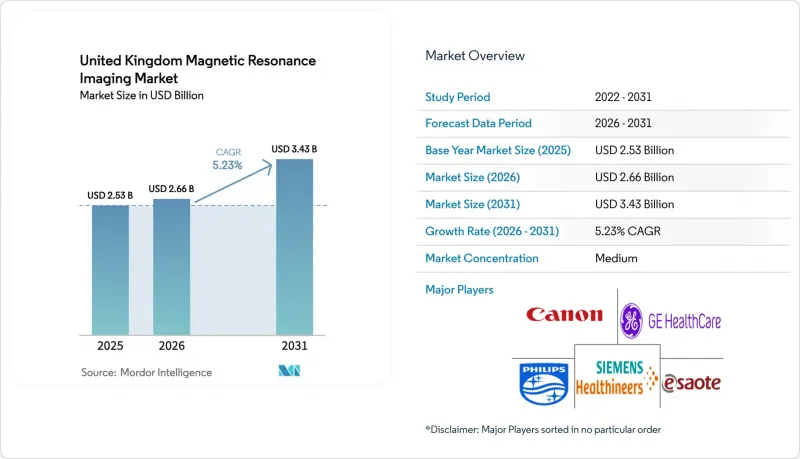
This report is Segmented by Architecture (Closed MRI Systems and Open MRI Systems), Field Strength (Low-Field <=0. 55T, Mid/High-Field 1. 5T, Very-High-Field 3T, and Ultra-High-Field 7T+), Application (Neurology, Oncology, Musculoskeletal, Cardiology, Gastroenterology, and Other Applications). The Market Forecasts are Provided in Terms of Value (USD).
United Kingdom Magnetic Resonance Imaging Market Trends and Insights
Rising Prevalence of Chronic and Age-Related Diseases
The proportion of U.K. residents aged 65 years and older reached 19% in 2024 and is projected to climb to 22% by 2030, sharply increasing the incidence of neurodegenerative and musculoskeletal disorders that require advanced MRI diagnostics. MRI procedure volumes already exceed 4.3 million annually, and longitudinal NHS data show double-digit growth in dementia-related scans across northern England and Scotland. High-resolution 3 T systems provide the superior contrast needed for early Alzheimer's and Parkinson's detection, which shortens diagnostic odysseys and reduces downstream healthcare costs. Ultra-high-field research at the University of Cambridge demonstrates lesion-level sensitivity improvements that could translate into routine clinical protocols over the forecast period. The linkage between demographic change and escalating neurological morbidity therefore places MRI at the center of age-friendly health-system planning. Vendor strategies that bundle geriatric-focused imaging protocols with AI-enriched post-processing are likely to secure procurement preference as trusts compete to meet government wait-time targets.
Rapid Adoption of 3 T Scanners Across NHS Estates
Centralized buying consortia now award multi-year lots for 3 T platforms, evidenced by recent installations at Imperial College Healthcare and University Hospital Southampton, both of which reported 20% reductions in repeat scans after commissioning higher field strengths. These outcomes validate the NHS assumption that superior signal-to-noise ratios reduce indeterminate findings that would otherwise trigger follow-up appointments. Capital risk is mitigated by framework contracts that lock in service pricing for up to 12 years, enabling trusts to amortize premium scanners over predictable budgets. By embedding AI-assisted protocols such as Siemens Deep Resolve, hospitals have shown throughput gains of up to 50%, directly addressing an average national MRI wait of 23 days NHS.UK. Vendors offering field-upgrade paths-for example, from 1.5 T to 3 T-are expected to capture incremental share because the strategy preserves legacy infrastructure investments while boosting diagnostic breadth.
High Upfront and Lifecycle Costs of MRI Equipment
Even with framework discounts, a new 3 T scanner and room build-out can exceed USD 3.5 million, stretching the capital envelopes of smaller district hospitals. Lifecycle economics further deteriorate when helium prices spike, as evidenced by Oxford Instruments' disclosure that cryogen costs eroded its MRI service margins in 2024. Infrastructure retrofits-RF shielding, chiller upgrades, and cable rerouting-often add 35% to total spend, forcing trusts to defer replacements beyond the manufacturer's recommended 10-year timeline. A secondary-market ecosystem has therefore emerged, offering certified refurbished 1.5 T systems at one-third the new-build price, although guarantees of uptime and software updates remain contentious.
Other drivers and restraints analyzed in the detailed report include:
- AI-Driven Image Reconstruction and Workflow Optimization
- Growth of Point-of-Care Low-Field MRI Pilots in Community Settings
- Stringent UKCA/CE Regulatory and HTA Approval Processes
For complete list of drivers and restraints, kindly check the Table Of Contents.
Segment Analysis
Closed-bore systems generated USD 1.39 billion in 2025, equal to 55.12% of the United Kingdom magnetic resonance imaging market, owing to their superior magnetic homogeneity that supports functional brain mapping, spectroscopy, and time-resolved cardiac imaging. Institution-level evidence shows that closed platforms reduce motion artifacts in pediatric sedation cases, a critical KPI for trusts that benchmark image-repeat rates. Though the initial purchase price is higher, refurbishment cycles reveal that closed systems retain residual value 25% above open counterparts, which influences leasing strategies. In mobile deployments, logistical trade-offs around weight and cooling are increasingly offset by diagnostic versatility and patient throughput, leading mobile fleet operators to favor closed 1.5 T units over lighter, open low-field alternatives.
Open designs, typically operating at 0.3-0.5 T, captured USD 1.14 billion in 2025 and are projected to grow at a 6.88% CAGR until 2031, the fastest of any architecture category. The growth rate stems from patient-centric factors such as claustrophobia mitigation and bariatric accommodation, which win favor in community hospitals and imaging centers that compete on comfort scores. AI-based denoising is narrowing the image-quality gap with closed systems, expanding the clinical indications suitable for open magnets beyond simple orthopedic scans. As the U.K. health-service strategy pivots toward community-based diagnostics hubs, open platforms will likely see pilot funding, yet their absolute market share gain remains capped by limitations in advanced neuro and cardiac protocols.
Complete Report Scope:
- By Architecture
- Closed MRI Systems
- Open MRI Systems
- By Field Strength
- Low-Field (<=0.55 T)
- Mid/High-Field (1.5 T)
- Very-High-Field (3 T)
- Ultra-High-Field (7 T +)
- By Application
- Neurology
- Oncology
- Musculoskeletal
- Cardiology
- Gastroenterology
- Other Applications
List of Companies Covered in this Report:
- Aspect Imaging
- Aurora Imaging Technology
- Canon
- Esaote
- FUJIFILM
- GE Healthcare
- Hitachi Healthcare
- Hyperfine
- Koninklijke Philips
- MR Solutions Group
- Neusoft Medical Systems
- Oxford Instruments
- Paramed Medical Systems
- Mindray
- Siemens Healthineers
- Tesla Engineering Ltd.
- Time Medical Systems
- United Imaging Healthcare
Additional Benefits:
- The market estimate (ME) sheet in Excel format
- 3 months of analyst support
TABLE OF CONTENTS
1 Introduction
- 1.1 Study Assumptions & Market Definition
- 1.2 Scope of the Study
2 Research Methodology
3 Executive Summary
4 Market Landscape
- 4.1 Market Overview
- 4.2 Market Drivers
- 4.2.1 Rising Prevalence of Chronic and Age-Related Diseases
- 4.2.2 Rapid Adoption of 3 T Scanners Across NHS Estates
- 4.2.3 AI-Driven Image-Reconstruction & Workflow Optimisation
- 4.2.4 Growth of Point-of-Care Low-Field MRI Pilots in Community Settings
- 4.2.5 Expansion of Intra-Operative MRI Suites for Neuro-Oncology Surgery
- 4.2.6 NHS Imaging Networks' Centralised Procurement Driving Fleet Standardisation
- 4.3 Market Restraints
- 4.3.1 High Upfront and Lifecycle Costs of MRI Equipment
- 4.3.2 Stringent UKCA/CE Regulatory and HTA Approval Processes
- 4.3.3 Shortage of Radiographers & MR-Qualified Physicists
- 4.3.4 Volatile Global Helium Supply Affecting Uptime
- 4.4 Value / Supply-Chain Analysis
- 4.5 Regulatory Landscape
- 4.6 Technological Outlook
- 4.7 Porter's Five Forces Analysis
- 4.7.1 Bargaining Power of Buyers
- 4.7.2 Bargaining Power of Suppliers
- 4.7.3 Threat of New Entrants
- 4.7.4 Threat of Substitute Products
- 4.7.5 Intensity of Competitive Rivalry
5 Market Size & Growth Forecasts (Value, USD)
- 5.1 By Architecture
- 5.1.1 Closed MRI Systems
- 5.1.2 Open MRI Systems
- 5.2 By Field Strength
- 5.2.1 Low-Field (<=0.55 T)
- 5.2.2 Mid/High-Field (1.5 T)
- 5.2.3 Very-High-Field (3 T)
- 5.2.4 Ultra-High-Field (7 T +)
- 5.3 By Application
- 5.3.1 Neurology
- 5.3.2 Oncology
- 5.3.3 Musculoskeletal
- 5.3.4 Cardiology
- 5.3.5 Gastroenterology
- 5.3.6 Other Applications
6 Competitive Landscape
- 6.1 Market Concentration
- 6.2 Market Share Analysis
- 6.3 Company Profiles (includes Global level Overview, Market level overview, Core Segments, Financials as available, Strategic Information, Market Rank/Share for key companies, Products & Services, Recent Developments)
- 6.3.1 Aspect Imaging
- 6.3.2 Aurora Imaging Technology
- 6.3.3 Canon Medical Systems
- 6.3.4 Esaote SpA
- 6.3.5 Fujifilm Healthcare
- 6.3.6 GE Healthcare
- 6.3.7 Hitachi Healthcare
- 6.3.8 Hyperfine Inc.
- 6.3.9 Koninklijke Philips N.V.
- 6.3.10 MR Solutions Group
- 6.3.11 Neusoft Medical Systems
- 6.3.12 Oxford Instruments plc
- 6.3.13 Paramed Medical Systems
- 6.3.14 Shenzhen Mindray Bio-Medical Electronics
- 6.3.15 Siemens Healthineers
- 6.3.16 Tesla Engineering Ltd.
- 6.3.17 Time Medical Systems
- 6.3.18 United Imaging Healthcare
7 Market Opportunities & Future Outlook
- 7.1 White-space & Unmet-Need Assessment

