PUBLISHER: Mordor Intelligence | PRODUCT CODE: 2116697

PUBLISHER: Mordor Intelligence | PRODUCT CODE: 2116697
Spain Magnetic Resonance Imaging - Market Share Analysis, Industry Trends & Statistics, Growth Forecasts (2026 - 2031)
According to Mordor Intelligence, the Spain magnetic resonance imaging market size in 2026 is estimated at USD 230.11 million, growing from 2025 value of USD 219.74 million with 2031 projections showing USD 289.86 million, growing at 4.72% CAGR over 2026-2031.
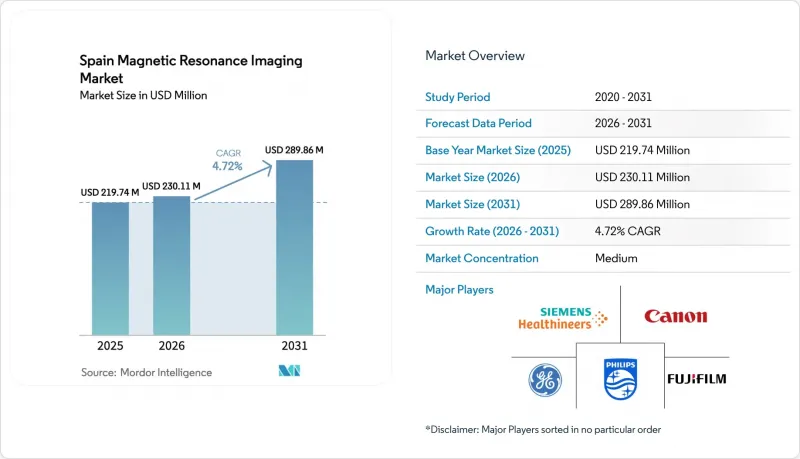
This report is Segmented by Architecture (Closed MRI Systems and Open MRI Systems), Field Strength (Low-Field <=0. 55T, Mid/High-Field 1. 5T, Very-High-Field 3T, and Ultra-High-Field 7T+), Application (Neurology, Oncology, Musculoskeletal, Cardiology, Gastroenterology, and Other Applications). The Market Forecasts are Provided in Terms of Value (USD).
Spain Magnetic Resonance Imaging Market Trends and Insights
Rising Burden of Chronic & Degenerative Diseases
Cancer incidence reached 287,000 new cases in 2024 and sits alongside cardiovascular mortality of 28.3%, creating a dual-pathway surge in MRI referrals that solidifies the Spain Magnetic Resonance Imaging market as an essential diagnostic backbone. Compounded multimorbidity means many cancer survivors now require routine cardiac follow-up, further lifting scan volumes. Dementia prevalence is projected to triple by 2050 as the over-65 cohort grows from 20.1% to 31.4%, magnifying demand for diffusion tensor and functional MRI sequences that depend on high-field stability. Spain's public-health expenditure of EUR 108.3 billion (USD 115.2 billion) in 2022 underscores fiscal headroom to absorb the added volume. The combined disease trajectory therefore contributes a 1.8 percentage-point uplift to forecast growth, ensuring the Spain Magnetic Resonance Imaging market retains long-term momentum.
Government INVEAT Program Renewing Obsolete Scanners
INVEAT allocated EUR 796 million (USD 846.7 million) and procured 144 scanners during 2024, cutting the average public-hospital magnet age from 18 to 10 years. New platforms embed AI engines that elevate daily throughput by up to 30%, alleviating radiologist shortages without proportionate head-count growth. Follow-on AMAT-I framework funds worth EUR 86 million (USD 91.5 million) cement a multiyear replacement cadence that penetrates rural regions where equipment had surpassed end-of-life thresholds. The program adds 1.2 percentage points to the Spain Magnetic Resonance Imaging market CAGR through predictable tender volumes and standardized technical specifications that shorten procurement cycles.
High Purchase & Lifecycle Costs
A helium-cooled 1.5 Tesla unit costs EUR 2-4 million (USD 2.1-4.3 million) and demands annual service fees equal to 10% of acquisition price. Helium spot prices have risen 300% since 2020, inflating operating budgets and prompting interest in magnet-free refrigeration. Budget disparities compound the strain, with Andalusia spending EUR 1,200 per capita on health versus EUR 1,800 in the Basque Country, delaying scanner refresh cycles outside Spain's wealthiest regions. Rural hospitals serving fewer than 50,000 residents often post utilization below 50%, rendering traditional ownership models uneconomic and stalling deployment, subtracting 0.8 percentage points from the Spain Magnetic Resonance Imaging market CAGR.
Other drivers and restraints analyzed in the detailed report include:
- AI-Enhanced High-Field Scanners Improve Throughput & Image Quality
- Expansion of Private Imaging Centers Amid Long Public Waiting Lists
- Stringent EU-MDR / AEMPS Approvals & Post-Market Vigilance
For complete list of drivers and restraints, kindly check the Table Of Contents.
Segment Analysis
Closed scanners captured a commanding 54.78% share of the Spain Magnetic Resonance Imaging market in 2025, driven by superior signal-to-noise performance that underpins complex neuro and cardiac applications. Public hospitals rely on enclosed bores to meet high throughput targets, and these sites represent 78% of closed-system placements nationwide. The Spain Magnetic Resonance Imaging market size tied to closed scanners equaled USD 120.32 million in 2025, underscoring their revenue weight. Open platforms, however, are advancing at a 6.41% CAGR as private centers target claustrophobic and pediatric cohorts, banking on wider bores and interventional flexibility to enhance patient satisfaction. GE's wide-bore SIGNA(TM) Creator and similar systems blur the comfort-performance trade-off, positioning the open category to win incremental volume. Manufacturers couple open geometries with AI-based motion correction to narrow historical image-quality gaps, a shift likely to recalibrate procurement criteria within private-hospital chains.
Ownership economics also diverge. Open magnets priced below EUR 1.5 million (USD 1.6 million) entice outpatient franchises whose cash-purchase cycles differ from public tenders. Still, EU-MDR evidence requirements favor closed systems with deep clinical datasets, tempering open-system traction in teaching hospitals. Over the forecast horizon the Spain Magnetic Resonance Imaging market is expected to show closed-system revenue climbing steadily at 4.05% CAGR, while open-system revenue will outpace at 6.41%, gradually lifting its contribution from 45.22% in 2025 to nearly 47.95% by 2031.
Complete Report Scope:
- By Architecture
- Closed MRI Systems
- Open MRI Systems
- By Field Strength
- Low-Field (<=0.55 T)
- Mid/High-Field (1.5 T)
- Very-High-Field (3 T)
- Ultra-High-Field (7 T +)
- By Application
- Neurology
- Oncology
- Musculoskeletal
- Cardiology
- Gastroenterology
- Other Applications
List of Companies Covered in this Report:
- AGFA-Gevaert Group
- AllTech Medical Systems
- Aspect Imaging
- Bruker Corp.
- Canon
- Esaote S.p.A.
- Fonar Corp.
- FUJIFILM Holdings Corp.
- GE Healthcare
- Hitachi Ltd. (Hitachi MR)
- Hyperfine
- Koninklijke Philips
- Mindray Bio-Medical
- Samsung Group
- Siemens Healthineers
- Synaptive Medical
- United Imaging Healthcare
Additional Benefits:
- The market estimate (ME) sheet in Excel format
- 3 months of analyst support
TABLE OF CONTENTS
1 Introduction
- 1.1 Study Assumptions & Market Definition
- 1.2 Scope of the Study
2 Research Methodology
3 Executive Summary
4 Market Landscape
- 4.1 Market Overview
- 4.2 Market Drivers
- 4.2.1 Rising Burden of Chronic & Degenerative Diseases
- 4.2.2 Government INVEAT Program Renewing Obsolete Scanners
- 4.2.3 AI-Enhanced High-Field Scanners Improve Throughput & Image Quality
- 4.2.4 Expansion of Private Imaging Centres Amid Long Public Waiting Lists
- 4.2.5 EU-Funded Portable/Low-Field MRI Prototypes (Nextmri)
- 4.2.6 Sustainability Push for Helium-Free 0.55 T Systems
- 4.3 Market Restraints
- 4.3.1 High Purchase & Lifecycle Costs
- 4.3.2 Stringent EU-MDR / AEMPS Approvals & Post-Market Vigilance
- 4.3.3 Radiologist Workforce Shortages Slow Scan Throughput
- 4.3.4 Over-Diagnosis Backlash from Incidental Findings
- 4.4 Value / Supply-Chain Analysis
- 4.5 Regulatory Landscape
- 4.6 Technological Outlook
- 4.7 Porter's Five Forces Analysis
- 4.7.1 Threat of New Entrants
- 4.7.2 Bargaining Power of Buyers
- 4.7.3 Bargaining Power of Suppliers
- 4.7.4 Threat of Substitutes
- 4.7.5 Intensity of Rivalry
5 Market Size & Growth Forecasts (Value, USD)
- 5.1 By Architecture
- 5.1.1 Closed MRI Systems
- 5.1.2 Open MRI Systems
- 5.2 By Field Strength
- 5.2.1 Low-Field (<=0.55 T)
- 5.2.2 Mid/High-Field (1.5 T)
- 5.2.3 Very-High-Field (3 T)
- 5.2.4 Ultra-High-Field (7 T +)
- 5.3 By Application
- 5.3.1 Neurology
- 5.3.2 Oncology
- 5.3.3 Musculoskeletal
- 5.3.4 Cardiology
- 5.3.5 Gastroenterology
- 5.3.6 Other Applications
6 Competitive Landscape
- 6.1 Market Concentration
- 6.2 Market Share Analysis
- 6.3 Company Profiles (includes Global level Overview, Market level overview, Core Segments, Financials as available, Strategic Information, Market Rank/Share for key companies, Products & Services, Recent Developments)
- 6.3.1 AGFA-Gevaert Group
- 6.3.2 AllTech Medical Systems
- 6.3.3 Aspect Imaging
- 6.3.4 Bruker Corp.
- 6.3.5 Canon Medical Systems Corp.
- 6.3.6 Esaote S.p.A.
- 6.3.7 Fonar Corp.
- 6.3.8 FUJIFILM Holdings Corp.
- 6.3.9 GE HealthCare
- 6.3.10 Hitachi Ltd. (Hitachi MR)
- 6.3.11 Hyperfine Inc.
- 6.3.12 Koninklijke Philips N.V.
- 6.3.13 Mindray Bio-Medical
- 6.3.14 Samsung Medison
- 6.3.15 Siemens Healthineers
- 6.3.16 Synaptive Medical
- 6.3.17 United Imaging Healthcare
7 Market Opportunities & Future Outlook
- 7.1 White-space & Unmet-Need Assessment

