PUBLISHER: Mordor Intelligence | PRODUCT CODE: 2116734

PUBLISHER: Mordor Intelligence | PRODUCT CODE: 2116734
US Magnetic Resonance Imaging - Market Share Analysis, Industry Trends & Statistics, Growth Forecasts (2026 - 2031)
According to Mordor Intelligence, US MRI market size in 2026 is estimated at USD 3.83 billion, growing from 2025 value of USD 3.62 billion with 2031 projections showing USD 5.1 billion, growing at 5.88% CAGR over 2026-2031.
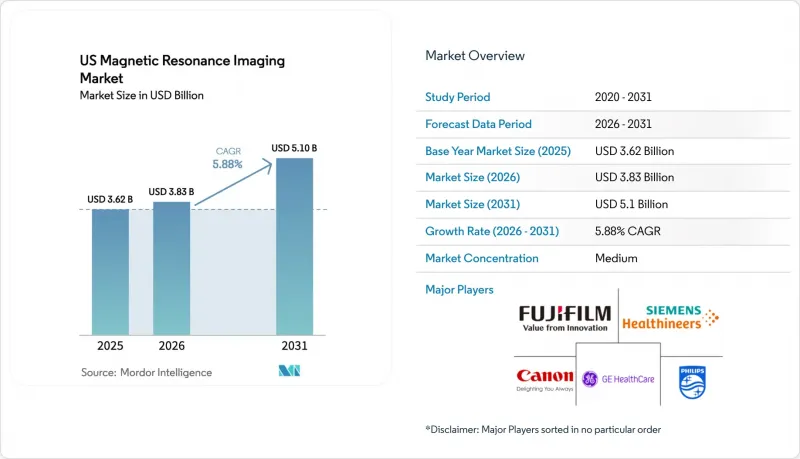
This report Segments the Industry Into Architecture (Closed MRI Systems, Open MRI Systems), Field Strength (Low Field MRI Systems, High Field MRI Systems, Very High Field MRI Systems and Ultra-High MRI Systems), and Application (Oncology, Neurology, Cardiology, Gastroenterology, Musculoskeletal, Other Applications). The Report Features Historical Data and Five-Year Forecasts.
US Magnetic Resonance Imaging Market Trends and Insights
Rising Global Burden of Chronic and Age-Related Diseases
Seventy-six point four percent of US adults reported at least one chronic condition in 2025, a pattern that translates into sustained MRI utilization for neurological, oncological, and cardiac evaluations. Providers favor the modality's soft-tissue contrast to diagnose Alzheimer's, multiple sclerosis, and ischemic stroke, where early detection improves therapeutic outcomes. FDA clearance for GE HealthCare's head-only SIGNA MAGNUS 3.0 T platform exemplifies industry response, delivering specialized neuro-imaging in shorter sessions . The same demographic shift accelerates oncology imaging because precision medicine protocols rely on repeat, high-resolution tumor mapping. Collectively, the chronic disease burden adds a 1.8-percentage-point lift to long-term market growth.
Increasing Reimbursement Coverage and Government Support for High-Value Imaging Modalities
CMS finalized a 5.06% rate hike for Medicare Advantage plans in 2026, releasing more than USD 25 billion in extra funding that will flow into diagnostic imaging volumes . Administrative relief also arrived when CMS removed the lumbar-spine MRI measure from quality reporting, easing provider workflow. Commercial payers follow suit by steering patients to cost-efficient outpatient centers, which often invest in new scanners to win network contracts. These moves collectively add 1.2-percentage-points to medium-term growth while reducing historical revenue volatility tied to fee-schedule cuts.
High Cost of MRI Systems
A high-field scanner typically costs more than USD 225,000 and demands expensive site prep that includes RF shielding and cryogenic cooling . Rural hospitals already under fiscal strain defer such purchases, contributing to more than 100 facility closures since 2010 that removed imaging access for nearly one-fifth of rural residents. Technology is starting to blunt the barrier: ultra-low-field hardware priced near USD 22,000 eliminates helium, while Philips BlueSeal magnets save 5 million liters of helium and 40 MWh of energy per system since 2018. Even as acquisition costs erode, price remains a drag of 0.8-percentage-points on long-term growth.
Other drivers and restraints analyzed in the detailed report include:
- Technological Breakthroughs in MRI
- Steady Growth in Healthcare Spending and Modernization of Hospital & Outpatient Imaging Infrastructure Worldwide
- Shortage of Certified MRI Technologists
For complete list of drivers and restraints, kindly check the Table Of Contents.
Segment Analysis
Closed units held 77.62% of the US MRI market in 2025, confirming the modality's reliance on full-body, high-field imaging for complex neuro and oncology cases. The canonical wide-bore 70 cm format eases patient anxiety without compromising gradient performance, a mix ideal for community hospitals that require versatility. Extremity-specific magnets cater to orthopedic clinics, yet their impact on total revenue remains modest. Portable systems contribute the fastest growth at 6.31% CAGR through 2031 as emergency departments, intensive-care units, and rural sites seek point-of-care diagnostic options. Hyperfine's FDA-cleared Swoop employs NVIDIA AI to improve brain image quality and demonstrates a mobile install footprint the size of a ventilator cart. Open magnets retain relevance for claustrophobic or bariatric patients, though their lower field strength limits nuanced neurovascular work compared with closed 1.5 T or 3 T designs.
Portable MRI's rise intersects with value-based care goals because bedside imaging avoids costly patient transport and lowers sedation risk. Yet reimbursement codes still favor conventional rooms, so adoption concentrates within academic centers able to fund pilots. Vendors now bundle financing and AI software to convert pilot orders into fleet rollouts, a tactic reflecting broader competition on total cost of ownership rather than sticker price. Hospitals that replace aging 1.5 T scanners often opt for helium-free magnets to hedge against commodity volatility, a choice that further cements closed architecture leadership while portable units carve new revenue streams in non-traditional settings.
Complete Report Scope:
- By Architecture
- Closed MRI Systems
- Open MRI Systems
- Wide-Bore MRI Systems
- Extremity MRI Systems
- By Field Strength
- Low Field MRI Systems (<=0.3 T)
- Mid Field MRI Systems (0.3 T-1.0 T)
- High Field MRI Systems (1.5 T)
- Very-High Field MRI Systems (3 T)
- Ultra-High Field MRI Systems (>=7 T)
- By Application
- Oncology
- Neurology
- Cardiology
- Gastroenterology
- Musculoskeletal
- Other Applications
List of Companies Covered in this Report:
- GE Healthcare
- Siemens Healthineers
- Koninklijke Philips
- Canon Inc. (Canon Medical Systems)
- Fujifilm Holdings Corp. (incl. Hitachi MRI)
- United Imaging Healthcare
- Shenzhen Anke High-Tech
- Esaote
- Neusoft Medical Systems Co.
- Aurora Imaging Technology
- Fonar Corp.
- Hyperfine, Inc.
- Bruker Corp.
- Imris (Deerfield Imaging)
- Aspect Imaging
- Paramed Medical Systems
- Medtronic plc (MRI-guided surgical systems)
- Insightec Ltd. (MRI-guided focused ultrasound)
- Hitachi Ltd. (legacy installed base)
- Synaptive Medical
- Time Medical Systems
Additional Benefits:
- The market estimate (ME) sheet in Excel format
- 3 months of analyst support
TABLE OF CONTENTS
1 Introduction
- 1.1 Study Assumptions & Market Definition
- 1.2 Scope of the Study
2 Research Methodology
3 Executive Summary
4 Market Landscape
- 4.1 Market Overview
- 4.2 Market Drivers
- 4.2.1 Rising global burden of chronic and age-related diseases
- 4.2.2 Increasing reimbursement coverage and government support for high-value imaging modalities
- 4.2.3 Technological breakthroughs in MRI
- 4.2.4 Steady growth in healthcare spending and modernization of hospital & outpatient imaging infrastructure worldwide
- 4.2.5 Expanding clinical indications for MRI
- 4.2.6 Shift toward patient-centric, non-ionizing diagnostic alternatives
- 4.3 Market Restraints
- 4.3.1 High cost of MRI systems
- 4.3.2 Shortage of Certified MRI Technologists
- 4.3.3 Declining reimbursement rates for advanced imaging
- 4.3.4 Safety and compatibility concerns for patients
- 4.4 Value / Supply-Chain Analysis
- 4.5 Regulatory Landscape
- 4.6 Technological Outlook
- 4.7 Porter's Five Forces Analysis
- 4.7.1 Bargaining Power of Suppliers
- 4.7.2 Bargaining Power of Buyers/Consumers
- 4.7.3 Threat of New Entrants
- 4.7.4 Threat of Substitute Products
- 4.7.5 Intensity of Competitive Rivalry
5 Market Size & Growth Forecasts (Value, USD)
- 5.1 By Architecture
- 5.1.1 Closed MRI Systems
- 5.1.2 Open MRI Systems
- 5.1.3 Wide-Bore MRI Systems
- 5.1.4 Extremity MRI Systems
- 5.2 By Field Strength
- 5.2.1 Low Field MRI Systems (<=0.3 T)
- 5.2.2 Mid Field MRI Systems (0.3 T-1.0 T)
- 5.2.3 High Field MRI Systems (1.5 T)
- 5.2.4 Very-High Field MRI Systems (3 T)
- 5.2.5 Ultra-High Field MRI Systems (>=7 T)
- 5.3 By Application
- 5.3.1 Oncology
- 5.3.2 Neurology
- 5.3.3 Cardiology
- 5.3.4 Gastroenterology
- 5.3.5 Musculoskeletal
- 5.3.6 Other Applications
6 Competitive Landscape
- 6.1 Market Concentration
- 6.2 Market Share Analysis
- 6.3 Company profiles (includes Global level Overview, Market level overview, Core Business Segments, Financials, Headcount, Key Information, Market Rank, Market Share, Products and Services, and analysis of Recent Developments)
- 6.3.1 GE HealthCare
- 6.3.2 Siemens Healthineers
- 6.3.3 Koninklijke Philips N.V.
- 6.3.4 Canon Inc. (Canon Medical Systems)
- 6.3.5 Fujifilm Holdings Corp. (incl. Hitachi MRI)
- 6.3.6 United Imaging Healthcare
- 6.3.7 Shenzhen Anke High-Tech Co.
- 6.3.8 Esaote SpA
- 6.3.9 Neusoft Medical Systems Co.
- 6.3.10 Aurora Imaging Technology
- 6.3.11 Fonar Corp.
- 6.3.12 Hyperfine, Inc.
- 6.3.13 Bruker Corp.
- 6.3.14 Imris (Deerfield Imaging)
- 6.3.15 Aspect Imaging
- 6.3.16 Paramed Medical Systems
- 6.3.17 Medtronic plc (MRI-guided surgical systems)
- 6.3.18 Insightec Ltd. (MRI-guided focused ultrasound)
- 6.3.19 Hitachi Ltd. (legacy installed base)
- 6.3.20 Synaptive Medical
- 6.3.21 Time Medical Systems
7 Market Opportunities & Future Outlook
- 7.1 White-space & Unmet-need Assessment

