PUBLISHER: Mordor Intelligence | PRODUCT CODE: 2113568

PUBLISHER: Mordor Intelligence | PRODUCT CODE: 2113568
Southeast Asia Oil And Gas Upstream - Market Share Analysis, Industry Trends & Statistics, Growth Forecasts (2026 - 2031)
According to Mordor Intelligence, the southeast asia oil and gas upstream market size was valued at USD 28.47 billion in 2025 and estimated to grow from USD 30.02 billion in 2026 to reach USD 39.16 billion by 2031, at a CAGR of 5.45% during the forecast period (2026-2031).
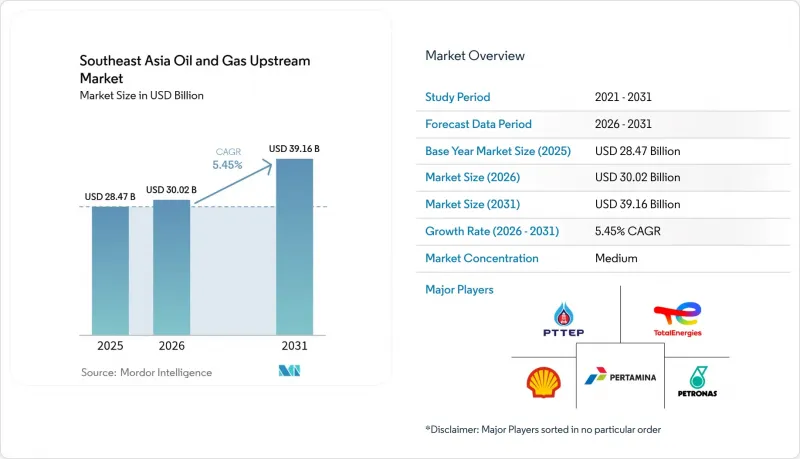
This report is Segmented by Location of Deployment (Onshore and Offshore), Resource Type (Crude Oil and Natural Gas), Well Type (Conventional and Unconventional), Service (Exploration, Development and Production, and Decommissioning), and Geography (Indonesia, Malaysia, Thailand, Vietnam, Philippines, Singapore, Myanmar, and Rest of Southeast Asia).
Southeast Asia Oil And Gas Upstream Market Trends and Insights
Surging Regional Gas Demand for Power & Industry
Natural gas consumption across the power and industrial sectors is forecast to reach 210 billion m3 by 2030, a 45% increase over current levels. Indonesia's PLN plans 20.9 GW of new gas-fired capacity, and Malaysia's market reforms treat gas as the preferred balancing fuel for solar and wind integration. Petrochemical expansions in Thailand and Singapore will lift feedstock needs, ensuring multi-decade demand visibility. This structural call on gas underpins aggressive upstream sanctioning of high-CO2 reservoirs that embed carbon-capture modules. Consequently, operators secure long-term sales contracts before first gas, de-risking multibillion-dollar investments and supporting the Southeast Asia oil and gas upstream market.
Deep-Water Gas Discoveries & Planned FIDs
Indonesia's Geng North (2.5 TCF) and Malaysia's Kasawari (3.3 TCF) rank among the world's most consequential deep-water finds, located in waters exceeding 1,500 m depth. BP's USD 7 billion Tangguh Ubadari sanction and Vietnam's Block B commitment illustrate investor confidence in subsea production, floating LNG, and CCS integration. Deep-water hubs shift the supply map away from maturing shelf assets and set local engineering benchmarks for high-pressure, high-CO2 developments. As national grids shift toward gas, these discoveries encourage fresh frontier exploration, reinforcing the outlook for growth in the Southeast Asia oil and gas upstream market.
Rapid Decline of Mature Shallow-Water Oil Fields
Shelf assets installed in the 1980s and 1990s now face annual decline rates of 8-12% as reservoir pressure falls and facilities surpass their design life. Indonesia alone operates more than 630 offshore platforms, many of which are over 40 years old. Replacement projects often fail to clear capital hurdles, prompting operators to abandon them prematurely. Such accelerated shut-ins weigh on near-term liquids output and cap upside to the Southeast Asia oil and gas upstream market.
Other drivers and restraints analyzed in the detailed report include:
- Enhanced Fiscal Terms & New PSC Licensing Rounds
- Mid-Size Asset Divestments by IOCs Opening Opportunities for NOCs
- Global Rig/Sub-Sea Equipment Tightness Stretching Project Schedules
For complete list of drivers and restraints, kindly check the Table Of Contents.
Segment Analysis
Offshore activities generated two-thirds of 2025 revenue, and the segment is forecast to compound at a 5.98% CAGR through 2031 as operators sanction ultra-deep gas hubs. The Southeast Asia oil and gas upstream market size for offshore reached USD 19.82 billion in 2026, reflecting momentum from Indonesia's Geng North and Malaysia's Kasawari FPSO installations. Floating production systems, subsea compression, and CCS modules are now integral, enabling the commercialization of previously stranded high-CO2 accumulations.
Onshore spending holds a smaller share, but investments in predictive maintenance and reservoir modeling lift recovery from legacy Sumatra and Thai onshore blocks. AI-enabled optimization reduced downtime 15-20% on Shell's Malaysian assets, helping offset natural declines. As the deep-water drive continues, rig and vessel bottlenecks will dictate project sequencing and preserve the premium enjoyed by offshore contractors within the Southeast Asia oil and gas upstream market.
Natural gas logged the fastest 8.08% CAGR and is expected to surpass half of incremental hydrocarbon volumes by 2031. Utility decarbonization mandates and petrochemical expansions lift baseload demand, while LNG import dependence prompts governments to monetize domestic gas. The natural-gas component of the Southeast Asia oil and gas upstream market is expected to increase from USD 13.75 billion in 2026 to USD 20.29 billion by 2031.
Crude oil remains important, holding a 54.20% share in 2025, but incremental growth centers on gas-rich reservoirs with CCS readiness. PETRONAS's Kasawari Phase 1 integrates 3.3 million tonnes per year of carbon-capture capacity, turning sour gas into a bankable project. Strong regional gas prices and policy support sustain the investment thesis, even as liquids output gently declines.
Complete Report Scope:
- By Location of Deployment
- Onshore
- Offshore
- By Resource Type
- Crude Oil
- Natural Gas
- By Well Type
- Conventional
- Unconventional
- By Service
- Exploration
- Development and Production
- Decomissioning
- By Geography
- Indonesia
- Malaysia
- Thailand
- Vietnam
- Philippines
- Singapore
- Myanmar
- Rest of Southeast Asia
List of Companies Covered in this Report:
- Shell plc
- Petronas
- PTT Exploration & Production (PTTEP)
- TotalEnergies SE
- Exxon Mobil Corp.
- Chevron Corp.
- ConocoPhillips
- BP plc
- Eni SpA
- Woodside Energy
- Harbour Energy
- Medco Energi
- Pertamina
- Vietnam Oil & Gas Group (PVN)
- Mubadala Energy
- Jadestone Energy
- KrisEnergy
- Halliburton
- Schlumberger
- Baker Hughes
Additional Benefits:
- The market estimate (ME) sheet in Excel format
- 3 months of analyst support
TABLE OF CONTENTS
1 Introduction
- 1.1 Study Assumptions & Market Definition
- 1.2 Scope of the Study
2 Research Methodology
3 Executive Summary
4 Market Landscape
- 4.1 Market Overview
- 4.2 Market Drivers
- 4.2.1 Surging regional gas demand for power & industry
- 4.2.2 Deep-water gas discoveries & planned FIDs (Indonesia, Malaysia)
- 4.2.3 Enhanced fiscal terms & new PSC licensing rounds
- 4.2.4 Mid-size asset divestments by IOCs opening opportunities for NOCs
- 4.2.5 CCS-ready sour-gas fields unlocking high-CO? reservoirs
- 4.2.6 AI-driven well optimisation lifting brown-field recovery factors
- 4.3 Market Restraints
- 4.3.1 Rapid decline of mature shallow-water oil fields
- 4.3.2 Fiscal & regulatory uncertainty in Vietnam & Thailand
- 4.3.3 Environmental opposition delaying frontier exploration acreage
- 4.3.4 Global rig/sub-sea equipment tightness stretching project schedules
- 4.4 Supply-Chain Analysis
- 4.5 Technological Outlook
- 4.6 Regulatory Landscape
- 4.7 Crude-Oil Production & Consumption Outlook
- 4.8 Natural-Gas Production & Consumption Outlook
- 4.9 Unconventional Resources CAPEX Outlook (tight oil, oil sands, deep-water)
- 4.10 Porter's Five Forces
- 4.10.1 Bargaining Power of Suppliers
- 4.10.2 Bargaining Power of Consumers
- 4.10.3 Threat of New Entrants
- 4.10.4 Threat of Substitutes
- 4.10.5 Intensity of Rivalry
5 Market Size & Growth Forecasts
- 5.1 By Location of Deployment
- 5.1.1 Onshore
- 5.1.2 Offshore
- 5.2 By Resource Type
- 5.2.1 Crude Oil
- 5.2.2 Natural Gas
- 5.3 By Well Type
- 5.3.1 Conventional
- 5.3.2 Unconventional
- 5.4 By Service
- 5.4.1 Exploration
- 5.4.2 Development and Production
- 5.4.3 Decomissioning
- 5.5 By Geography
- 5.5.1 Indonesia
- 5.5.2 Malaysia
- 5.5.3 Thailand
- 5.5.4 Vietnam
- 5.5.5 Philippines
- 5.5.6 Singapore
- 5.5.7 Myanmar
- 5.5.8 Rest of Southeast Asia
6 Competitive Landscape
- 6.1 Market Concentration
- 6.2 Strategic Moves (M&A, Partnerships, PPAs)
- 6.3 Market Share Analysis (Market Rank/Share for key companies)
- 6.4 Company Profiles (includes Global level Overview, Market level overview, Core Segments, Financials as available, Strategic Information, Products & Services, and Recent Developments)
- 6.4.1 Shell plc
- 6.4.2 Petronas
- 6.4.3 PTT Exploration & Production (PTTEP)
- 6.4.4 TotalEnergies SE
- 6.4.5 Exxon Mobil Corp.
- 6.4.6 Chevron Corp.
- 6.4.7 ConocoPhillips
- 6.4.8 BP plc
- 6.4.9 Eni SpA
- 6.4.10 Woodside Energy
- 6.4.11 Harbour Energy
- 6.4.12 Medco Energi
- 6.4.13 Pertamina
- 6.4.14 Vietnam Oil & Gas Group (PVN)
- 6.4.15 Mubadala Energy
- 6.4.16 Jadestone Energy
- 6.4.17 KrisEnergy
- 6.4.18 Halliburton
- 6.4.19 Schlumberger
- 6.4.20 Baker Hughes
7 Market Opportunities & Future Outlook
- 7.1 White-space & Unmet-Need Assessment

