PUBLISHER: Mordor Intelligence | PRODUCT CODE: 2123257

PUBLISHER: Mordor Intelligence | PRODUCT CODE: 2123257
GCC Luxury Goods - Market Share Analysis, Industry Trends & Statistics, Growth Forecasts (2026 - 2031)
According to Mordor Intelligence, the GCC luxury goods market size is expected to increase from USD 15.02 billion in 2025 to USD 16.53 billion in 2026 and reach USD 26.66 billion by 2031, growing at a CAGR of 10.03% over 2026-2031.
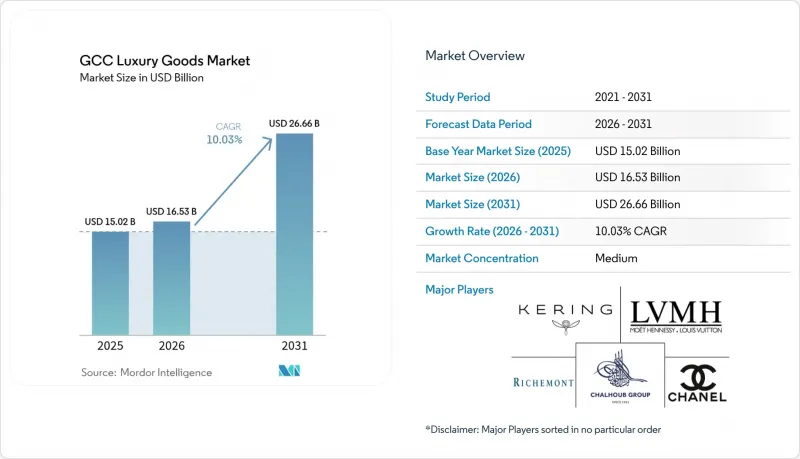
This report is Segmented by Product Type (Clothing and Apparel, Footwear, Leather Goods, Watches, Jewellery, Eyewear, Other Product Types), End User (Men, Women, Unisex), Distribution Channel (Single-Brand Stores, Multi-Brand Stores, Online Luxury Stores, Other Distribution Channels), and Geography (Saudi Arabia, UAE, Qatar, Kuwait, Oman, Bahrain). The Market Forecasts are Provided in Terms of Value (USD).
GCC Luxury Goods Market Trends and Insights
Increased consumer demand for limited edition offerings
Increased consumer demand for limited edition luxury goods in the GCC is driven by affluent shoppers seeking exclusivity, personalization, and emotional value beyond standard product offerings. This trend is underpinned by rising disposable incomes and wealth concentration, which enhance the willingness to pay premiums for scarcity-driven collections. The growing number of high-net-worth individuals further supports this dynamic, with the UAE recording a net increase of 6,700 high-net-worth individuals in 2024, the highest globally, according to the World Economic Forum . This expansion directly broadens the target audience for limited edition releases. Brands are increasingly adopting strategies such as capsule collections and regional exclusives to create urgency and reinforce brand prestige. For example, Louis Vuitton's Middle East-exclusive handbag launches have generated significant waitlists in Dubai and Riyadh boutiques, often tied to cultural events to enhance emotional relevance. Limited editions also boost perceptions of resale value, strengthening their investment appeal. Social media amplifies demand by transforming scarcity into visibility-driven desirability, ensuring sustained interest in limited edition luxury offerings in the GCC.
Heritage festivals supported by governments driving consumer spending
Government-supported heritage festivals are increasingly influencing consumer spending in the luxury goods market by integrating cultural pride with premium retail experiences. Saudi Arabia's Riyadh Season 2024 featured the "Christian Dior: Designer of Dreams" exhibition and the "1001 Seasons of Elie Saab" fashion show, aligning global luxury brands with national cultural themes and transforming luxury consumption into immersive lifestyle experiences. Similarly, Layali Diriyah 2025 attracted over 110,000 visitors near the Diriyah UNESCO site, combining designer pop-ups with heritage-focused entertainment formats to encourage longer visitor engagement and higher discretionary spending within curated retail spaces. Luxury brands benefit from increased foot traffic and stronger emotional connections through destination-driven luxury experiences. For example, Elie Saab leveraged its fashion show to enhance brand loyalty among affluent regional consumers. Furthermore, government-backed festivals lower market entry barriers for luxury brands by offering infrastructure and visibility support. Collectively, cultural programming, tourism initiatives, and brand storytelling are driving sustained growth in luxury spending across the GCC.
Proliferation of counterfeit products
The proliferation of counterfeit products poses a significant challenge in the luxury goods market across the GCC, eroding brand equity, consumer trust, and legitimate sales volumes. Enforcement data highlights the scale of this issue, with Dubai Customs reporting 285 intellectual property seizures in 2024 valued at approximately AED 92.695 million. These seizures encompassed watches, eyewear, clothing, bags, and shoes, directly impacting core luxury segments. Despite the registration of 439 trademarks, 205 commercial agencies, and 6 intellectual property assets reflecting intensified brand protection efforts, counterfeiting risks persist . The circulation of fake goods undermines pricing power and premium positioning, while consumer confusion between authentic and counterfeit products delays purchase decisions. For example, Gucci continues to invest heavily in authentication technologies and regional legal enforcement to combat counterfeit handbags in the GCC. This environment increases compliance and monitoring costs for luxury brands, ultimately constraining market growth by diluting exclusivity and damaging long-term brand credibility in the region.
Other drivers and restraints analyzed in the detailed report include:
- Growing market for sustainable and eco-certified luxury products
- Expansion of luxury retail spaces and shopping malls
- Increased import duties on personal luxury goods in Saudi Arabia (2024)
For complete list of drivers and restraints, kindly check the Table Of Contents.
Segment Analysis
Clothing and apparel are expected to maintain the largest share of the market, accounting for 35.28% of the product-type segment in 2025. This category's dominance is attributed to its broad scope, encompassing ready-to-wear, haute couture, and modest fashion. However, growth in this segment is moderating as brands face inventory challenges in aligning seasonal collections with both Western fashion calendars and Islamic holidays. Watches, on the other hand, are forecast to grow at an annual rate of 10.50% from 2026 to 2031, outpacing the overall market. Swiss manufacturers are leveraging cultural occasions such as Ramadan and Eid by introducing limited-edition timepieces, exemplified by Audemars Piguet's 2025 novelties, including the Caliber 7138 perpetual calendar and Royal Oak variants, which sold out shortly after launch.
Jewelry, footwear, leather goods, and eyewear collectively represent the remaining market share. Jewelry benefits from the cultural significance of gold in the region, while leather goods are gaining traction through personalized monogramming services offered by brands like Louis Vuitton and Hermes. Eyewear and footwear are emerging as underdeveloped categories, with opportunities for growth through standalone boutiques and collaborations with regional retailers. Additionally, the watch segment is bolstered by the pre-owned and vintage markets, where platforms like The Luxury Closet in Dubai are attracting younger buyers, fostering a progression from entry-level purchases to new-watch acquisitions as incomes and brand familiarity increase.
Complete Report Scope:
- By Product Type
- Clothing and Apparel
- Footwear
- Leather Goods
- Watches
- Jewellery
- Eyewear
- Other Product Types
- By End User
- Men
- Women
- Unisex
- By Distribution Channel
- Single-Brand Stores
- Multi-Brand Stores
- Online Luxury Stores
- Other Distribution Channels
- By Country
- Saudi Arabia
- United Arab Emirates
- Qatar
- Kuwait
- Oman
- Bahrain
List of Companies Covered in this Report:
- LVMH Moet Hennessy Louis Vuitton
- Kering SA
- Compagnie Financiere Richemont SA
- Chanel SA
- Capri Holdings Ltd
- Breitling SA
- The Swatch Group Ltd.
- Burberry Group Plc
- Dolce & Gabbana Srl
- Audemars Piguet Holding SA
- Tapestry Inc.
- Giorgio Armani SpA
- Hermes International SA
- Rolex SA
- Estee Lauder Companies Inc.
- Chopard & Cie S.A
- Hugo Boss AG
- Chalhoub Group
- Tod's S.p.A.
- Prada SpA
Additional Benefits:
- The market estimate (ME) sheet in Excel format
- 3 months of analyst support
TABLE OF CONTENTS
1 INTRODUCTION
- 1.1 Study Assumptions and Market Definition
- 1.2 Scope of the Study
2 RESEARCH METHODOLOGY
3 EXECUTIVE SUMMARY
4 MARKET DYNAMICS
- 4.1 Market Overview
- 4.2 Market Drivers
- 4.2.1 Increased consumer demand for limited edition offerings
- 4.2.2 Role of social media and celebrity endorsements in influencing purchases
- 4.2.3 Heritage festivals supported by governments driving consumer spending
- 4.2.4 Strategic investments by the gulf cooperation council in European luxury brands
- 4.2.5 Growing market for sustainable and eco-certified luxury products
- 4.2.6 Expansion of luxury retail spaces and shopping malls
- 4.3 Market Restraints
- 4.3.1 Proliferation of counterfeit products
- 4.3.2 Impact of cultural sensitivities and norms
- 4.3.3 Compliance costs due to regulatory frameworks
- 4.3.4 Increased import duties on personal luxury goods in Saudi Arabia (2024)
- 4.4 Consumer Behavior Analysis
- 4.5 Regulatory Landscape
- 4.6 Porter's Five Forces Analysis
- 4.6.1 Threat of New Entrants
- 4.6.2 Bargaining Power of Suppliers
- 4.6.3 Bargaining Power of Buyers
- 4.6.4 Threat of Substitutes
- 4.6.5 Intensity of Competitive Rivalry
5 MARKET SIZE AND GROWTH FORECASTS (VALUE AND VOLUME)
- 5.1 By Product Type
- 5.1.1 Clothing and Apparel
- 5.1.2 Footwear
- 5.1.3 Leather Goods
- 5.1.4 Watches
- 5.1.5 Jewellery
- 5.1.6 Eyewear
- 5.1.7 Other Product Types
- 5.2 By End User
- 5.2.1 Men
- 5.2.2 Women
- 5.2.3 Unisex
- 5.3 By Distribution Channel
- 5.3.1 Single-Brand Stores
- 5.3.2 Multi-Brand Stores
- 5.3.3 Online Luxury Stores
- 5.3.4 Other Distribution Channels
- 5.4 By Country
- 5.4.1 Saudi Arabia
- 5.4.2 United Arab Emirates
- 5.4.3 Qatar
- 5.4.4 Kuwait
- 5.4.5 Oman
- 5.4.6 Bahrain
6 COMPETITIVE LANDSCAPE
- 6.1 Market Concentration
- 6.2 Strategic Moves
- 6.3 Market Share Analysis
- 6.4 Company Profiles (includes Global level Overview, Market level overview, Core Segments, Financials as available, Strategic Information, Market Rank/Share for key companies, Products and Services, and Recent Developments)
- 6.4.1 LVMH Moet Hennessy Louis Vuitton
- 6.4.2 Kering SA
- 6.4.3 Compagnie Financiere Richemont SA
- 6.4.4 Chanel SA
- 6.4.5 Capri Holdings Ltd
- 6.4.6 Breitling SA
- 6.4.7 The Swatch Group Ltd.
- 6.4.8 Burberry Group Plc
- 6.4.9 Dolce & Gabbana Srl
- 6.4.10 Audemars Piguet Holding SA
- 6.4.11 Tapestry Inc.
- 6.4.12 Giorgio Armani SpA
- 6.4.13 Hermes International SA
- 6.4.14 Rolex SA
- 6.4.15 Estee Lauder Companies Inc.
- 6.4.16 Chopard & Cie S.A
- 6.4.17 Hugo Boss AG
- 6.4.18 Chalhoub Group
- 6.4.19 Tod's S.p.A.
- 6.4.20 Prada SpA
7 MARKET OPPORTUNITIES AND FUTURE OUTLOOK

