PUBLISHER: Mordor Intelligence | PRODUCT CODE: 2124352

PUBLISHER: Mordor Intelligence | PRODUCT CODE: 2124352
GCC Major Home Appliances - Market Share Analysis, Industry Trends & Statistics, Growth Forecasts (2026 - 2031)
According to Mordor Intelligence, the GCC major home appliances market size reached USD 3.23 billion in 2025, is at USD 3.83 billion in 2026, and is projected to reach USD 4.51 billion by 2031 at a 3.32% CAGR.
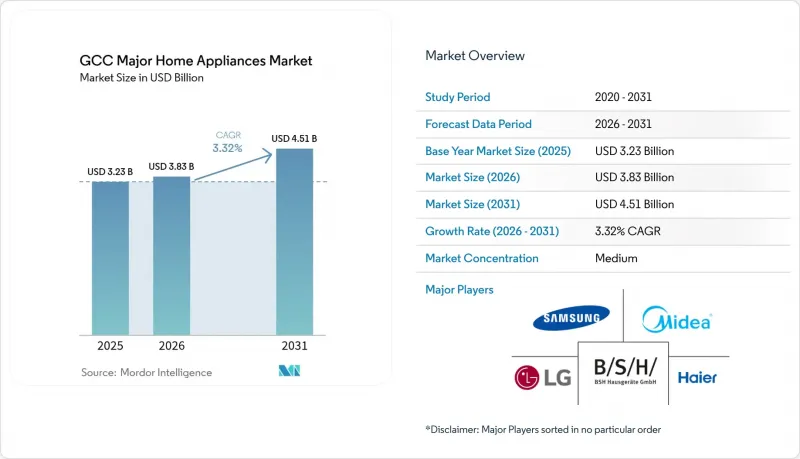
This report is Segmented by Product Type (Refrigerators, Freezers, Dishwashing Machines, Washing Machines, Ovens, Air Conditioners, Other Major Home Appliances), Distribution Channel (Multi-Brand Stores, and Other), Technology (Smart Connected Major Appliances, Conventional Major Appliances), and Geography (Saudi Arabia, UAE, and Other). The Market Forecasts are Provided in Terms of Value (USD).
GCC Major Home Appliances Market Trends and Insights
Housing and Hospitality Build-out Propels Turnkey Demand
Saudi Arabia's Vision 2030 housing pipeline delivered more than 800,000 Sakani contracts by 2024 and targets 115,000 residential starts annually through the decade, while NEOM, Qiddiya, and the Red Sea Project are slated to add 320,000 hotel rooms by 2030 that each require coordinated procurement across refrigeration, laundry, and climate control. In the UAE, developers in Expo City and on Abu Dhabi's Yas Island specify built-in suites for luxury villas, which supports a 4.12% CAGR for integrated installations relative to a dominant 71.12% free-standing share in 2025. Hospitality operators lock multi-year service agreements that compress per-unit lifecycle costs, nudging suppliers to expand B2B coverage and then convert project-led placements into B2C brand pull. Preparations for the 2030 Asian Games and World Cup legacy projects in Qatar sustain a steady pipeline of mid-market apartments, prompting demand for efficient washers and French-door refrigerators that balance utility pricing with comfort needs. Air-conditioning vendors report growth tied to mega-project participation and exports, reinforcing how construction cycles translate into appliance volumes across the GCC Major Home Appliances Market.
Tightening Energy-Efficiency Standards Accelerates Replacements
Saudi Arabia's SASO 2663 introduced seasonal energy-efficiency ratio labeling and disqualified fixed-speed ACs effective April 2022, which pushed retailers to clear legacy inventory and spurred manufacturers to shift new stock into inverter systems that reached 70% of new models by late 2024. The Saudi Energy Efficiency Center's Estbdal program adds a SAR 1,000 rebate with free delivery for compliant split ACs and has pulled more than 50,000 non-compliant window units from shelves, reinforcing the replacement pace that lifts value over volume. The UAE's Cabinet Resolution No. 157 of 2025, effective November 4, 2025, enforces UAE.S 5010-1:2025 and UAE.S 5010-5:2025 for low and large-capacity ACs with a 365-day compliance window, which shortens product-refresh cycles while aligning refrigerant choices with R-32 and R-600a. Five-star refrigerator labels in the UAE consume far less electricity than one-star units, which translates into measurable household savings and strengthens the case for upgrades in price-sensitive segments. Regional guidance from Eurovent Middle East and product showcases from leading HVAC firms add technical clarity, helping the GCC Major Home Appliances Market transition to low-GWP and high-efficiency SKUs without sacrificing high-ambient performance.
VAT and Policy-Driven Cost Pass-Through to Retail Prices
VAT regimes in the UAE and Saudi Arabia, along with customs and tariff policies, raise landed costs and flow through to appliance retail prices that are most sensitive in mid-tier segments. Duty-related changes in electrical items and local-assembly incentives are shifting sourcing patterns as manufacturers weigh deeper in-country partnerships to stabilize margins. Although higher prices can defer purchases, government housing programs, employer allowances, and zero-interest installment plans help moderate the net impact on replacement cycles. Region-wide regulatory updates also influence certification timelines and stocking strategies, which can add complexity to assortment planning. The result is a manageable drag on near-term growth in the GCC Major Home Appliances Market that is partly offset by financing innovation and developer-led bulk procurement.
Other drivers and restraints analyzed in the detailed report include:
- Omnichannel Expansion with E-commerce Scaling Last-Mile
- Rising Disposable Incomes and Urban Household Formation
- Highly Fragmented Brand Landscape and Retailer Private Labels
For complete list of drivers and restraints, kindly check the Table Of Contents.
Segment Analysis
Refrigerators captured 32.74% of the GCC Major Home Appliances market share in 2025, anchored by universal need across households and hospitality, while vendors pursue compliant designs aligned with updated energy standards to stabilize unit economics. Air conditioners are projected to expand at a 3.72% CAGR to 2031 as the GCC Major Home Appliances Market aligns with SEER labeling, T3 performance specs, and low-GWP refrigerant transitions that favor inverter compressors. Washing machines hold the second-largest subsegment but face slower penetration in water-stressed cities, which pushes makers to add water-saving programs and sensors that optimize each cycle. Dishwashers are gaining traction in premium homes under Saudi labeling mandates that steer buyers toward efficient SKUs despite continued hand-wash habits in some households. Built-in cooking solutions move with luxury spec packages across new towers and villas, which lifts average selling prices even when unit volumes hold flat.
Freezers and niche cooking devices round out the product mix and serve hotel kitchens and villa upgrades that require specific footprints and energy labels now harmonized under GSO frameworks. Air-conditioning innovation continues to cluster around inverter control, AI-assisted optimization, and R-32 or R-600a refrigerants, all tuned for high-ambient reliability. Expanded local testing capacity for chillers and performance labs narrows certification cycles and reduces overseas dependency for high-capacity equipment. Regulatory tightening across the region penalizes legacy stocks and rewards manufacturers with pre-certified lineups ready for immediate listing, which channels growth toward ACs and smart refrigerators in the GCC Major Home Appliances Market. The overall shift keeps refrigerators as anchors for volume while ACs provide incremental growth that reshapes category balance across 2026-2031.
Multi-brand stores held 48.62% of sales in 2025 on the strength of tactile demos, bundled installation, and omnichannel pickup, which remains central to category decisions like AC tonnage and washer capacity in the GCC Major Home Appliances Market. Flagship alliances in malls and national chains pair co-op advertising with exclusive SKUs to drive footfall and cross-sell warranties or smart-home packages. Hypermarkets focus on entry-tier SKUs and seasonal promotions, while premium European brands continue to rely on specialist outlets and direct-to-consumer storefronts. Online channels are projected to grow at a 4.31% CAGR to 2031 as end-to-end installation, financing, and faster logistics remove friction from large-ticket e-commerce. Trade-in programs for AI-enabled appliances, together with regional re-export hubs, are improving inventory pooling and regional shipping efficiency on scale.
Direct-to-consumer and subscription service bundles are emerging in select categories, offering convenience and predictable maintenance for mobile tenants and project buyers. Historical channel growth was steady through 2025, with recent momentum tilting online as last-mile networks mature and tax structures reshape pricing strategies. Manufacturers calibrate presence by country, with ACs still skewed to store-based consultative sales in Saudi Arabia and refrigerators or washers increasingly purchased online in the UAE. Regional brands leverage GSO certifications and localized features to secure shelf slots and online placement at competitive MSRPs, which sustains choice across the GCC Major Home Appliances Market. As omnichannel adoption rises, last-mile readiness and post-purchase services become the decisive differentiators for repeat purchases.
Complete Report Scope:
- By Product Type
- Refrigerators
- Freezers
- Washing Machines
- Dishwashers
- Cooktops & Ranges
- Microwave Ovens
- Air Conditioners
- Others (Electric Hobs)
- By Distribution Channel
- Multi-Brand and Exclusive Brand Stores (EBOs)
- Hypermarkets & Supermarkets
- Online / E-commerce Platforms
- Direct-to-Consumer (D2C) & Subscription Models
- By Installation Type
- Free-Standing
- Built-In / Integrated
- By Technology
- Conventional Appliances
- Smart / Connected Appliances
- By Geography
- Saudi Arabia
- United Arab Emirates
- Kuwait
- Qatar
- Oman
- Bahrain
List of Companies Covered in this Report:
- LG Electronics Inc.
- Samsung Electronics Co., Ltd.
- BSH Hausgerate GmbH (Bosch, Siemens)
- Whirlpool Corporation
- Haier Smart Home Co., Ltd. (incl. Candy/Hoover)
- Midea Group Co., Ltd. (incl. Toshiba Lifestyle)
- Electrolux AB
- Panasonic Marketing Middle East & Africa FZE
- Hisense Middle East
- Arcelik A.S.
- TCL Electronics
- Daikin Middle East & Africa
- Carrier Middle East
- Gree Electric Appliances, Inc.
- Fujitsu General (O General)
- Zamil Air Conditioners Holding Co. Ltd.
- Hitachi Global Life Solutions (Hitachi Sales Middle East FZE)
- Toshiba Lifestyle Products & Services (Middle East)
- Sharp Middle East & Africa
- Miele & Cie. KG (Middle East)
- Smeg S.p.A. (Middle East)
Additional Benefits:
- The market estimate (ME) sheet in Excel format
- 3 months of analyst support
TABLE OF CONTENTS
1 Introduction
- 1.1 Study Assumptions & Market Definition
- 1.2 Scope of the Study
2 Research Methodology
3 Executive Summary
4 Market Landscape
- 4.1 Market Overview
- 4.2 Market Drivers
- 4.2.1 Housing and hospitality build-out in GCC premium and mid-market segments
- 4.2.2 Tightening energy-efficiency standards accelerating replacements
- 4.2.3 Omnichannel expansion with e-commerce scaling last-mile
- 4.2.4 Rising disposable incomes and urban household formation
- 4.2.5 Refrigerant transitions (Kigali) catalyzing product refresh cycles
- 4.2.6 High-ambient T3/inverter designs boosting premiumization
- 4.3 Market Restraints
- 4.3.1 VAT and policy-driven cost pass-through to retail prices
- 4.3.2 Highly fragmented brand landscape and retailer private labels
- 4.3.3 Water stress raising total cost of use for washers/dishwashers
- 4.3.4 Compliance costs from updated MEPS/labels and testing
- 4.4 Industry Value Chain Analysis
- 4.5 Porter's Five Forces Analysis
- 4.5.1 Threat of New Entrants
- 4.5.2 Bargaining Power of Suppliers
- 4.5.3 Bargaining Power of Buyers
- 4.5.4 Threat of Substitutes
- 4.5.5 Competitive Rivalry
- 4.6 Insights into the Latest Trends and Innovations in the Market
- 4.7 Insights on Recent Developments (New Product Launches, Strategic Initiatives, Investments, Partnerships, JVs, Expansion, M&As, etc.) in the Industry
5 Market Size & Growth Forecasts (Value)
- 5.1 By Product Type
- 5.1.1 Refrigerators
- 5.1.2 Freezers
- 5.1.3 Washing Machines
- 5.1.4 Dishwashers
- 5.1.5 Cooktops & Ranges
- 5.1.6 Microwave Ovens
- 5.1.7 Air Conditioners
- 5.1.8 Others (Electric Hobs)
- 5.2 By Distribution Channel
- 5.2.1 Multi-Brand and Exclusive Brand Stores (EBOs)
- 5.2.2 Hypermarkets & Supermarkets
- 5.2.3 Online / E-commerce Platforms
- 5.2.4 Direct-to-Consumer (D2C) & Subscription Models
- 5.3 By Installation Type
- 5.3.1 Free-Standing
- 5.3.2 Built-In / Integrated
- 5.4 By Technology
- 5.4.1 Conventional Appliances
- 5.4.2 Smart / Connected Appliances
- 5.5 By Geography
- 5.5.1 Saudi Arabia
- 5.5.2 United Arab Emirates
- 5.5.3 Kuwait
- 5.5.4 Qatar
- 5.5.5 Oman
- 5.5.6 Bahrain
6 Competitive Landscape
- 6.1 Market Concentration
- 6.2 Strategic Moves
- 6.3 Market Share Analysis
- 6.4 Company Profiles {(includes Global level Overview, Market level overview, Core Segments, Financials as available, Strategic Information, Market Rank/Share for key companies, Products & Services, and Recent Developments)}
- 6.4.1 LG Electronics Inc.
- 6.4.2 Samsung Electronics Co., Ltd.
- 6.4.3 BSH Hausgerate GmbH (Bosch, Siemens)
- 6.4.4 Whirlpool Corporation
- 6.4.5 Haier Smart Home Co., Ltd. (incl. Candy/Hoover)
- 6.4.6 Midea Group Co., Ltd. (incl. Toshiba Lifestyle)
- 6.4.7 Electrolux AB
- 6.4.8 Panasonic Marketing Middle East & Africa FZE
- 6.4.9 Hisense Middle East
- 6.4.10 Arcelik A.S.
- 6.4.11 TCL Electronics
- 6.4.12 Daikin Middle East & Africa
- 6.4.13 Carrier Middle East
- 6.4.14 Gree Electric Appliances, Inc.
- 6.4.15 Fujitsu General (O General)
- 6.4.16 Zamil Air Conditioners Holding Co. Ltd.
- 6.4.17 Hitachi Global Life Solutions (Hitachi Sales Middle East FZE)
- 6.4.18 Toshiba Lifestyle Products & Services (Middle East)
- 6.4.19 Sharp Middle East & Africa
- 6.4.20 Miele & Cie. KG (Middle East)
- 6.4.21 Smeg S.p.A. (Middle East)
7 Market Opportunities & Future Outlook
- 7.1 Built-in and smart bundles for premium apartments and villas
- 7.2 Energy-as-a-service and D2C maintenance subscriptions
- 7.3 Water-smart laundry/dish solutions tailored for GCC utilities

