PUBLISHER: Mordor Intelligence | PRODUCT CODE: 2125332

PUBLISHER: Mordor Intelligence | PRODUCT CODE: 2125332
Middle East And Africa Mobile Payments - Market Share Analysis, Industry Trends & Statistics, Growth Forecasts (2026 - 2031)
According to Mordor Intelligence, the Middle East and Africa mobile payments market size was valued at USD 7.24 billion in 2025 and estimated to grow from USD 9.91 billion in 2026 to reach USD 47.28 billion by 2031, at a CAGR of 36.72% during the forecast period (2026-2031).
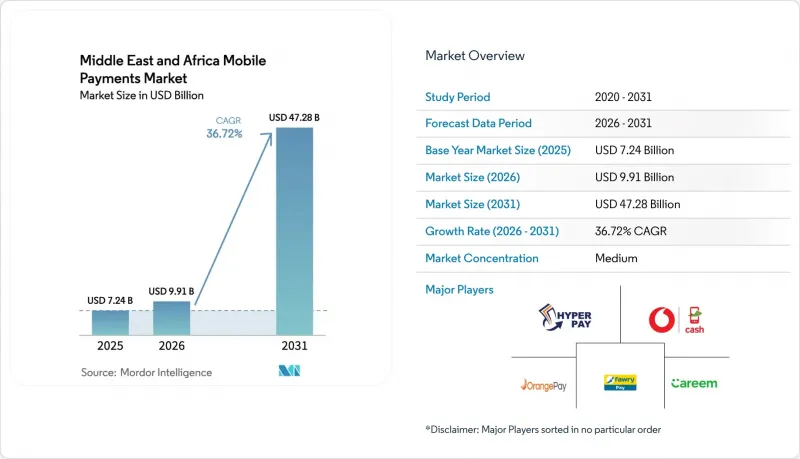
This report is Segmented by Payment Type (Proximity Payments, Remote Payments), Transaction Type (Peer-To-Peer (P2P), In-Store Point-Of-Sale (POS), Person-To-Merchant (P2M/Checkout), Other Transaction Types), Application (Retail & ECommerce, Transportation and Logistics, Hospitality & Food-Service, and More), End-User (Personal, Business), and Country. The Market Forecasts are Provided in Terms of Value (USD).
Middle East And Africa Mobile Payments Market Trends and Insights
GCC Wage-Protection-System (WPS) Mandates Accelerating Cash-to-Digital Migration
WPS compliance reached 99.8% in the UAE and 92% in Saudi Arabia in 2024, onboarding 5.8 million formerly cash-paid workers into digital channels. Mandatory wage digitisation funnels recurring salary inflows into mobile wallets, boosting average non-salary transaction frequency by 3.2 times for providers such as STC Pay. The programme is expanding across Bahrain, Qatar and Oman, standardising payroll rails and lowering customer-acquisition costs. Banks benefit from float balances while telco wallets monetise fees on remittances and bill-pay. The initiative embeds financial inclusion at scale, cementing long-term volume upside for the Middle East and Africa mobile payments market.
BNPL-Enabled Wallet Loyalty Programs Boosting Transaction Frequency in UAE & KSA
Tabby's integration with STC Pay lifted wallet transaction frequency by 42% in 2024, underscoring BNPL's ability to extend consumer credit within existing digital wallets. BNPL adoption has reached 39% in the UAE and 42% in Saudi Arabia, driving USD 10 billion in annual wallet volumes and generating 2.7-times higher average ticket sizes versus traditional cards. Merchants gain higher conversion rates, consumers obtain deferred payments, and wallet operators capture interchange and late-fee income. Rapid scaling of BNPL-wallet hybrids is likely to deepen user stickiness and sharpen competitive differentiation in the Middle East and Africa mobile payments market.
Fragmented Licensing Across 45+ African Regulators Delays Market Entry
Payment providers allocate 18-24% of their operating budgets to compliance as they navigate divergent licence classes and fee structures. Approval timelines range from three months to over one year, dampening time-to-market for cross-border propositions. Activity-based licensing models in Kenya and Ghana offer promising templates, but broad harmonisation remains a long-term agenda. The resulting friction restricts capital inflows, stifles innovation and clips growth for the Middle East and Africa mobile payments market.
Other drivers and restraints analyzed in the detailed report include:
- Telco Super-App Race Unlocking Rural USSD Adoption in Sub-Saharan Africa
- SoftPOS Roll-outs Among Micro-Merchants (Visa Tap-to-Phone Pilots)
- Mobile-Money Transaction Caps in Nigeria & Egypt Reduce Ticket Size
For complete list of drivers and restraints, kindly check the Table Of Contents.
Segment Analysis
Remote payments accounted for 68.35% of the Middle East and Africa mobile payments market in 2025, driven by bill-pay and e-commerce transfers. Visa's Tap-to-Phone and widespread NFC handsets are now nudging proximity adoption upward with a projected 30.05% CAGR, especially in GCC urban centres where contactless initiatives led to a 47% uptick in 2024. Retailers gain higher throughput at checkout, while consumers benefit from tap-and-go convenience. Transaction data mined from proximity events enables hyper-local offers, boosting merchant sales and deepening ecosystem engagement.
The rapid diffusion of SoftPOS among micro-merchants lowers acceptance costs and targets previously cash-only outlets, expanding addressable volumes for the Middle East and Africa mobile payments market. Proximity payments also facilitate offline authentication, a vital feature in intermittent-connectivity environments. As infrastructure scales, the proximity share is expected to close the gap with remote transactions, shifting provider focus toward in-store experiences and embedded commerce offerings.
POS transactions led with a 40.55% share in 2025, reflecting high smartphone penetration and merchant digitisation across GCC states. P2P transfers, however, are projected to outpace other flows at a 32.1% CAGR, buoyed by remittance needs and limited branch networks. First-time mobile money users in Africa initiate 78% of their journeys through P2P, making it a critical acquisition funnel for the Middle East and Africa mobile payments market size.
International mobile-money remittances reached USD 34 billion in 2024. Providers are layering value-added services such as savings pots, micro-loans and insurance to monetise rising wallet balances. As regulators progress toward real-time-gross settlement interoperability, P2P corridors will deepen liquidity and reinforce the ecosystem's role in economic integration.
Complete Report Scope:
- By Payment Type
- Proximity Payments
- Remote Payments
- By Transaction Type
- Peer-to-Peer (P2P)
- In-store Point-of-Sale (POS)
- Person-to-Merchant (P2M/Checkout)
- Other Transaction Types
- By Application
- Retail and eCommerce
- Transportation and Logistics
- Hospitality and Food-Service
- Government and Public Sector
- Other Applications (Education, Healthcare)
- By End-user
- Personal
- Business
- Geography
- Middle East
- Saudi Arabia
- United Arab Emirates
- Qatar
- Kuwait
- Turkey
- Oman
- Rest of Middle East
- Africa
- South Africa
- Nigeria
- Egypt
- Morocco
- Rest of Africa
- Middle East
List of Companies Covered in this Report:
- STC Pay (Saudi Digital Payments Co.)
- MTN Group - MoMo
- Vodafone Group
- Orange S.A. (Orange Money)
- Fawry (MyFawry)
- Careem (CareemPay)
- HyperPay Inc.
- PalmPay Ltd.
- OPay Digital Services Ltd.
- Flutterwave Inc.
- Paystack Payments Ltd.
- Paymob Solutions
- BayanPay
- SADAD Payment System
- Payit Digital Wallet (ADCB)
- eand money (Etisalat)
- Zain Cash
- Beam Wallet
- Klip Digital Wallet
- Wave Mobile Money
Additional Benefits:
- The market estimate (ME) sheet in Excel format
- 3 months of analyst support
TABLE OF CONTENTS
1 INTRODUCTION
- 1.1 Study Assumptions and Market Definition
- 1.2 Scope of the Study
2 RESEARCH METHODOLOGY
3 EXECUTIVE SUMMARY
4 MARKET LANDSCAPE
- 4.1 Market Overview
- 4.2 Market Drivers
- 4.2.1 GCC Wage-Protection-System (WPS) Mandates Accelerating Cash-to-Digital Migration
- 4.2.2 BNPL-Enabled Wallet Loyalty Programs Boosting Transaction Frequency in UAE and KSA
- 4.2.3 Telco-Super-App Race Unlocking Rural USSD Adoption in Sub-Saharan Africa
- 4.2.4 SoftPOS Roll-outs Among Micro-Merchants (Visa Tap-to-Phone Pilots)
- 4.2.5 Wallet-to-Wallet GCC-Africa Remittance Corridors Cutting Transfer Fees
- 4.3 Market Restraints
- 4.3.1 Fragmented Licensing Across 45+ African Regulators Delays Market Entry
- 4.3.2 Mobile-Money Transaction Caps in Nigeria and Egypt Reduce Ticket Size
- 4.3.3 High USSD Fraud Rates Trigger Bank-Imposed PIN-Retry Limits
- 4.3.4 PAPSS Funding Gaps Slow Real-time Rail Deployment in Francophone Africa
- 4.4 Value Chain Analysis
- 4.5 Regulatory Outlook
- 4.6 Technological Outlook
- 4.7 Porter's Five Forces Analysis
- 4.7.1 Bargaining Power of Suppliers
- 4.7.2 Bargaining Power of Buyers
- 4.7.3 Threat of New Entrants
- 4.7.4 Threat of Substitutes
- 4.7.5 Intensity of Competitive Rivalry
- 4.8 Assessment of Macro Economic Trends on the Market
- 4.9 Analysis of Business Models
- 4.10 Mobile-Wallet Penetration by Key Country
- 4.11 Enabling Technologies (NFC, QR, USSD, Tokenisation)
- 4.12 Influence of M-Commerce Growth
5 MARKET SIZE AND GROWTH FORECASTS (VALUES)
- 5.1 By Payment Type
- 5.1.1 Proximity Payments
- 5.1.2 Remote Payments
- 5.2 By Transaction Type
- 5.2.1 Peer-to-Peer (P2P)
- 5.2.2 In-store Point-of-Sale (POS)
- 5.2.3 Person-to-Merchant (P2M/Checkout)
- 5.2.4 Other Transaction Types
- 5.3 By Application
- 5.3.1 Retail and eCommerce
- 5.3.2 Transportation and Logistics
- 5.3.3 Hospitality and Food-Service
- 5.3.4 Government and Public Sector
- 5.3.5 Other Applications (Education, Healthcare)
- 5.4 By End-user
- 5.4.1 Personal
- 5.4.2 Business
- 5.5 Geography
- 5.5.1 Middle East
- 5.5.1.1 Saudi Arabia
- 5.5.1.2 United Arab Emirates
- 5.5.1.3 Qatar
- 5.5.1.4 Kuwait
- 5.5.1.5 Turkey
- 5.5.1.6 Oman
- 5.5.1.7 Rest of Middle East
- 5.5.2 Africa
- 5.5.2.1 South Africa
- 5.5.2.2 Nigeria
- 5.5.2.3 Egypt
- 5.5.2.4 Morocco
- 5.5.2.5 Rest of Africa
- 5.5.1 Middle East
6 COMPETITIVE LANDSCAPE
- 6.1 Market Concentration
- 6.2 Strategic Moves
- 6.3 Market Share Analysis
- 6.4 Company Profiles (includes Global- and Market-level Overview, Core Segments, Financials, Strategic Info, Market Rank/Share, Products and Services, Recent Developments)
- 6.4.1 STC Pay (Saudi Digital Payments Co.)
- 6.4.2 MTN Group - MoMo
- 6.4.3 Vodafone Group
- 6.4.4 Orange S.A. (Orange Money)
- 6.4.5 Fawry (MyFawry)
- 6.4.6 Careem (CareemPay)
- 6.4.7 HyperPay Inc.
- 6.4.8 PalmPay Ltd.
- 6.4.9 OPay Digital Services Ltd.
- 6.4.10 Flutterwave Inc.
- 6.4.11 Paystack Payments Ltd.
- 6.4.12 Paymob Solutions
- 6.4.13 BayanPay
- 6.4.14 SADAD Payment System
- 6.4.15 Payit Digital Wallet (ADCB)
- 6.4.16 eand money (Etisalat)
- 6.4.17 Zain Cash
- 6.4.18 Beam Wallet
- 6.4.19 Klip Digital Wallet
- 6.4.20 Wave Mobile Money
7 MARKET OPPORTUNITIES AND FUTURE OUTLOOK
- 7.1 White-space and Unmet-Need Assessment

