PUBLISHER: Mordor Intelligence | PRODUCT CODE: 2125347

PUBLISHER: Mordor Intelligence | PRODUCT CODE: 2125347
Thailand Mobile Payments - Market Share Analysis, Industry Trends & Statistics, Growth Forecasts (2026 - 2031)
According to Mordor Intelligence, Thailand mobile payments market size in 2026 is estimated at USD 34.08 billion, growing from 2025 value of USD 29.73 billion with 2031 projections showing USD 67.41 billion, growing at 14.62% CAGR over 2026-2031.
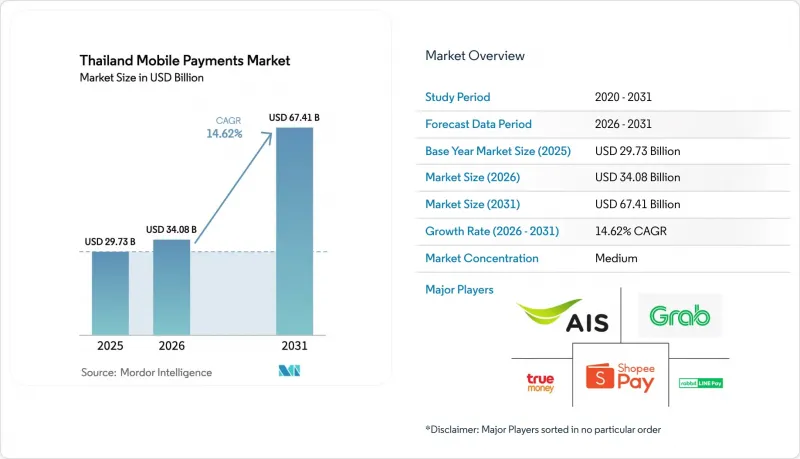
This report is Segmented by Payment Instrument (PromptPay/RTP Transfers, Mobile Wallets, and More), Transaction Channel (In-Store POS, E-Commerce, and More), Payment Type (Proximity Payments and Remote Payments), End-User Industry (Retail and FMCG, Transportation and Mobility, and More), Technology (QR Code, NFC/Tokenised Card, and More), and Region. The Market Forecasts are Provided in Terms of Value (USD).
Thailand Mobile Payments Market Trends and Insights
Explosive E-commerce Growth Drives Payment Digitization
Thailand's e-commerce boom fosters habitual mobile checkout, making friction-free wallets indispensable for both merchants and shoppers. Deep wallet integration inside super-apps keeps users within a single ecosystem, locking in repeat spend. Cross-platform payment interoperability now lets buyers preserve preferred payment settings across multiple marketplaces, pushing wallet stickiness from online channels into offline QR-enabled stores. Partnerships such as ShopeePay's tie-up with the National Savings Fund broaden financial inclusion, funneling fresh users into regulated e-wallet rails. The cadence of flash-sales and live-stream commerce also amplifies micro-transaction frequency, enlarging fee pools for providers.
Smartphone and 5G Network Infrastructure Expansion
Nationwide 5G has lowered latency and boosted bandwidth, enabling biometric verification and AI-driven fraud filters in real time. Budget Android handsets priced below USD 100 have pushed smartphone penetration past 90%, minimizing device-access hurdles. Rural towers installed under the Universal Service Obligation Fund shrink the urban-rural gap, widening the Thailand mobile payments market addressable base. High-speed links also power emerging modalities such as sound-wave payments, which sidestep the camera alignment needed for QR codes. Telecom operators monetize network upgrades via bundled wallet promotions, turning connectivity into a direct acquisition lever.
Escalating Cyber-Fraud and Data Breaches Undermine Consumer Confidence
Thailand logged 168 million scam SMS and calls in 2024, the region's highest tally, and several multi-million-record breaches seeded personal data on dark-web forums. Consumers equate digital rails with higher theft risk, slowing wallet adoption among risk-averse demographics. Compliance with the Personal Data Protection Act has raised fixed costs for smaller fintechs, diverting funds from innovation to security audits. Media coverage of fraud incidents prompts banks to impose stricter KYC checks, elongating onboarding time and adding friction to first-use transactions.
Other drivers and restraints analyzed in the detailed report include:
- National PromptPay Program Cross-Border Scaling
- ASEAN Cross-Border QR Code Interoperability
- Persistent Cash Preference in Rural Areas Limits Market Expansion
For complete list of drivers and restraints, kindly check the Table Of Contents.
Segment Analysis
PromptPay transfers captured 41.10% of the Thailand mobile payments market share in 2025, a lead built on fee-free P2P and merchant acceptance baked into every domestic bank app. Mobile wallets, however, are swelling at a 16.2% CAGR and could expand the Thailand mobile payments market size by USD 13.4 billion between 2026 and 2031 as TrueMoney penetrates cash-centric provinces and Rabbit LINE Pay rides urban transit systems.
TrueMoney leverages its 39,000 agent outlets to convert cash for the unbanked, while Rabbit LINE Pay bundles ride fares with micro-insurance, turning daily commutes into recurring wallet engagement. Card-linked wallets maintain traction among affluent urbanites who prefer revolving credit, whereas carrier billing survives in niche content subscriptions. Siam Commercial Bank's tap-to-pay feature blurs category lines by embedding NFC directly into banking apps, delivering card-grade convenience without plastic issuance. Biometrics such as facial recognition shorten authentication steps, partly offsetting fraud fears and pushing high-ticket transactions onto wallet rails.
E-commerce contributed 46.25% of 2025 transaction value, anchoring the Thailand mobile payments market around app-based checkouts and one-click repeat orders. Cross-platform promotions funnel wallet users from Shopee flash sales to offline QR-enabled coffee chains, reinforcing payment familiarity.
P2P transfers, forecast at a 16.6% CAGR, benefit from gig-economy payouts and family remittances that bypass ATM queues. In-store POS volumes rise via camera-based QR scans and nascent tap-to-phone software that turns Android devices into card readers. Bill payments move online as utilities embed PromptPay QR on invoices, while cross-border tourists spend rebounds on QR interoperability, lifting average merchant basket sizes during high-season months.
Complete Report Scope:
- By Payment Instrument
- PromptPay/RTP Transfers
- Mobile Wallets (TrueMoney, Rabbit LINE Pay, etc.)
- Card-based Mobile Payments
- Carrier Billing/Others
- By Transaction Channel
- In-store POS
- E-commerce
- P2P Transfers
- Bill and Government Payments
- Cross-border/Tourist
- By Payment Type
- Proximity Payments
- Remote Payments
- By End-User Industry
- Retail and FMCG
- Transportation and Mobility
- Hospitality and Tourism
- Utilities and Telecom
- Healthcare and Education
- Other End-User Industries
- By Technology
- QR Code
- NFC/Tokenised Card
- USSD/STK
- Sound-wave and Other Alt-Tech
- By Region
- Bangkok Metropolitan Region
- Central
- Northern
- Northeastern
- Southern
List of Companies Covered in this Report:
- True Money Co., Ltd.
- Rabbit LINE Pay Co., Ltd.
- ShopeePay (Thailand) Co., Ltd.
- Advanced Info Service Public Company Limited
- Grab Holdings Limited (GrabPay)
- KASIKORNBANK Public Company Limited
- Siam Commercial Bank Public Company Limited
- Bangkok Bank Public Company Limited
- Bank of Ayudhya Public Company Limited
- Omise Co., Ltd.
- Ascend Money Co., Ltd.
- GHL Systems Berhad (Thailand)
- Alipay.com Co., Ltd.
- Tencent Holdings Limited (WeChat Pay)
- Apple Inc. (Apple Pay)
- Google LLC (Google Pay)
- Mastercard Incorporated
- Visa Inc.
- Thai Payment Network Co., Ltd.
- National ITMX Co., Ltd.
- PromptPay Ltd.
- Mobiamo Inc.
Additional Benefits:
- The market estimate (ME) sheet in Excel format
- 3 months of analyst support
TABLE OF CONTENTS
1 INTRODUCTION
- 1.1 Study Assumptions and Market Definitions
- 1.2 Scope of the Study
2 RESEARCH METHODOLOGY
3 EXECUTIVE SUMMARY
4 MARKET LANDSCAPE
- 4.1 Market Overview
- 4.2 Market Drivers
- 4.2.1 Explosive e-commerce growth
- 4.2.2 Smartphone and 5G penetration surge
- 4.2.3 National PromptPay program scaling
- 4.2.4 ASEAN cross-border QR interoperability
- 4.2.5 Tap-to-phone for MSME acceptance
- 4.2.6 Social-commerce wallet embedding
- 4.3 Market Restraints
- 4.3.1 Escalating cyber-fraud and data breaches
- 4.3.2 Persistent cash preference in rural areas
- 4.3.3 MDR/compliance burden on micro-merchants
- 4.3.4 Regulatory flux on in-wallet credit/BNPL
- 4.4 Industry Value Chain Analysis
- 4.5 Regulatory Landscape
- 4.6 Technological Outlook
- 4.7 Porter's Five Forces Analysis
- 4.7.1 Bargaining Power of Suppliers
- 4.7.2 Bargaining Power of Buyers
- 4.7.3 Threat of New Entrants
- 4.7.4 Threat of Substitutes
- 4.7.5 Intensity of Competitive Rivalry
- 4.8 Impact of Macroeconomic Trends on the Market
5 MARKET SIZE AND GROWTH FORECASTS (VALUES)
- 5.1 By Payment Instrument
- 5.1.1 PromptPay/RTP Transfers
- 5.1.2 Mobile Wallets (TrueMoney, Rabbit LINE Pay, etc.)
- 5.1.3 Card-based Mobile Payments
- 5.1.4 Carrier Billing/Others
- 5.2 By Transaction Channel
- 5.2.1 In-store POS
- 5.2.2 E-commerce
- 5.2.3 P2P Transfers
- 5.2.4 Bill and Government Payments
- 5.2.5 Cross-border/Tourist
- 5.3 By Payment Type
- 5.3.1 Proximity Payments
- 5.3.2 Remote Payments
- 5.4 By End-User Industry
- 5.4.1 Retail and FMCG
- 5.4.2 Transportation and Mobility
- 5.4.3 Hospitality and Tourism
- 5.4.4 Utilities and Telecom
- 5.4.5 Healthcare and Education
- 5.4.6 Other End-User Industries
- 5.5 By Technology
- 5.5.1 QR Code
- 5.5.2 NFC/Tokenised Card
- 5.5.3 USSD/STK
- 5.5.4 Sound-wave and Other Alt-Tech
- 5.6 By Region
- 5.6.1 Bangkok Metropolitan Region
- 5.6.2 Central
- 5.6.3 Northern
- 5.6.4 Northeastern
- 5.6.5 Southern
6 COMPETITIVE LANDSCAPE
- 6.1 Market Concentration
- 6.2 Strategic Moves
- 6.3 Market Share Analysis
- 6.4 Company Profiles (includes Global level Overview, Market level overview, Core Segments, Financials as available, Strategic Information, Market Rank/Share, Products and Services, Recent Developments)
- 6.4.1 True Money Co., Ltd.
- 6.4.2 Rabbit LINE Pay Co., Ltd.
- 6.4.3 ShopeePay (Thailand) Co., Ltd.
- 6.4.4 Advanced Info Service Public Company Limited
- 6.4.5 Grab Holdings Limited (GrabPay)
- 6.4.6 KASIKORNBANK Public Company Limited
- 6.4.7 Siam Commercial Bank Public Company Limited
- 6.4.8 Bangkok Bank Public Company Limited
- 6.4.9 Bank of Ayudhya Public Company Limited
- 6.4.10 Omise Co., Ltd.
- 6.4.11 Ascend Money Co., Ltd.
- 6.4.12 GHL Systems Berhad (Thailand)
- 6.4.13 Alipay.com Co., Ltd.
- 6.4.14 Tencent Holdings Limited (WeChat Pay)
- 6.4.15 Apple Inc. (Apple Pay)
- 6.4.16 Google LLC (Google Pay)
- 6.4.17 Mastercard Incorporated
- 6.4.18 Visa Inc.
- 6.4.19 Thai Payment Network Co., Ltd.
- 6.4.20 National ITMX Co., Ltd.
- 6.4.21 PromptPay Ltd.
- 6.4.22 Mobiamo Inc.
7 MARKET OPPORTUNITIES AND FUTURE OUTLOOK
- 7.1 White-Space and Unmet-Need Assessment

