PUBLISHER: Mordor Intelligence | PRODUCT CODE: 2117383

PUBLISHER: Mordor Intelligence | PRODUCT CODE: 2117383
India Mining Equipment - Market Share Analysis, Industry Trends & Statistics, Growth Forecasts (2026 - 2031)
According to Mordor Intelligence, the India mining equipment market size was valued at USD 8.35 billion in 2025, and is projected to grow from USD 8.81 billion in 2026 to reach USD 11.53 billion by 2031, growing at a CAGR of 5.52% over 2026-2031.
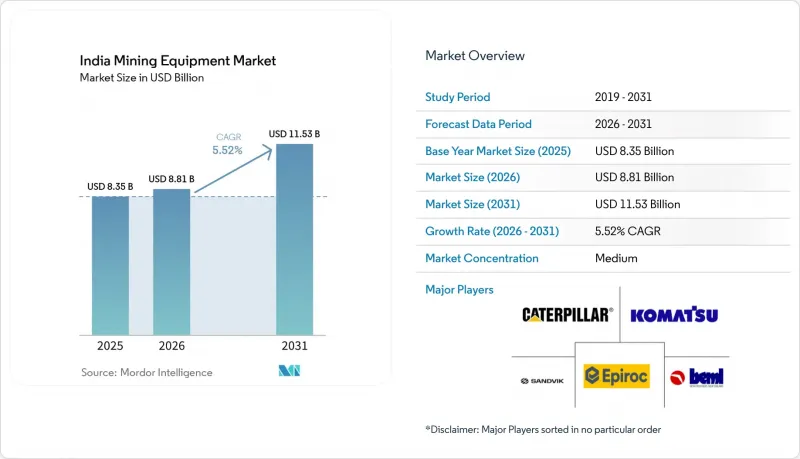
This report is Segmented by Equipment Type (Surface Mining Equipment, Underground Mining Equipment, and More), Automation Level (Manual Equipment, Semi-Autonomous Equipment, and More), Powertrain Type (Internal-Combustion Engine Vehicles, Battery-Electric Vehicles, and More), Power Output, Application, and Region. The Market Forecasts are Provided in Terms of Value (USD) and Volume (Units).
India Mining Equipment Market Trends and Insights
Government Infrastructure Build-Out Spurring Mineral Demand
India's record infrastructure allocation (~USD 134 billion) for fiscal 2026 raises steel and cement consumption, which in turn lifts demand for high-capacity earthmoving and processing machines. Highway, metro, and port projects add fresh tonnage for limestone and aggregates, compelling miners to upgrade crushers and screens to keep pace. National coking-coal targets foster interest in longwall equipment that improves recovery in deeper seams. Each incremental tonne of raw material translates to extra engine hours and quicker replacement cycles, creating a multiplier effect for the Indian mining equipment market. Rental firms are scaling fleets in mineral-rich belts so that mid-sized operators can deploy modern gear without heavy upfront outlays.
Coal India's Mechanization and Capacity Expansion Roadmap
Coal India's pipeline of mechanized continuous-miner projects replaces drill-and-blast workflows with integrated cutting, conveying, and silo loading. The program shortens cycle time, improves safety, and anchors long-term orders for loaders, belt systems, and automated haulage units. Subsidiaries that target higher silo-loading ratios are standardizing truck sizes and adopting dispatch software, a shift that percolates across supplier tiers. Domestic fabricators are entering turnkey packages to capture rising localization incentives, while global majors bundle telemetry with hardware to secure full-life support contracts. The roadmap, therefore, remains a decisive catalyst for the Indian mining equipment market through the late 2020s.
High Upfront CAPEX and Financing Hurdles
A single ultra-class haul truck or continuous miner commands a multimillion-dollar price tag, and lenders now offer lower loan-to-value ratios, which raises equity requirements. Smaller leaseholders often postpone mechanization or settle for pre-owned machines with higher downtime, delaying efficiency gains. Equipment rental offsets part of the burden, yet fragmented suppliers and interstate logistics hinder penetration. The financing gap thus slows fleet modernization among mid-tier firms, especially for underground units that carry higher sticker prices and longer payback periods.
Other drivers and restraints analyzed in the detailed report include:
- Stricter Safety Norms Accelerating Automation Adoption
- Lithium-Copper Exploration Boom Requiring Specialty Gear
- Tightening Emission and ESG Compliance Costs
For complete list of drivers and restraints, kindly check the Table Of Contents.
Segment Analysis
Surface mining equipment accounted for 50.51% of India's mining equipment market share in 2025. Strong opencast output in coal, iron ore, and limestone keeps draglines, shovels, and rigid-frame trucks central to mine plans. The replacement of manual loading with hydraulic excavators gains pace as operators seek faster cycle times. Local assemblers expand capacity for body fabrication and engine packaging, improving lead times and after-sales reach. Second-hand imports continue but face growing competition from subsidy-eligible domestic models.
Underground mining equipment is projected to see the fastest expansion at a 6.73% CAGR through 2031. Continuous miners, shuttle cars, and roof-support systems move center stage as deeper seams enter production. Automation features such as tele-remote drilling and real-time strata monitoring shift procurement toward digital-ready platforms. Government incentives for indigenously built bolters and loaders nudge buyers toward local prototypes. Global brands still hold technological edges in battery-electric and autonomous variants, prompting tie-ups with Indian fabricators. Concerted safety enforcement further accelerates the turnover of underground equipment.
Manual equipment commanded 73.66% of India's mining equipment market share in 2025, reflecting the entrenched dominance of operator-driven trucks and excavators. Local workshops retrofit basic telematics and safety sensors to extend compliance at low cost. Training deficits and patchy connectivity keep many fleets in manual mode despite interest in upgrades. Miner education programs are starting to close the skills gap, smoothing the transition to higher automation tiers.
Fully autonomous equipment is set to grow at 17.99% CAGR and represents the speed lane for productivity gains. Pilot deployments demonstrate collision-free operation and lower fuel burn, encouraging wider adoption. Software-as-a-service models let mines pay a monthly autonomy fee instead of a heavy upfront investment. Network operators are testing private 5G cells in remote pits, promising the latency control needed for unmanned fleets. Interoperability standards emerge to enable mixed-brand trucks and drills to share a single command center.
Complete Report Scope:
- By Equipment Type
- Surface Mining Equipment
- Underground Mining Equipment
- Mineral Processing Equipment
- Drills and Breakers
- Crushing, Pulverizing and Screening
- Loaders and Haul Trucks
- By Automation Level
- Manual Equipment
- Semi-Autonomous Equipment
- Fully Autonomous Equipment
- By Powertrain Type
- Internal-Combustion Engine Vehicles
- Battery-Electric Vehicles
- Hybrid Vehicles
- By Power Output
- Less than 500 HP
- 500 - 1,000 HP
- Above 1,000 HP
- By Application
- Metal Mining
- Mineral Mining
- Coal Mining
- By Region
- Northern India
- Eastern India
- Western India
- Southern India
- Central India
List of Companies Covered in this Report:
- Caterpillar Inc.
- Komatsu Ltd.
- Sandvik AB
- Epiroc AB
- BEML Limited
- Tata Hitachi Construction Machinery
- Gainwell Engineering
- Liebherr-India Pvt. Ltd.
- Volvo CE India
- JCB India
- Sany Heavy Industry India
- Atlas Copco India
- Wirtgen India
- Doosan Bobcat India
- Hyundai CE India
- XCMG India
- BELAZ (Thriveni Earthmovers)
- Metso Outotec India
- Mahindra Construction Equipment
Additional Benefits:
- The market estimate (ME) sheet in Excel format
- 3 months of analyst support
TABLE OF CONTENTS
1 Introduction
- 1.1 Study Assumptions & Market Definition
- 1.2 Scope of the Study
2 Research Methodology
3 Executive Summary
4 Market Landscape
- 4.1 Market Overview
- 4.2 Market Drivers
- 4.2.1 Government Infrastructure Build-Out Spurring Mineral Demand
- 4.2.2 Coal India's Mechanization and Capacity Expansion Roadmap
- 4.2.3 Stricter Safety Norms Accelerating Automation Adoption
- 4.2.4 Lithium-Copper Exploration Boom Requiring Specialty Gear
- 4.2.5 "Make in India" Push for Indigenous Equipment Manufacturing
- 4.2.6 Rise of Rental Models Widening Access to Modern Fleets
- 4.3 Market Restraints
- 4.3.1 High Upfront CAPEX and Financing Hurdles
- 4.3.2 Tightening Emission and ESG Compliance Costs
- 4.3.3 Skilled-Operator Deficit for Digital/Electric Machinery
- 4.3.4 Patchy Mine-Site Connectivity Limiting Autonomy
- 4.4 Value / Supply-Chain Analysis
- 4.5 Regulatory Landscape
- 4.6 Technological Outlook
- 4.7 Porter's Five Forces
- 4.7.1 Competitive Rivalry
- 4.7.2 Threat of New Entrants
- 4.7.3 Threat of Substitutes
- 4.7.4 Bargaining Power of Suppliers
- 4.7.5 Bargaining Power of Buyers
5 Market Size & Growth Forecasts (Value (USD) & Volume (Units))
- 5.1 By Equipment Type
- 5.1.1 Surface Mining Equipment
- 5.1.2 Underground Mining Equipment
- 5.1.3 Mineral Processing Equipment
- 5.1.4 Drills and Breakers
- 5.1.5 Crushing, Pulverizing and Screening
- 5.1.6 Loaders and Haul Trucks
- 5.2 By Automation Level
- 5.2.1 Manual Equipment
- 5.2.2 Semi-Autonomous Equipment
- 5.2.3 Fully Autonomous Equipment
- 5.3 By Powertrain Type
- 5.3.1 Internal-Combustion Engine Vehicles
- 5.3.2 Battery-Electric Vehicles
- 5.3.3 Hybrid Vehicles
- 5.4 By Power Output
- 5.4.1 Less than 500 HP
- 5.4.2 500 - 1,000 HP
- 5.4.3 Above 1,000 HP
- 5.5 By Application
- 5.5.1 Metal Mining
- 5.5.2 Mineral Mining
- 5.5.3 Coal Mining
- 5.6 By Region
- 5.6.1 Northern India
- 5.6.2 Eastern India
- 5.6.3 Western India
- 5.6.4 Southern India
- 5.6.5 Central India
6 Competitive Landscape
- 6.1 Market Concentration
- 6.2 Strategic Moves
- 6.3 Market Share Analysis
- 6.4 Company Profiles (Includes Global Level Overview, Market Level Overview, Core Segments, Financials as Available, Strategic Information, Market Rank/Share for Key Companies, Products and Services, SWOT Analysis, and Recent Developments)
- 6.4.1 Caterpillar Inc.
- 6.4.2 Komatsu Ltd.
- 6.4.3 Sandvik AB
- 6.4.4 Epiroc AB
- 6.4.5 BEML Limited
- 6.4.6 Tata Hitachi Construction Machinery
- 6.4.7 Gainwell Engineering
- 6.4.8 Liebherr-India Pvt. Ltd.
- 6.4.9 Volvo CE India
- 6.4.10 JCB India
- 6.4.11 Sany Heavy Industry India
- 6.4.12 Atlas Copco India
- 6.4.13 Wirtgen India
- 6.4.14 Doosan Bobcat India
- 6.4.15 Hyundai CE India
- 6.4.16 XCMG India
- 6.4.17 BELAZ (Thriveni Earthmovers)
- 6.4.18 Metso Outotec India
- 6.4.19 Mahindra Construction Equipment
7 Market Opportunities & Future Outlook
- 7.1 White-space & Unmet-Need Assessment

