PUBLISHER: Mordor Intelligence | PRODUCT CODE: 2117389

PUBLISHER: Mordor Intelligence | PRODUCT CODE: 2117389
Malaysia Mining Equipment - Market Share Analysis, Industry Trends & Statistics, Growth Forecasts (2026 - 2031)
According to Mordor Intelligence, the Malaysia mining equipment market size was valued at USD 6.78 billion in 2025 and is estimated to grow from USD 7.27 billion in 2026 to reach USD 10.31 billion by 2031, at a CAGR of 7.23% during the forecast period (2026-2031).
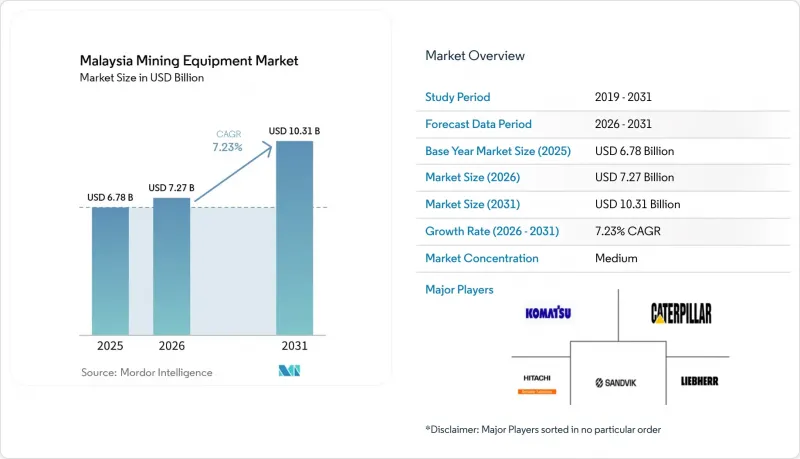
This report is Segmented by Equipment Type (Surface Mining Equipment and More), Automation Level (Manual and More), Powertrain Type (ICE and More), Power Output (Less Than 500 HP and More), Application (Metal and More), and Geography. The Market Forecasts are Provided in Value (USD) and Volume (Units).
Malaysia Mining Equipment Market Trends and Insights
Surging Demand for Critical Minerals for EV Supply Chain
Malaysia's battery-materials ambitions extend beyond bauxite and tin. Lynas shipped 4,600 t of NdPr oxide in H1 2025, up 12% year-on-year, supporting global magnet supply . Fortress Minerals ordered Metso crushers for Bukit Besi and Mengapur in 2025, thereby widening processing capacity for iron ore and copper-gold concentrates . Sabah's Botanickel phytomining trial uses hyperaccumulator plants to lift nickel from laterite soils, driving demand for high-pressure grinding rolls and flotation cells that carry higher ticket prices than bulk earthmovers. Equipment suppliers able to package mineral-processing units with water-recycling systems secure premium margins under stricter environmental rules.
Accelerating Adoption of Smart-Mining & Automation Solutions
Autonomous technology is moving from Australian mega-mines to mid-scale pits in Southeast Asia. Epiroc's SEK 380 million order in March 2026 marked one of the region's largest autonomous-fleet deals outside Australia . Komatsu's joint venture with Bangkok Motor Works, signed in November 2025, will assemble semi-autonomous excavators that bundle payload tracking and collision avoidance, trimming retrofit costs for Malaysian quarries. Hitachi's ZAXIS-7G range, launched in January 2024, sends real-time fuel, hydraulic, and wear data to cloud dashboards, cutting downtime by up to 30%. Sarawak's Centexs Lawas Green Mining Academy began training operators in December 2025, easing the skills gap that has slowed rollouts. Procurement frameworks now compare lifetime ownership cost, including software and connectivity, rather than upfront price alone.
Tougher Environmental Permitting & Bauxite Moratoriums
The 2016 bauxite ban, partly lifted in 2019, still forces operators to pave haul roads, cap stockpiles, and fit real-time water monitors, raising capital needs by up to 30%. Battery-electric fleets and dust-suppression packages from Sandvik and Epiroc meet compliance, but low-cost Chinese imports struggle without environmental certification. Lengthier environmental-impact studies stretch project lead times to 18-24 months, delaying replacement cycles and trimming near-term equipment orders.
Other drivers and restraints analyzed in the detailed report include:
- Government CAPEX in Oil & Gas Brown-Field Extensions
- Phytomining Pilots for Low-Impact Nickel Extraction
- Commodity-Price Volatility Limiting CAPEX Cycles
For complete list of drivers and restraints, kindly check the Table Of Contents.
Segment Analysis
Surface mining equipment accounted for 46.17% of the Malaysian mining equipment market in 2025, reflecting the dominance of open-pit bauxite, tin, and gold operations concentrated in Pahang and Perak. The segment's installed base favors high-capacity shovels, graders, and draglines that maintain low stripping ratios on lateritic orebodies. Loaders and haul trucks are forecast to expand at a 7.27% CAGR between 2026 and 2031, buoyed by Sandvik's battery-electric production line in Seremban and Komatsu's regional semi-autonomous assembly program. Demand for mineral-processing systems is also rising, following Fortress Minerals' September 2025 order of Metso crushers to raise throughput at Bukit Besi and Mengapur. Drills and breakers benefit from PETRONAS's brownfield subsea work, which requires hydraulic breakers and rotary rigs that share hydraulic subassemblies with mining gear, helping suppliers amortize R&D across sectors.
The second-order effect is a technological pivot: real-time ore-grade sensors now arrive factory-installed in crushers, letting operators tweak closed-circuit settings and cut reprocessing energy by up to 15%. Chinese battery-cell makers such as CATL and BYD are courting OEMs with modular, high-capacity packs, forcing incumbent diesel-engine suppliers to race to secure electrification partnerships. Taken together, these shifts support a balanced outlook in which the Malaysian mining equipment market size for surface machines continues to dominate in terms of volumes, but loaders and haul trucks capture the steepest value growth on the back of electrification and autonomy premiums.
Manual equipment still controlled 56.34% of the Malaysian mining equipment market share in 2025 because 2,496 workers operate small bauxite and tin pits that lack the scale for wired control rooms. Yet fully autonomous fleets are projected to post a 7.25% CAGR through 2031 as mid-scale copper-gold and limestone operators chase labor and safety dividends. Semi-autonomous machines, which bundle payload monitoring and collision avoidance without full driverless capability, offer a bridge for quarries that need incremental upgrades rather than greenfield digital platforms.
Skills shortages remain the chief friction point. The federal RM 1 billion up-skilling fund and Sarawak's Centexs Lawas Green Mining Academy aim to certify 500 technicians by 2027, closing the data-literacy gap that has slowed deployments. As training pipelines mature, procurement criteria are shifting from capex to total cost of ownership, including software licensing, over-the-air updates, and cybersecurity safeguards. This tiered adoption curve ensures the Malaysia mining equipment market size for manual units erodes gradually, while autonomous categories capture outsized margin expansion.
Complete Report Scope:
- By Equipment Type
- Surface Mining Equipment
- Underground Mining Equipment
- Mineral Processing Equipment
- Drills & Breakers
- Crushing, Pulverizing & Screening
- Loaders & Haul Trucks
- By Automation Level
- Manual Equipment
- Semi-Autonomous Equipment
- Fully Autonomous Equipment
- By Powertrain Type
- Internal-Combustion Engine Vehicles
- Battery-Electric Vehicles
- Hybrid Vehicles
- By Power Output
- Less than 500 HP
- 500 - 1,000 HP
- Above 1,000 HP
- By Application
- Metal Mining
- Mineral Mining
- Coal Mining
- Rare Earth Mining
- By Geography
- Peninsular Malaysia
- Perak
- Pahang
- Terengganu
- Johor
- Selangor
- East Malaysia
- Sabah
- Sarawak
- Federal Territory of Labuan
- Peninsular Malaysia
List of Companies Covered in this Report:
- Caterpillar Inc.
- Komatsu Ltd.
- Sandvik AB
- Epiroc AB
- Hitachi Construction Machinery Co. Ltd.
- Liebherr Group
- Volvo Construction Equipment
- Sany Heavy Equipment Intl. Holdings
- Zoomlion Heavy Industry Sci. & Tech.
- Terex Corporation
- HD Hyundai Infracore Co. Ltd.
- Goscor Group
- XCMG Group
- Atlas Copco AB
- FLSmidth
- UMW Holdings Berhad
- Sime Darby Industrial Sdn Bhd
- Sunway Construction Group Berhad
- Yinson Holdings Berhad
- Bahvest Resources Berhad
Additional Benefits:
- The market estimate (ME) sheet in Excel format
- 3 months of analyst support
TABLE OF CONTENTS
1 Introduction
- 1.1 Study Assumptions & Market Definition
- 1.2 Scope of the Study
2 Research Methodology
3 Executive Summary
4 Market Landscape
- 4.1 Market Overview
- 4.2 Market Drivers
- 4.2.1 Surging Demand for Critical Minerals for EV Supply Chain
- 4.2.2 Accelerating Adoption of Smart-Mining & Automation Solutions
- 4.2.3 Government CAPEX in Oil & Gas Brown-Field Extensions
- 4.2.4 Tax Incentives for Locally-Assembled Heavy Machinery
- 4.2.5 Boom in Small-Scale Bauxite & Ilmenite Operations
- 4.2.6 Phytomining Pilots for Low-Impact Nickel Extraction
- 4.3 Market Restraints
- 4.3.1 Tougher Environmental Permitting & Bauxite Moratoriums
- 4.3.2 Commodity-Price Volatility Limiting CAPEX Cycles
- 4.3.3 Skills Gap for Autonomous Equipment Deployment
- 4.3.4 Scarcity of High-Capacity Battery Packs for BEV Fleets
- 4.4 Value / Supply-Chain Analysis
- 4.5 Regulatory Landscape
- 4.6 Technological Outlook
- 4.7 Porter's Five Forces
- 4.7.1 Threat of New Entrants
- 4.7.2 Bargaining Power of Suppliers
- 4.7.3 Bargaining Power of Buyers
- 4.7.4 Threat of Substitutes
- 4.7.5 Competitive Rivalry
5 Market Size & Growth Forecasts (Value (USD) and Volume (Units))
- 5.1 By Equipment Type
- 5.1.1 Surface Mining Equipment
- 5.1.2 Underground Mining Equipment
- 5.1.3 Mineral Processing Equipment
- 5.1.4 Drills & Breakers
- 5.1.5 Crushing, Pulverizing & Screening
- 5.1.6 Loaders & Haul Trucks
- 5.2 By Automation Level
- 5.2.1 Manual Equipment
- 5.2.2 Semi-Autonomous Equipment
- 5.2.3 Fully Autonomous Equipment
- 5.3 By Powertrain Type
- 5.3.1 Internal-Combustion Engine Vehicles
- 5.3.2 Battery-Electric Vehicles
- 5.3.3 Hybrid Vehicles
- 5.4 By Power Output
- 5.4.1 Less than 500 HP
- 5.4.2 500 - 1,000 HP
- 5.4.3 Above 1,000 HP
- 5.5 By Application
- 5.5.1 Metal Mining
- 5.5.2 Mineral Mining
- 5.5.3 Coal Mining
- 5.5.4 Rare Earth Mining
- 5.6 By Geography
- 5.6.1 Peninsular Malaysia
- 5.6.1.1 Perak
- 5.6.1.2 Pahang
- 5.6.1.3 Terengganu
- 5.6.1.4 Johor
- 5.6.1.5 Selangor
- 5.6.2 East Malaysia
- 5.6.2.1 Sabah
- 5.6.2.2 Sarawak
- 5.6.2.3 Federal Territory of Labuan
- 5.6.1 Peninsular Malaysia
6 Competitive Landscape
- 6.1 Market Concentration
- 6.2 Strategic Moves
- 6.3 Market Share Analysis
- 6.4 Company Profiles (Includes Global Level Overview, Market Level Overview, Core Segments, Financials as Available, Strategic Information, Market Rank/Share for Key Companies, Products and Services, SWOT Analysis, and Recent Developments)
- 6.4.1 Caterpillar Inc.
- 6.4.2 Komatsu Ltd.
- 6.4.3 Sandvik AB
- 6.4.4 Epiroc AB
- 6.4.5 Hitachi Construction Machinery Co. Ltd.
- 6.4.6 Liebherr Group
- 6.4.7 Volvo Construction Equipment
- 6.4.8 Sany Heavy Equipment Intl. Holdings
- 6.4.9 Zoomlion Heavy Industry Sci. & Tech.
- 6.4.10 Terex Corporation
- 6.4.11 HD Hyundai Infracore Co. Ltd.
- 6.4.12 Goscor Group
- 6.4.13 XCMG Group
- 6.4.14 Atlas Copco AB
- 6.4.15 FLSmidth
- 6.4.16 UMW Holdings Berhad
- 6.4.17 Sime Darby Industrial Sdn Bhd
- 6.4.18 Sunway Construction Group Berhad
- 6.4.19 Yinson Holdings Berhad
- 6.4.20 Bahvest Resources Berhad
7 Market Opportunities & Future Outlook
- 7.1 White-space & Unmet-Need Assessment

