PUBLISHER: Mordor Intelligence | PRODUCT CODE: 2184615

PUBLISHER: Mordor Intelligence | PRODUCT CODE: 2184615
Asia-Pacific Food Flavor - Market Share Analysis, Industry Trends & Statistics, Growth Forecasts (2026 - 2031)
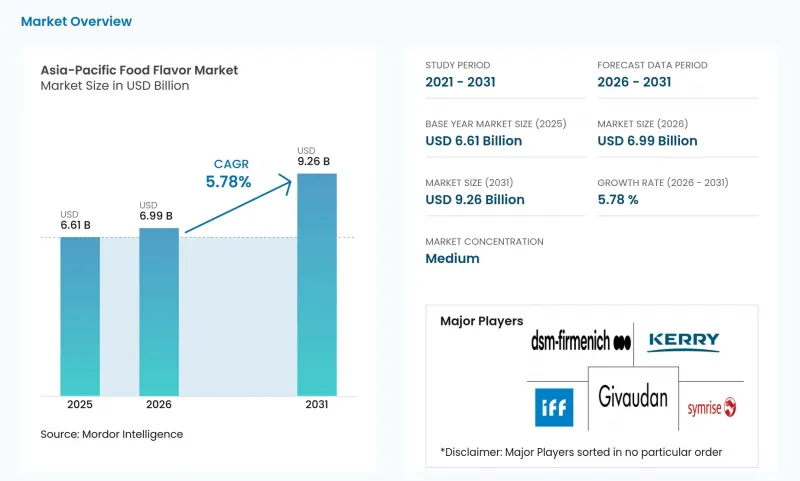
According to Mordor Intelligence, the Asia-Pacific food flavor market was valued at USD 6.61 billion in 2025 and is estimated to grow from USD 6.99 billion in 2026 to reach USD 9.26 billion by 2031, at a CAGR of 5.78% during the forecast period (2026-2031).
Asia-Pacific Food Flavor Market Trends and Insights
Rising Demand for Convenience and Ready-to-Eat Foods
Rising demand for convenience and ready-to-eat foods is driving the Asia-Pacific food flavors market, as consumers increasingly seek products that deliver consistent taste, aroma, and sensory appeal with minimal preparation time. The growing popularity of instant meals is encouraging manufacturers to develop flavor formulations that retain seasoning intensity, withstand processing and storage conditions, and deliver reliable taste upon preparation. According to the World Instant Noodles Association (WINA), instant noodle demand in 2025 reached 43.27 billion servings in China/Hong Kong and 14.54 billion servings in Indonesia, highlighting the substantial consumption of convenient food products in these markets. This sustained demand creates opportunities for flavor suppliers to develop differentiated seasoning blends, savory profiles, and customized flavor systems that meet evolving consumer preferences while maintaining consistency across large-scale production.
Growing Preference for Natural and Clean-Label Flavoring Ingredients
Consumer preference for natural and clean-label flavoring ingredients is encouraging food manufacturers across Asia-Pacific to reconsider ingredient selection and formulation strategies. According to Cargill's Asia-Pacific IngredienTracker 2025 study, more than 70% of surveyed consumers across China, Indonesia, Australia, and Japan checked product labels before purchasing, reflecting greater attention to ingredient composition and transparency. The study also found that consumers tended to perceive familiar, natural-sounding, and plant-based ingredients more favorably than unfamiliar or scientific-sounding ingredients. These preferences are prompting manufacturers to explore naturally derived flavor compounds, botanical extracts, and simpler ingredient declarations to strengthen consumer trust.
Complex and Stringent Food Safety and Flavor Ingredient Regulations
Complex and stringent food safety regulations are restraining the Asia-Pacific food flavors market by increasing compliance requirements, formulation review costs, and the time required to commercialize flavor ingredients. For instance, China implemented GB 2760-2024, its revised National Food Safety Standard for the Use of Food Additives, on February 8, 2025, replacing GB 2760-2014. According to China's State Administration for Market Regulation, the revised standard modifies provisions for certain food flavoring substances, flavoring essences, preservatives, and processing aids. It also requires affected food manufacturers to review product formulations, ingredient-use conditions, and labeling to ensure compliance. These changes can increase regulatory assessment and reformulation costs for flavor suppliers and their customers, particularly when existing ingredients or applications require reassessment.
Other drivers and restraints analyzed in the detailed report include:
- Increasing Demand for Bold, Spicy, Savory and Umami Flavor Profiles
- Advancements in Flavor Encapsulation and Delivery Technologies
- High Costs of Natural Flavor Extraction and Standardization
For complete list of drivers and restraints, kindly check the Table Of Contents.
Segment Analysis
Synthetic flavor accounts for 61.92% of the Asia-Pacific food flavors market in 2025, supported by its ability to deliver precise sensory characteristics, predictable ingredient performance, and reproducible flavor profiles through controlled chemical synthesis. The segment benefits from the availability of individual aroma compounds that can be combined in specific proportions to achieve targeted flavor characteristics, giving formulators greater control over the intensity, balance, and uniformity of finished formulations. Unlike flavor ingredients whose composition can vary with agricultural conditions or extraction methods, synthetic compounds can be manufactured to defined specifications, supporting tighter quality control and reducing variability in formulation outcomes.
Natural flavor is the fastest-growing segment in the Asia-Pacific food flavors market, registering a CAGR of 7.49% over 2026-2031, driven by increasing preference for ingredients derived from recognizable natural sources and growing interest in the origin and composition of flavoring ingredients. Advances in extraction, distillation, enzymatic processing, and bioconversion are expanding the range of natural flavor profiles that manufacturers can develop, while improving control over aroma characteristics and ingredient consistency. The availability of diverse botanical materials, including herbs, spices, fruits, flowers, and plant extracts, provides flavor developers with opportunities to create distinctive sensory profiles aligned with evolving product formulation requirements.
Complete Report Scope:
- By Flavor Type
- Natural Flavor
- Synthetic Flavor
- Nature Identical Flavoring
- By Form
- Powder
- Liquid
- Others
- By Application
- Dairy
- Bakery
- Confectionery
- Savory Snack
- Meat and Seafood
- Beverage
- Other Food Applications
- By Country
- China
- India
- Japan
- Australia
- Indonesia
- South Korea
- Thailand
- Singapore
- Rest of Asia-Pacific
List of Companies Covered in this Report:
- Givaudan S.A.
- International Flavors & Fragrances Inc.
- Symrise AG
- DSM-Firmenich AG
- Kerry Group plc
- Sensient Technologies Corporation
- Takasago International Corporation
- Archer Daniels Midland Company
- Cargill, Incorporated
- MANE Group
- Robertet SA
- T. Hasegawa Co., Ltd.
- Huabao International Holdings Limited
- Zhejiang NHU Co., Ltd.
- Shanghai Apple Flavor & Fragrance Co., Ltd.
- Guangzhou Baihua Flavour & Fragrance Company Limited
- Dohler GmbH
- McCormick & Company, Incorporated
- Synergy Flavors, Inc.
- PT Indesso Aroma
Additional Benefits:
- The market estimate (ME) sheet in Excel format
- 3 months of analyst support
TABLE OF CONTENTS
1 INTRODUCTION
- 1.1 Study Assumptions and Market Definition
- 1.2 Scope of the Study
2 RESEARCH METHODOLOGY
3 EXECUTIVE SUMMARY
4 MARKET LANDSCAPE
- 4.1 Market Overview
- 4.2 Market Drivers
- 4.2.1 Rising Demand for Convenience and Ready-to-Eat Foods
- 4.2.2 Growing Preference for Natural and Clean-Label Flavoring Ingredients
- 4.2.3 Increasing Demand for Bold, Spicy, Savory and Umami Flavor Profiles
- 4.2.4 Advancements in Flavor Encapsulation and Delivery Technologies
- 4.2.5 Growing Popularity of Korean, Japanese and Other Asian-Inspired Flavors
- 4.2.6 Expansion of Specialty Beverages and Innovative Beverage Flavor Profiles
- 4.3 Market Restraints
- 4.3.1 Complex and Stringent Food Safety and Flavor Ingredient Regulations
- 4.3.2 High Costs of Natural Flavor Extraction and Standardization
- 4.3.3 Dependence on Imported Specialty Flavor Ingredients and Supply Chain Vulnerabilities
- 4.3.4 Allergen Cross-Contact Risks and Associated Quality-Control Costs
- 4.4 Supply Chain Analysis
- 4.5 Regulatory Landscape
- 4.6 Technological Outlook
- 4.7 Porter's Five Forces Analysis
- 4.7.1 Threat of New Entrants
- 4.7.2 Bargaining Power of Buyers
- 4.7.3 Bargaining Power of Suppliers
- 4.7.4 Threat of Substitutes
- 4.7.5 Intensity of Competitive Rivalry
5 MARKET SIZE AND GROWTH FORECASTS (VALUE)
- 5.1 By Flavor Type
- 5.1.1 Natural Flavor
- 5.1.2 Synthetic Flavor
- 5.1.3 Nature Identical Flavoring
- 5.2 By Form
- 5.2.1 Powder
- 5.2.2 Liquid
- 5.2.3 Others
- 5.3 By Application
- 5.3.1 Dairy
- 5.3.2 Bakery
- 5.3.3 Confectionery
- 5.3.4 Savory Snack
- 5.3.5 Meat and Seafood
- 5.3.6 Beverage
- 5.3.7 Other Food Applications
- 5.4 By Country
- 5.4.1 China
- 5.4.2 India
- 5.4.3 Japan
- 5.4.4 Australia
- 5.4.5 Indonesia
- 5.4.6 South Korea
- 5.4.7 Thailand
- 5.4.8 Singapore
- 5.4.9 Rest of Asia-Pacific
6 COMPETITIVE LANDSCAPE
- 6.1 Market Concentration
- 6.2 Strategic Moves
- 6.3 Market Positioning Analysis
- 6.4 Company Profiles (includes Global level Overview, Market level overview, Core Segments, Financials as available, Strategic Information, Market Rank/Share for key companies, Products and Services, and Recent Developments)
- 6.4.1 Givaudan S.A.
- 6.4.2 International Flavors & Fragrances Inc.
- 6.4.3 Symrise AG
- 6.4.4 DSM-Firmenich AG
- 6.4.5 Kerry Group plc
- 6.4.6 Sensient Technologies Corporation
- 6.4.7 Takasago International Corporation
- 6.4.8 Archer Daniels Midland Company
- 6.4.9 Cargill, Incorporated
- 6.4.10 MANE Group
- 6.4.11 Robertet SA
- 6.4.12 T. Hasegawa Co., Ltd.
- 6.4.13 Huabao International Holdings Limited
- 6.4.14 Zhejiang NHU Co., Ltd.
- 6.4.15 Shanghai Apple Flavor & Fragrance Co., Ltd.
- 6.4.16 Guangzhou Baihua Flavour & Fragrance Company Limited
- 6.4.17 Dohler GmbH
- 6.4.18 McCormick & Company, Incorporated
- 6.4.19 Synergy Flavors, Inc.
- 6.4.20 PT Indesso Aroma
7 MARKET OPPORTUNITIES AND FUTURE OUTLOOK

