PUBLISHER: Mordor Intelligence | PRODUCT CODE: 2184635

PUBLISHER: Mordor Intelligence | PRODUCT CODE: 2184635
Asia-Pacific Food Flavors and Enhancers - Market Share Analysis, Industry Trends & Statistics, Growth Forecasts (2026 - 2031)
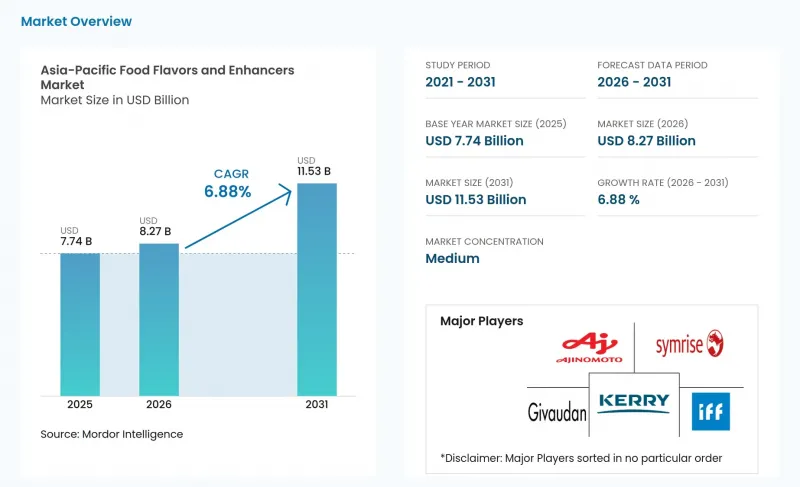
According to Mordor Intelligence, the Asia-Pacific food flavors and enhancers market was valued at USD 7.74 billion in 2025 and is estimated to grow from USD 8.27 billion in 2026 to reach USD 11.53 billion by 2031, at a CAGR of 6.88% during the forecast period (2026-2031).
Asia-Pacific Food Flavors and Enhancers Market Trends and Insights
Rising Demand for Authentic Regional and Ethnic Flavors
Growing consumer interest in distinctive taste experiences, traditional culinary heritage, and region-specific food preferences is encouraging manufacturers to incorporate authentic ethnic flavors and innovative combinations inspired by local cuisines. The appeal of regional seasonings, indigenous spices, and culturally familiar taste profiles is driving greater experimentation with flavor formulations that preserve traditional characteristics while introducing new sensory experiences. This trend is reinforcing the importance of flavor customization, as consumers increasingly associate distinctive tastes with product quality, authenticity, and memorable eating experiences. For instance, according to Cargill's 2025 Indulgence Study for Southeast Asia, 70% of surveyed consumers were willing to pay more for unique tastes, with innovative flavors driving increased purchases. This willingness to pay for distinctive taste experiences is encouraging continued flavor innovation and supporting demand for authentic regional and ethnic flavor solutions across the Asia-Pacific food industry.
Growing Consumption of Convenience Food Products
Growing demand for convenient, quick-to-prepare meals is encouraging food manufacturers to expand their portfolios of instant noodles, ready-to-eat meals, packaged soups, and other convenience food products. As consumers seek products that require minimal preparation while delivering consistent taste experiences, manufacturers are placing greater emphasis on flavor formulations that preserve sensory quality, improve taste intensity, and differentiate products in competitive categories. For instance, according to the World Instant Noodles Association (WINA), global instant noodle demand reached 123.07 billion servings in 2024, with China and Hong Kong accounting for 43.80 billion servings and Indonesia recording 14.68 billion servings. This substantial consumption across Asian markets underlines the importance of convenient food formats and supports demand for specialized seasoning blends, savory flavor compounds, spice extracts, and taste enhancers.
Stringent Regulations Governing Flavor Ingredients
Strict food safety requirements, additive approval procedures, and labeling standards across Asia-Pacific can constrain the development and commercialization of flavor ingredients. Manufacturers must ensure that flavoring substances comply with permitted-use conditions, purity specifications, maximum usage limits, and applicable declaration requirements in each target market. Differences in national regulatory frameworks can further complicate product formulation, cross-border trade, and market entry, requiring additional testing, documentation, and compliance management. Changes in ingredient approval requirements and restrictions on certain additives may also necessitate reformulation, increasing product development timelines and operational complexity.
Other drivers and restraints analyzed in the detailed report include:
- Expansion of Plant-based Food and Alternative Protein Products
- Innovation in Flavor Development and Manufacturing
- Volatility in Natural Flavor Raw Material Availability
For complete list of drivers and restraints, kindly check the Table Of Contents.
Segment Analysis
Food flavors dominated the Asia-Pacific Food Flavors and Enhancers Market in 2025, accounting for a 79.13% share. This dominance is attributed to their essential role in establishing distinctive sensory identities and maintaining desired taste characteristics in finished food products. The segment's position is reinforced by the growing emphasis on flavor precision, consistency, and product differentiation, as manufacturers seek to develop formulations that deliver recognizable and repeatable sensory experiences. Improvements in flavor chemistry, extraction methods, and blending technologies are enabling the development of more sophisticated flavor profiles, including greater control over aroma intensity, taste complexity, and flavor release. The ability to combine complementary flavor compounds also helps manufacturers achieve a balanced sensory profile while minimizing undesirable notes arising from ingredient interactions or processing conditions.
Food enhancers are the fastest-growing product type in the Asia-Pacific Food Flavors and Enhancers Market, registering a CAGR of 7.61% over 2026-2031. Their growth is driven by increasing demand for ingredients that intensify umami, improve taste depth, and create a more rounded sensory profile in formulated foods. Ingredients such as yeast extracts, nucleotides, and other taste-modifying compounds help strengthen savory notes, balance flavor profiles, and minimize undesirable aftertastes. The growing emphasis on sodium reduction is further encouraging the use of enhancers that preserve savory intensity when salt levels are lowered. Advances in ingredient formulation are also enabling more precise control over taste perception and flavor interactions, supporting the development of products with improved sensory consistency.
Synthetic flavors dominated the Asia-Pacific food flavors and enhancers market by type in 2025, accounting for a 71.13% share. This dominance is driven by their formulation precision, consistent sensory performance, and suitability for large-scale manufacturing. These ingredients enable manufacturers to reproduce specific taste and aroma profiles with greater control over flavor intensity, composition, and batch-to-batch uniformity. Their predictable performance under varying processing conditions also helps minimize fluctuations in the sensory characteristics of finished products. Additionally, the ability to develop standardized flavor compounds with defined chemical properties supports efficient formulation, quality assurance, and production planning. These advantages reinforce the widespread use of synthetic flavors among manufacturers seeking reliable sensory outcomes, reproducible formulations, and greater control over product specifications.
Natural flavors are projected to be the fastest-growing type in the Asia-Pacific food flavors and enhancers market, registering a CAGR of 7.95% during 2026-2031. Growth is supported by increasing interest in naturally derived ingredients and the development of flavor formulations based on botanical extracts, essential oils, spices, herbs, and fruit-derived compounds. Improvements in extraction, fractionation, and flavor recovery technologies are enabling manufacturers to preserve delicate aroma characteristics and develop more complex sensory profiles from natural sources. The segment is also benefiting from greater emphasis on ingredient transparency and clean-label product positioning, encouraging manufacturers to explore naturally derived flavor solutions.
Complete Report Scope:
- By Product Type
- Food Flavors
- Food Enhancers
- By Type
- Natural
- Synthetic
- Nature Identical
- By Form
- Powder
- Liquid
- Others
- By Application
- Dairy
- Bakery
- Confectionery
- Savory Snacks
- Meat
- Beverages
- Other Applications
- By Geography
- China
- India
- Japan
- Australia
- South Korea
- Thailand
- Indonesia
- Singapore
- Rest of Asia-Pacific
List of Companies Covered in this Report:
- Ajinomoto Co., Inc.
- Givaudan S.A.
- Symrise AG
- International Flavors & Fragrances Inc.
- Kerry Group plc
- Takasago International Corporation
- DSM-Firmenich AG
- Sensient Technologies Corporation
- Archer Daniels Midland Company
- Tate & Lyle PLC
- Angel Yeast Co., Ltd.
- Fufeng Group Limited
- Meihua Holdings Group Co., Ltd.
- Vedan International (Holdings) Limited
- CJ CheilJedang Corporation
- Kikkoman Corporation
- Dohler Group SE
- Lesaffre et Compagnie
- Mane SA
- Robertet Group
Additional Benefits:
- The market estimate (ME) sheet in Excel format
- 3 months of analyst support
TABLE OF CONTENTS
1 INTRODUCTION
- 1.1 Study Assumptions and Market Definition
- 1.2 Scope of the Study
2 RESEARCH METHODOLOGY
3 EXECUTIVE SUMMARY
4 MARKET LANDSCAPE
- 4.1 Market Overview
- 4.2 Market Drivers
- 4.2.1 Rising demand for authentic regional and ethnic flavors
- 4.2.2 Growing consumption of convenience food products
- 4.2.3 Expansion of plant-based food and alternative protein products
- 4.2.4 Innovation in flavor development and manufacturing
- 4.2.5 Growing demand for clean-label flavor ingredients
- 4.2.6 Demand for sugar-free and reduced-calorie confectionery
- 4.3 Market Restraints
- 4.3.1 Stringent regulations governing flavor ingredients
- 4.3.2 Volatility in natural flavor raw material availability
- 4.3.3 High costs of natural and clean-label flavor ingredients
- 4.3.4 Complexity of maintaining flavor stability during processing
- 4.4 Supply Chain Analysis
- 4.5 Regulatory Landscape
- 4.6 Technological Outlook
- 4.7 Porter's Five Forces Analysis
- 4.7.1 Threat of New Entrants
- 4.7.2 Bargaining Power of Buyers
- 4.7.3 Bargaining Power of Suppliers
- 4.7.4 Threat of Substitutes
- 4.7.5 Intensity of Competitive Rivalry
5 MARKET SIZE AND GROWTH FORECASTS (VALUE)
- 5.1 By Product Type
- 5.1.1 Food Flavors
- 5.1.2 Food Enhancers
- 5.2 By Type
- 5.2.1 Natural
- 5.2.2 Synthetic
- 5.2.3 Nature Identical
- 5.3 By Form
- 5.3.1 Powder
- 5.3.2 Liquid
- 5.3.3 Others
- 5.4 By Application
- 5.4.1 Dairy
- 5.4.2 Bakery
- 5.4.3 Confectionery
- 5.4.4 Savory Snacks
- 5.4.5 Meat
- 5.4.6 Beverages
- 5.4.7 Other Applications
- 5.5 By Geography
- 5.5.1 China
- 5.5.2 India
- 5.5.3 Japan
- 5.5.4 Australia
- 5.5.5 South Korea
- 5.5.6 Thailand
- 5.5.7 Indonesia
- 5.5.8 Singapore
- 5.5.9 Rest of Asia-Pacific
6 COMPETITIVE LANDSCAPE
- 6.1 Market Concentration
- 6.2 Strategic Moves
- 6.3 Market Positioning Analysis
- 6.4 Company Profiles (includes Global level Overview, Market level overview, Core Segments, Financials as available, Strategic Information, Market Rank/Share for key companies, Products and Services, and Recent Developments)
- 6.4.1 Ajinomoto Co., Inc.
- 6.4.2 Givaudan S.A.
- 6.4.3 Symrise AG
- 6.4.4 International Flavors & Fragrances Inc.
- 6.4.5 Kerry Group plc
- 6.4.6 Takasago International Corporation
- 6.4.7 DSM-Firmenich AG
- 6.4.8 Sensient Technologies Corporation
- 6.4.9 Archer Daniels Midland Company
- 6.4.10 Tate & Lyle PLC
- 6.4.11 Angel Yeast Co., Ltd.
- 6.4.12 Fufeng Group Limited
- 6.4.13 Meihua Holdings Group Co., Ltd.
- 6.4.14 Vedan International (Holdings) Limited
- 6.4.15 CJ CheilJedang Corporation
- 6.4.16 Kikkoman Corporation
- 6.4.17 Dohler Group SE
- 6.4.18 Lesaffre et Compagnie
- 6.4.19 Mane SA
- 6.4.20 Robertet Group
7 MARKET OPPORTUNITIES AND FUTURE OUTLOOK

