PUBLISHER: Mordor Intelligence | PRODUCT CODE: 2184653

PUBLISHER: Mordor Intelligence | PRODUCT CODE: 2184653
United States Food Flavor - Market Share Analysis, Industry Trends & Statistics, Growth Forecasts (2026 - 2031)
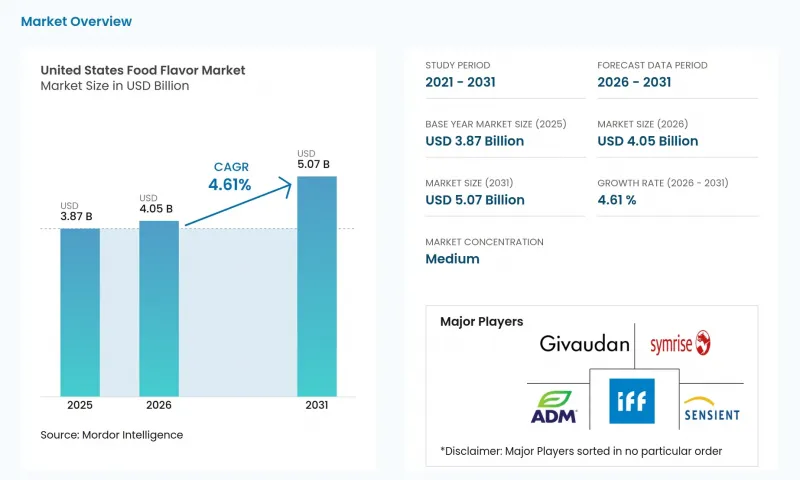
According to Mordor Intelligence, the United States food flavor market was valued at USD 3.87 billion in 2025 and is estimated to grow from USD 4.05 billion in 2026 to reach USD 5.07 billion by 2031, registering a CAGR of 4.61% during 2026-2031.
United States Food Flavor Market Trends and Insights
Growing Demand for Clean-Label Food Products
Growing demand for clean-label food products is encouraging manufacturers to prioritize ingredient transparency, recognizable ingredients, and formulations that align with consumer expectations around food quality and processing. According to the National Sanitation Foundation (NSF) 2025 survey, 79% of United States consumers checked ingredient lists when reading food labels before making a purchase. This interest in ingredient information is prompting food manufacturers to reassess flavor formulations and consider natural flavoring ingredients, simpler ingredient declarations, and alternatives to certain artificial additives. These trends are supporting demand for clean-label flavor solutions that help manufacturers maintain taste, aroma, and product consistency while meeting evolving consumer expectations.
Increasing Popularity of Plant-Based Food Products
The growing popularity of plant-based food products is driving demand for specialized flavor solutions that improve taste, aroma, and overall sensory appeal. As manufacturers expand their portfolios of plant-based meat alternatives, dairy-free beverages, cheese alternatives, and vegan prepared foods, they require flavors that replicate familiar animal-based products while masking undesirable earthy, bitter, or beany notes associated with plant proteins. For instance, according to the Plant Based Foods Association (PBFA), 60% of United States households purchased plant-based foods in 2025, highlighting the broad reach of the category. This growing consumer adoption is encouraging manufacturers to develop more authentic savory, meaty, creamy, and dairy-like flavor profiles, supporting demand for flavor formulations tailored to plant-based products.
Stringent Regulatory Requirements for Flavor Ingredients
Stringent regulatory requirements for flavor ingredients restrain the United States Food Flavor Market by increasing compliance costs, extending product development timelines, and limiting the use of certain ingredients in food formulations. The Food and Drug Administration (FDA) oversees food additive authorizations, safety requirements, and ingredient labeling, requiring manufacturers to ensure that flavoring substances meet relevant regulatory standards. Restrictions on specific flavoring substances can necessitate reformulation, additional safety assessments, supplier verification, and product label revisions. These requirements create technical and operational challenges for flavor manufacturers, particularly when replacing established ingredients with suitable alternatives while maintaining the desired taste, aroma, stability, and consistency.
Other drivers and restraints analyzed in the detailed report include:
- Innovation in Reduced-Sugar and Sugar-Free Products
- Demand for Premium and Novel Flavor Experiences
- Volatility in Natural Flavor Ingredient Availability
For complete list of drivers and restraints, kindly check the Table Of Contents.
Segment Analysis
Synthetic flavors held a 62.35% share of the United States food flavor market in 2025, supported by their ability to deliver consistent taste profiles, predictable flavor intensity, and reliable performance across repeated production batches. Their chemically defined compositions allow manufacturers to reproduce specific flavor characteristics with greater precision, reducing variations associated with differences in raw material quality and seasonal sourcing. Synthetic flavor compounds also offer formulation flexibility, enabling flavor developers to adjust aroma strength, taste balance, and sensory characteristics according to product specifications. Their compatibility with industrial processing conditions and suitability for standardized manufacturing processes further support their continued use, particularly when maintaining uniform product quality throughout production cycles is essential.
Natural flavors are the fastest-growing flavor type in the United States food flavor market, projected to register a CAGR of 5.81% during 2026-2031. Growth is supported by increasing consumer interest in natural ingredients and greater attention to food production and ingredient transparency. For instance, according to the International Food Information Council (IFIC), 41% of Americans looked for natural label claims when shopping for food and beverages in 2025, making it the most frequently sought food production claim. This preference encourages food manufacturers to explore naturally derived flavoring ingredients to align product formulations with consumer expectations.
Complete Report Scope:
- By Flavor Type
- Natural Flavor
- Synthetic Flavor
- Nature Identical Flavoring
- By Form
- Powder
- Liquid
- Others
- By Application
- Dairy
- Bakery
- Confectionery
- Savory Snack
- Meat
- Beverage
- Other Applications
List of Companies Covered in this Report:
- Givaudan S.A.
- International Flavors & Fragrances Inc.
- Symrise AG
- Archer Daniels Midland Company
- Sensient Technologies Corporation
- Kerry Group plc
- dsm-firmenich AG
- Takasago International Corporation
- MANE
- Robertet S.A.
- Flavorchem Corporation
- Bell Flavors and Fragrances, Inc.
- T. Hasegawa Co., Ltd.
- Kalsec Inc.
- Corbion N.V.
- Huabao International Holdings Limited
- Synergy Flavors, Inc.
- Blue Pacific Flavors, Inc.
- Aurochemicals, Inc.
- The Flavor Factory, Inc.
Additional Benefits:
- The market estimate (ME) sheet in Excel format
- 3 months of analyst support
TABLE OF CONTENTS
1 INTRODUCTION
- 1.1 Study Assumptions and Market Definition
- 1.2 Scope of the Study
2 RESEARCH METHODOLOGY
3 EXECUTIVE SUMMARY
4 MARKET LANDSCAPE
- 4.1 Market Overview
- 4.2 Market Drivers
- 4.2.1 Growing demand for clean-label food products
- 4.2.2 Increasing popularity of plant-based food products
- 4.2.3 Innovation in reduced-sugar and sugar-free products
- 4.2.4 Demand for premium and novel flavor experiences
- 4.2.5 Precision fermentation and biotechnology-enabled flavor development
- 4.2.6 Expansion of ready-to-eat and convenience foods
- 4.3 Market Restraints
- 4.3.1 Stringent regulatory requirements for flavor ingredients
- 4.3.2 Volatility in natural flavor ingredient availability
- 4.3.3 Flavor instability during food processing and storage
- 4.3.4 Supply chain disruptions for specialty flavor ingredients
- 4.4 Supply Chain Analysis
- 4.5 Regulatory Landscape
- 4.6 Technological Outlook
- 4.7 Porter's Five Forces Analysis
- 4.7.1 Threat of New Entrants
- 4.7.2 Bargaining Power of Buyers
- 4.7.3 Bargaining Power of Suppliers
- 4.7.4 Threat of Substitutes
- 4.7.5 Intensity of Competitive Rivalry
5 MARKET SIZE AND GROWTH FORECASTS (VALUE)
- 5.1 By Flavor Type
- 5.1.1 Natural Flavor
- 5.1.2 Synthetic Flavor
- 5.1.3 Nature Identical Flavoring
- 5.2 By Form
- 5.2.1 Powder
- 5.2.2 Liquid
- 5.2.3 Others
- 5.3 By Application
- 5.3.1 Dairy
- 5.3.2 Bakery
- 5.3.3 Confectionery
- 5.3.4 Savory Snack
- 5.3.5 Meat
- 5.3.6 Beverage
- 5.3.7 Other Applications
6 COMPETITIVE LANDSCAPE
- 6.1 Market Concentration
- 6.2 Strategic Moves
- 6.3 Market Positioning Analysis
- 6.4 Company Profiles (includes Global level Overview, Market level overview, Core Segments, Financials as available, Strategic Information, Market Rank/Share for key companies, Products and Services, and Recent Developments)
- 6.4.1 Givaudan S.A.
- 6.4.2 International Flavors & Fragrances Inc.
- 6.4.3 Symrise AG
- 6.4.4 Archer Daniels Midland Company
- 6.4.5 Sensient Technologies Corporation
- 6.4.6 Kerry Group plc
- 6.4.7 dsm-firmenich AG
- 6.4.8 Takasago International Corporation
- 6.4.9 MANE
- 6.4.10 Robertet S.A.
- 6.4.11 Flavorchem Corporation
- 6.4.12 Bell Flavors and Fragrances, Inc.
- 6.4.13 T. Hasegawa Co., Ltd.
- 6.4.14 Kalsec Inc.
- 6.4.15 Corbion N.V.
- 6.4.16 Huabao International Holdings Limited
- 6.4.17 Synergy Flavors, Inc.
- 6.4.18 Blue Pacific Flavors, Inc.
- 6.4.19 Aurochemicals, Inc.
- 6.4.20 The Flavor Factory, Inc.
7 MARKET OPPORTUNITIES AND FUTURE OUTLOOK

