PUBLISHER: Mordor Intelligence | PRODUCT CODE: 2184623

PUBLISHER: Mordor Intelligence | PRODUCT CODE: 2184623
South America Food Flavors and Enhancers - Market Share Analysis, Industry Trends & Statistics, Growth Forecasts (2026 - 2031)
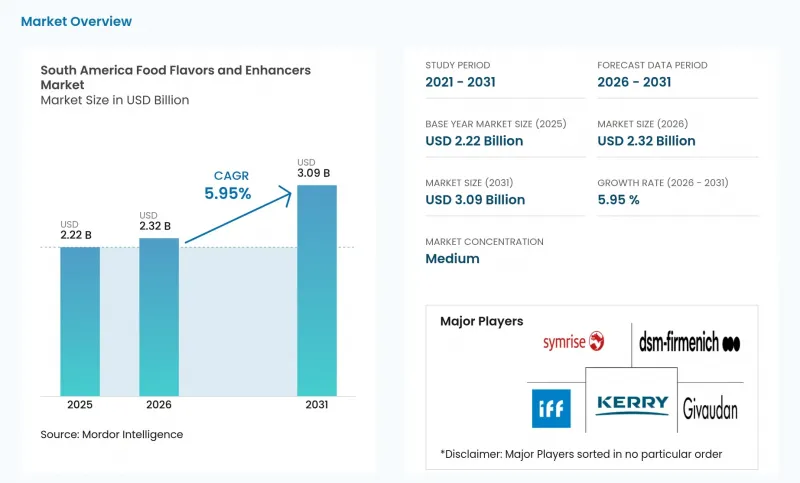
According to Mordor Intelligence, the South America food flavors and Enhancers Market was valued at USD 2.22 billion in 2025 and is estimated to grow from USD 2.32 billion in 2026 to reach USD 3.09 billion by 2031, at a CAGR of 5.95% during the forecast period (2026-2031).
South America Food Flavors and Enhancers Market Trends and Insights
Expansion of the Meat and Processed Meat Industry
The growth of the meat and processed meat industry is driving demand for food flavors and enhancers, as manufacturers seek to develop distinctive savory profiles, improve taste consistency, and enhance the sensory quality of meat-based products. Flavor ingredients such as smoke, roasted, grilled, peppery, and umami notes help manufacturers differentiate processed meat formulations while maintaining consistent flavor characteristics across production batches. According to the Brazilian Beef Exporters Association (ABIEC), Brazil slaughtered 47.79 million cattle in 2025, produced 12.35 million tonnes of beef in carcass-weight equivalent, and exported USD 18 billion worth of beef to 177 countries. This scale of production and export activity underlines the size of Brazil's beef industry and the opportunities for flavor solutions that support sensory consistency, product differentiation, and the evolving requirements of meat processing.
Increasing Demand for Sodium-Reduction and Taste-Modulation Solutions
The growing focus on reducing sodium content without compromising sensory quality is driving demand for food flavors and enhancers across South America. Food manufacturers are increasingly incorporating yeast extracts, umami compounds, flavor potentiators, and taste-modulation ingredients to preserve savory intensity and compensate for taste changes associated with lower salt levels. These solutions help balance flavor profiles, reduce bitterness, improve mouthfeel, and maintain palatability in reformulated products. Advances in flavor-modulation technologies are enabling manufacturers to address complex sensory challenges while meeting product formulation targets and consumer expectations. Additionally, the need to maintain recognizable taste characteristics during reformulation is encouraging ingredient suppliers to develop customized flavor systems that deliver greater control over salt perception and overall flavor intensity.
Stringent Food Safety and Labeling Regulations
Stringent food safety requirements and labeling regulations restrain the South America Food Flavors and Enhancers Market by increasing compliance costs, extending product approval timelines, and complicating the introduction of new flavoring ingredients. Manufacturers and ingredient suppliers must ensure that flavoring compounds meet applicable authorization requirements, permitted-use conditions, safety standards, and labeling obligations before commercialization. Brazil's National Health Surveillance Agency (ANVISA) operates a comprehensive regulatory framework for food flavoring additives, with Resolution RDC No. 725/2022 establishing requirements for flavorings and their use in food. Compliance with these provisions can require additional documentation, technical assessments, and formulation adjustments, particularly when introducing novel or modified flavor systems.
Other drivers and restraints analyzed in the detailed report include:
- Growing Consumer Preference for Spicy, Smoky, and Bold Flavor Profiles
- Rising Demand for Natural Flavors and Clean-Label Ingredients
- Supply Chain and Storage Limitations
For complete list of drivers and restraints, kindly check the Table Of Contents.
Segment Analysis
Food flavors hold a 77.69% market share in 2025, supported by their versatility in flavor formulation and their ability to deliver precise sensory characteristics across diverse product development requirements. The scale of the food processing industry further strengthens this demand. According to the United States Department of Agriculture (USDA), Brazil had approximately 42,000 active food processing companies in 2025, reflecting a substantial manufacturing base that requires ingredients to support product formulation and sensory consistency. This extensive processing ecosystem provides opportunities for flavor suppliers to serve manufacturers seeking differentiated formulations.
Food enhancers are the fastest-growing product segment, projected to expand at a 7.67% CAGR over 2026-2031, driven by food manufacturers' increasing focus on improving taste intensity, strengthening savory notes, and optimizing sensory performance without substantially changing product formulations. Ingredients such as yeast extracts, umami compounds, flavor potentiators, and taste modulators are gaining relevance because they help balance flavor profiles, reduce undesirable aftertastes, and maintain palatability in reformulated products. The segment also benefits from growing demand for sodium-reduction solutions, as manufacturers use flavor enhancers to preserve savory depth when lowering salt content.
Synthetic flavors held a 70.61% market share in 2025, supported by their cost-effectiveness, consistent sensory performance, and suitability for large-scale food manufacturing. Their ability to deliver standardized taste profiles with controlled intensity and stability enables manufacturers to maintain uniform product quality across production batches. Synthetic flavor compounds also offer greater formulation precision, allowing specific aroma and taste characteristics to be reproduced without relying on the natural variability of agricultural raw materials. Their versatility in flavor design, predictable performance during processing, and availability across a broad range of taste profiles reinforce their established position in commercial formulations. These characteristics continue to support demand from food ingredient manufacturers seeking reliable, scalable solutions for consistent sensory outcomes.
Natural flavors are forecast to grow at a CAGR of 8.56% over 2026-2031, driven by increasing interest in recognizable ingredient sources and flavor formulations aligned with clean-label product positioning. Extracts derived from fruits, herbs, spices, botanicals, and other natural materials offer manufacturers opportunities to develop distinctive sensory profiles while responding to consumer preferences for naturally sourced ingredients. Improvements in extraction, concentration, and flavor stabilization technologies are also helping suppliers preserve delicate aromatic compounds and improve the performance of natural ingredients during processing. The ability to develop differentiated flavor profiles from identifiable natural sources is strengthening their appeal in premium and innovation-focused product development, supporting faster growth than the established synthetic flavor segment.
Complete Report Scope:
- By Product Type
- Food Flavors
- Food Enhancers
- By Type
- Natural
- Synthetic
- Nature Identical
- By Form
- Powder
- Liquid
- Others
- By Application
- Dairy
- Bakery
- Confectionery
- Savory Snacks
- Meat and Seafood
- Beverages
- Other Applications
- By Country
- Brazil
- Argentina
- Colombia
- Chile
- Peru
- Rest of South America
List of Companies Covered in this Report:
- Givaudan S.A.
- Kerry Group plc
- International Flavors and Fragrances Inc.
- dsm-firmenich AG
- Symrise AG
- Sensient Technologies Corporation
- Takasago International Corporation
- McCormick and Company, Incorporated
- Cargill, Incorporated
- Archer-Daniels-Midland Company
- Ajinomoto Co., Inc.
- Ingredion Incorporated
- Corbion N.V.
- Robertet SA
- Mane SA
- Duas Rodas Industrial Ltda.
- Doremus Aromas e Ingredientes
- MasterSense
- Aromax Industria e Comercio de Aromas Ltda.
- Solina Group
Additional Benefits:
- The market estimate (ME) sheet in Excel format
- 3 months of analyst support
TABLE OF CONTENTS
1 INTRODUCTION
- 1.1 Study Assumptions and Market Definition
- 1.2 Scope of the Study
2 RESEARCH METHODOLOGY
3 EXECUTIVE SUMMARY
4 MARKET LANDSCAPE
- 4.1 Market Overview
- 4.2 Market Drivers
- 4.2.1 Expansion of the meat and processed meat industry
- 4.2.2 Increasing demand for sodium-reduction and taste-modulation solutions
- 4.2.3 Growing consumer preference for spicy, smoky, and bold flavor profiles
- 4.2.4 Growing adoption of plant-based food products and demand for flavor optimization
- 4.2.5 Rising demand for natural flavors and clean-label ingredients
- 4.2.6 Advancements in flavor encapsulation and controlled-release technologie
- 4.3 Market Restraints
- 4.3.1 Stringent food safety and labeling regulations
- 4.3.2 Supply chain and storage limitations
- 4.3.3 Long product development and reformulation cycles
- 4.3.4 Taste-masking challenges in functional food products
- 4.4 Supply Chain Analysis
- 4.5 Regulatory Landscape
- 4.6 Technological Outlook
- 4.7 Porter's Five Forces Analysis
- 4.7.1 Threat of New Entrants
- 4.7.2 Bargaining Power of Buyers
- 4.7.3 Bargaining Power of Suppliers
- 4.7.4 Threat of Substitutes
- 4.7.5 Intensity of Competitive Rivalry
5 MARKET SIZE AND GROWTH FORECASTS (VALUE)
- 5.1 By Product Type
- 5.1.1 Food Flavors
- 5.1.2 Food Enhancers
- 5.2 By Type
- 5.2.1 Natural
- 5.2.2 Synthetic
- 5.2.3 Nature Identical
- 5.3 By Form
- 5.3.1 Powder
- 5.3.2 Liquid
- 5.3.3 Others
- 5.4 By Application
- 5.4.1 Dairy
- 5.4.2 Bakery
- 5.4.3 Confectionery
- 5.4.4 Savory Snacks
- 5.4.5 Meat and Seafood
- 5.4.6 Beverages
- 5.4.7 Other Applications
- 5.5 By Country
- 5.5.1 Brazil
- 5.5.2 Argentina
- 5.5.3 Colombia
- 5.5.4 Chile
- 5.5.5 Peru
- 5.5.6 Rest of South America
6 COMPETITIVE LANDSCAPE
- 6.1 Market Concentration
- 6.2 Strategic Moves
- 6.3 Market Positioning Analysis
- 6.4 Company Profiles (includes Global level Overview, Market level overview, Core Segments, Financials as available, Strategic Information, Market Rank/Share for key companies, Products and Services, and Recent Developments)
- 6.4.1 Givaudan S.A.
- 6.4.2 Kerry Group plc
- 6.4.3 International Flavors and Fragrances Inc.
- 6.4.4 dsm-firmenich AG
- 6.4.5 Symrise AG
- 6.4.6 Sensient Technologies Corporation
- 6.4.7 Takasago International Corporation
- 6.4.8 McCormick and Company, Incorporated
- 6.4.9 Cargill, Incorporated
- 6.4.10 Archer-Daniels-Midland Company
- 6.4.11 Ajinomoto Co., Inc.
- 6.4.12 Ingredion Incorporated
- 6.4.13 Corbion N.V.
- 6.4.14 Robertet SA
- 6.4.15 Mane SA
- 6.4.16 Duas Rodas Industrial Ltda.
- 6.4.17 Doremus Aromas e Ingredientes
- 6.4.18 MasterSense
- 6.4.19 Aromax Industria e Comercio de Aromas Ltda.
- 6.4.20 Solina Group
7 MARKET OPPORTUNITIES AND FUTURE OUTLOOK

