PUBLISHER: Mordor Intelligence | PRODUCT CODE: 2124414

PUBLISHER: Mordor Intelligence | PRODUCT CODE: 2124414
South-East Asia Used Car - Market Share Analysis, Industry Trends & Statistics, Growth Forecasts (2026 - 2031)
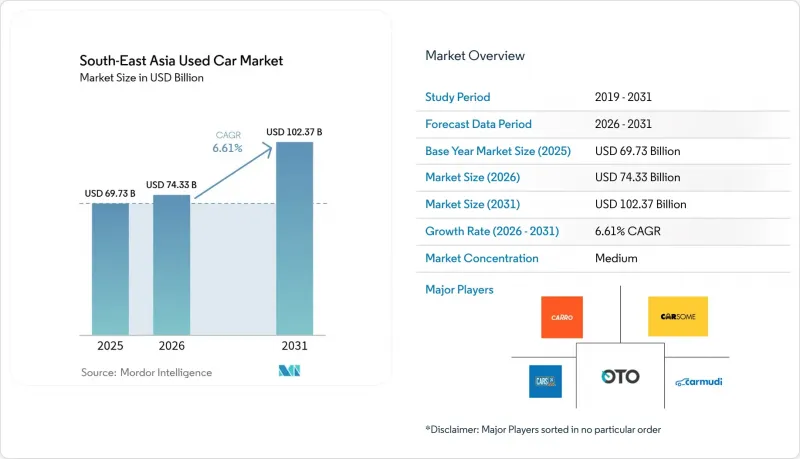
According to Mordor Intelligence, the south-East Asia used car market size is projected to be USD 69.73 billion in 2025, USD 74.33 billion in 2026, and reach USD 102.37 billion by 2031, growing at a CAGR of 6.61% from 2026 to 2031.
This report is Segmented by Vehicle Type (Hatchback and More), Fuel Type (Gasoline, Diesel, and More), Vehicle Age (0 To 3 Years and More), Mileage (Less Than 30, 000 Km and More), Sales Channel (Offline and Online), Vendor Type (Organized and Unorganized), Purchase Method, and Country. The Market Forecasts are Provided in Value (USD) and Volume (Units).
South-East Asia Used Car Market Trends and Insights
Growth in Organized Dealership Networks and Certified Pre-Owned Programs
Toyota U Trust and Honda Certified add one-year warranties and 100-point inspections, commanding premiums that many SUV buyers accept for peace of mind . Luxury badges push the envelope: BMW Premium Selection in Singapore offers 24-month coverage and rate discounts through its captive lender, tethering clients to the brand's lifecycle. Malaysia's inspection firm Puspakom rolled out AI-aided CAVIS V4 in 2025, giving organized lots an external benchmark to distance themselves from curbside sellers .
Availability of Integrated Financing and Insurance Solutions
Carsome Capital bolstered its standing by curbing non-performing loans. This was achieved by merging borrower cash-flow data with AI-driven vehicle grading, thereby refining credit risk assessments. Such a meticulous strategy won the trust of major banks, including AmBank and Maybank, which offered substantial credit lines and bolstered confidence in Carsome's lending model. In early 2025, JACCS, eyeing the gig-economy segment, acquired a notable minority stake. They tapped into alternative data streams, notably e-wallet transactions, to broaden their reach. Concurrently, Carsome introduced bundled insurance offerings, seamlessly integrating roadside assistance into monthly installments. This move not only alleviated buyer friction but also enriched the customer experience and elevated commission take-rates within Carsome's ecosystem.
Dominance of Unorganized Dealers and Roadside Lots
In Southeast Asia's used car market, cash-based curbside dealers are outpacing certified sellers by offering lower prices and flexible weekly payments, all without the need for formal credit checks. For instance, in Jakarta's Kemayoran market, social trust often takes precedence over digital records, bolstering the presence of these informal dealers. Meanwhile, in Thailand, stricter bank lending has shuttered many small dealerships. Those that remain are turning to repossession auctions for inventory, sidestepping refurbishment costs. Furthermore, the lack of mandatory dealer licensing means that unregulated vendors incur lower compliance costs, giving them a competitive edge over organized dealers bound by stricter regulations.
Other drivers and restraints analyzed in the detailed report include:
- Increasing Turnover of New-Car Sales (Especially SUVs) Feeding Used Supply
- Rising Sales Through Online Channels and Digital Marketplaces
- Lack of Standardized Vehicle-Condition Reporting Protocols
For complete list of drivers and restraints, kindly check the Table Of Contents.
Segment Analysis
SUVs represented 32.37% of the 2025 market share and are set to climb at a 6.63% CAGR, the fastest of any body style. The Southeast Asia used-car market for SUVs is projected to reach USD 33.1 billion in 2031, driven by residual values that remain 60-70% of the original price after 3 years. Thailand's Toyota Fortuner and Indonesia's Mitsubishi Xpander funnel high-clearance stock into certified lots, while Malaysia's Proton X70 lifts the mid-range bracket. Sedans lose share as corporate and ride-hailing fleets pivot toward crossovers. Hatchbacks and multipurpose vehicles hold niche appeal in Vietnam and the Philippines, where tight urban lanes favor compact footprints.
Trade-in cycles average 3-5 years for SUVs, compared with 5-7 years for sedans, which injects late-model units that qualify for warranty extensions. New launches such as the BYD Atto 3 will seed the pipeline by 2028, when early adopters re-enter the Southeast Asian used-car market. Certified programs cherry-pick SUVs because reconditioning costs are spread over higher resale values.
Gasoline cars still accounted for 73.36% of the 2025 market share, yet electric vehicles will grow at a 6.71% CAGR through 2031. Malaysia's battery passport rule reduces buyer discounting of used EVs from the historical 30-40% to 20% by providing state-of-health scores.
Starting from a modest base of under 150 units sold in 2020, electric vehicle (EV) sales have experienced a notable uptick, especially in the first half of 2025. By the second quarter of 2025, quarterly sales had climbed to around 22,000 units; most of these units will enter the Southeast Asian used-car market after 2028. Diesel's relevance slides as Bangkok and Jakarta introduce low-emission zones. Vietnam's 2026 tax incentive, pricing hybrids at 70% of the internal-combustion duty, will spur hybrid adoption and expand future supply.
In 2025, the 4-to-6-year age band commanded a dominant 38.72% share. However, it now grapples with pricing pressures. Since 2015, Thailand's used-vehicle index has plummeted by over 30 points, diminishing residual values. On the other hand, the 0-to-3-year segment is on a rapid ascent, boasting a projected CAGR of 6.78%. This growth is bolstered by early SUV upgrades and residual-value guarantees, which promote swifter replacement cycles.
Meanwhile, in both Vietnam and Thailand, imports over a decade old face stringent policy challenges. This has nudged buyers towards younger, certified vehicles, further solidifying the trend towards organized channels in Southeast Asia's used-car arena.
Complete Report Scope:
- By Vehicle Type
- Hatchback
- Sedan
- Sport-Utility Vehicle (SUV)
- Multi-Purpose Vehicle (MPV)
- By Fuel Type
- Gasoline
- Diesel
- Electric
- Alternative Fuels (LPG/CNG/Hybrid)
- By Vehicle Age
- 0 to 3 Years
- 4 to 6 Years
- 7 to 10 Years
- More than 10 Years
- By Mileage
- Less than 30 000 km
- 30 001 to 60 000 km
- 60 001 to 100 000 km
- More than 100 000 km
- By Sales Channel
- Online
- Offline
- By Vendor Type
- Organized
- Unorganized
- By Purchase Method
- Outright Purchase
- Financed Purchase
- Captive Financing
- Bank Financing
- Non-Banking Financial Companies (NBFC)
- By Country
- Indonesia
- Thailand
- Vietnam
- Malaysia
- Philippines
- Singapore
- Other Countries (Cambodia, Laos, Myanmar, Brunei)
List of Companies Covered in this Report:
- Carro
- Carsome
- Cars24 Services Pvt Ltd
- Carousell
- OLX
- iCar Asia (Carlist.my)
- myTukar
- BeliMobilGue.co.id
- Carmudi
- Oto.com
- Automart PH
- Mercedes-Benz Certified
- Toyota U Trust
- Honda Certified Pre-Owned
- BMW Premium Selection
- Nissan Intelligent Choice
- Hyundai Promise
- Mitsubishi Diamond Certified
- Isuzu Used Car Program
- LausAutoGroup (Carmix)
Additional Benefits:
- The market estimate (ME) sheet in Excel format
- 3 months of analyst support
TABLE OF CONTENTS
1 Introduction
- 1.1 Study Assumptions & Market Definition
- 1.2 Scope of the Study
2 Research Methodology
3 Executive Summary
4 Market Landscape
- 4.1 Market Overview
- 4.2 Market Drivers
- 4.2.1 Growth in Organized Dealership Networks and Certified-Pre-Owned Programs
- 4.2.2 Availability of Integrated Financing and Insurance Solutions
- 4.2.3 Increasing Turnover of New-Car Sales (Especially SUVs) Feeding Used Supply
- 4.2.4 Rising Sales Through Online Channels and Digital Marketplaces
- 4.2.5 Government Circular-Economy and Scrappage Incentives Accelerating Trade-Ins
- 4.2.6 AI-Driven Inspection/Pricing Platforms Boosting Buyer Trust
- 4.3 Market Restraints
- 4.3.1 Dominance of Unorganized Dealers and Roadside Lots
- 4.3.2 Lack of Standardized Vehicle-Condition Reporting Protocols
- 4.3.3 Emerging Import Restrictions on Older Used Vehicles
- 4.3.4 Reduced Private-Car Ownership in Urban Areas Due to Mobility-As-A-Service
- 4.4 Value / Supply-Chain Analysis
- 4.5 Regulatory Landscape
- 4.6 Technological Outlook
- 4.7 Porter's Five Forces
- 4.7.1 Threat of New Entrants
- 4.7.2 Bargaining Power of Suppliers
- 4.7.3 Bargaining Power of Buyers
- 4.7.4 Threat of Substitutes
- 4.7.5 Competitive Rivalry
5 Market Size & Growth Forecasts (Value (USD) and Volume (Units))
- 5.1 By Vehicle Type
- 5.1.1 Hatchback
- 5.1.2 Sedan
- 5.1.3 Sport-Utility Vehicle (SUV)
- 5.1.4 Multi-Purpose Vehicle (MPV)
- 5.2 By Fuel Type
- 5.2.1 Gasoline
- 5.2.2 Diesel
- 5.2.3 Electric
- 5.2.4 Alternative Fuels (LPG/CNG/Hybrid)
- 5.3 By Vehicle Age
- 5.3.1 0 to 3 Years
- 5.3.2 4 to 6 Years
- 5.3.3 7 to 10 Years
- 5.3.4 More than 10 Years
- 5.4 By Mileage
- 5.4.1 Less than 30 000 km
- 5.4.2 30 001 to 60 000 km
- 5.4.3 60 001 to 100 000 km
- 5.4.4 More than 100 000 km
- 5.5 By Sales Channel
- 5.5.1 Online
- 5.5.2 Offline
- 5.6 By Vendor Type
- 5.6.1 Organized
- 5.6.2 Unorganized
- 5.7 By Purchase Method
- 5.7.1 Outright Purchase
- 5.7.2 Financed Purchase
- 5.7.3 Captive Financing
- 5.7.4 Bank Financing
- 5.7.5 Non-Banking Financial Companies (NBFC)
- 5.8 By Country
- 5.8.1 Indonesia
- 5.8.2 Thailand
- 5.8.3 Vietnam
- 5.8.4 Malaysia
- 5.8.5 Philippines
- 5.8.6 Singapore
- 5.8.7 Other Countries (Cambodia, Laos, Myanmar, Brunei)
6 Competitive Landscape
- 6.1 Market Concentration
- 6.2 Strategic Moves
- 6.3 Market Share Analysis
- 6.4 Company Profiles (Includes Global Level Overview, Market Level Overview, Core Segments, Financials as Available, Strategic Information, Market Rank/Share for Key Companies, Products and Services, SWOT Analysis, and Recent Developments)
- 6.4.1 Carro
- 6.4.2 Carsome
- 6.4.3 Cars24 Services Pvt Ltd
- 6.4.4 Carousell
- 6.4.5 OLX
- 6.4.6 iCar Asia (Carlist.my)
- 6.4.7 myTukar
- 6.4.8 BeliMobilGue.co.id
- 6.4.9 Carmudi
- 6.4.10 Oto.com
- 6.4.11 Automart PH
- 6.4.12 Mercedes-Benz Certified
- 6.4.13 Toyota U Trust
- 6.4.14 Honda Certified Pre-Owned
- 6.4.15 BMW Premium Selection
- 6.4.16 Nissan Intelligent Choice
- 6.4.17 Hyundai Promise
- 6.4.18 Mitsubishi Diamond Certified
- 6.4.19 Isuzu Used Car Program
- 6.4.20 LausAutoGroup (Carmix)
7 Market Opportunities & Future Outlook
- 7.1 White-space & unmet-need assessment

