
PUBLISHER: Mordor Intelligence | PRODUCT CODE: 2063942

PUBLISHER: Mordor Intelligence | PRODUCT CODE: 2063942
Asia-Pacific Integrated Facility Management - Market Share Analysis, Industry Trends & Statistics, Growth Forecasts (2026 - 2031)
According to Mordor Intelligence, the asia-Pacific integrated facility management market size is expected to grow from USD 149.29 billion in 2025 to USD 159.17 billion in 2026 and is forecast to reach USD 225.71 billion by 2031 at 7.24% CAGR over 2026-2031.
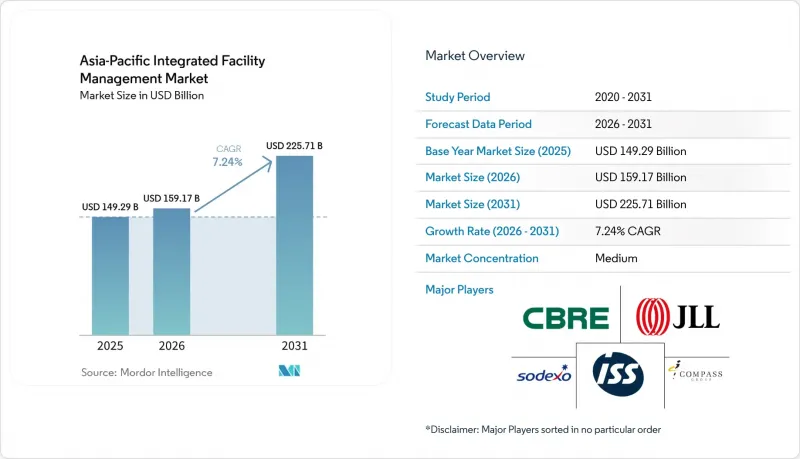
This report is Segmented by Service Type (Hard Facility Management [Asset Management, MEP and HVAC Services, and More], and Soft Facility Management [Office Support and Security, Cleaning Services, Catering Services, and More]), End User (Commercial, Hospitality, Industrial and Process Sector, and More), and Geography. The Market Forecasts are Provided in Terms of Value (USD).
Asia-Pacific Integrated Facility Management Market Trends and Insights
Increasing Adoption of IoT and Smart Building Technologies in Facility Management
Connected building systems are moving from optional upgrades to routine operating tools in commercial portfolios across the APAC integrated facility management market. Singapore's Green Building Masterplan places strong emphasis on better building performance, which raises the value of integrated monitoring and service response in daily operations. The Building Control Act changes for existing buildings also make energy performance and plant efficiency more visible in operating decisions, which pushes owners to rely on data-rich FM models rather than manual rounds alone. Shanghai's 2025 green building rules add further momentum because higher baseline performance standards increase the importance of system integration from commissioning through operations. This is widening the commercial gap between providers that can connect sensors, asset data, and work orders in one workflow and providers that only offer task-based delivery. As adoption broadens, the Asia-Pacific integrated facility management market is likely to reward operators that can turn building data into faster service decisions, clearer compliance records, and more stable service quality.
Rising Demand For Energy Efficiency and Green Buildings Compliance
Energy efficiency has become a procurement requirement rather than a discretionary upgrade in much of the Asia-Pacific integrated facility management market. Singapore's Mandatory Energy Improvement regime for large energy-intensive buildings requires audits and measurable reductions in energy use intensity, which brings FM providers directly into compliance planning and execution. Shanghai now requires all new civilian buildings to meet at least a one-star green standard, while government and large public buildings must reach the highest three-star level. Hong Kong has broadened mandatory energy audits to 11 building types and shortened the audit cycle to 5 years, which raises the need for recurring technical review and follow-through. These rules favor providers that can combine maintenance, retro-commissioning, and digital reporting in one contract because owners need proof of operational improvement and not only service coverage. The result is a stronger bidding position for companies with certified energy management capabilities across the APAC integrated facility management market.
Fragmented Regulatory Codes Across Asia-Pacific Jurisdictions Increasing Compliance Costs
Cross-border FM delivery remains difficult because APAC jurisdictions apply different rules for building energy performance, safety, audit cycles, and reporting. A provider serving Singapore, Australia, India, and Southeast Asia cannot rely on one compliance playbook, which raises overhead and slows standardization. Research on smart building adoption in Malaysia also identified the absence of specific legislation and policy frameworks as a major barrier, alongside data-sharing and ownership issues. These frictions matter most in regional contracts where clients want consistency across sites but local operating rules force market-by-market customization. Local operators that stay within one jurisdiction often avoid part of this burden, which can make them look cheaper even when their scope is narrower. Until standards align further, the APAC IFM market will continue to face margin pressure from duplicated compliance work and uneven operating requirements.
Other drivers and restraints analyzed in the detailed report include:
- Government Net-Zero Carbon Mandates Accelerating Retro-Commissioning Contracts
- Rapid Commercial Real Estate Growth in Tier 2 Asia-Pacific Cities
- Cybersecurity Vulnerabilities Arising From Connected Building Systems
For complete list of drivers and restraints, kindly check the Table Of Contents.
Segment Analysis
Soft FM accounted for 61.72% of regional revenue in 2025, while Hard FM is set to expand at a 7.74% CAGR through 2031. Soft facility management services remained the larger pool because cleaning, security, office support, and catering are labor-intensive and widely outsourced across commercial, institutional, and public facilities. Even so, the balance is shifting because energy codes and equipment complexity are increasing the value of technical maintenance inside integrated contracts. Hard FM benefits directly from the growing stock of MEP-heavy assets, including data centers and life-sciences campuses, where uptime and compliance matter as much as routine service coverage. This is pushing the Asia-Pacific integrated facility management market toward contracts where engineering depth carries more pricing power than basic task execution.
The hard FM opportunity is also changing the revenue model because predictive maintenance and remote monitoring add recurring digital layers to what used to be scheduled or break-fix work. Singapore's periodic air-conditioning plant audit requirement and Hong Kong's broader audit scope both strengthen demand for providers that can interpret plant data and translate it into corrective action. Samsung Electronics' Factorial Seongsu building in South Korea showed how integrated building controls can support lower energy use and stronger smart building credentials, which reinforces the case for technically capable operators. In the integrated facility management industry, providers that combine field technicians, energy expertise, and building systems visibility are better positioned than pure soft-service vendors to capture the faster-growing side of the APAC integrated facility management market.
List of Companies Covered in this Report:
- Sodexo SA
- CBRE Group, Inc.
- ISS A/S
- Compass Group PLC
- Jones Lang LaSalle Incorporated
- Colliers International Group Inc.
- Cushman & Wakefield plc
- Ventia Services Group
- OCS Group Limited
- Aeon Delight Co. Ltd.
- Serco Group plc
- Aramark Corporation
- Quess Corp Limited
- Aden Services
- Atalian Global Services
- Sinar Jernih Sdn Bhd
- UEMS Solutions Pte Ltd.
- NIPPON KANZAI Co., Ltd.
- Keppel Land Limited (Keppel Infrastructure Services)
- SIS Limited
Additional Benefits:
- The market estimate (ME) sheet in Excel format
- 3 months of analyst support
TABLE OF CONTENTS
1 INTRODUCTION
- 1.1 Study Assumptions and Market Definition
- 1.2 Scope of the Study
2 RESEARCH METHODOLOGY
3 EXECUTIVE SUMMARY
4 MARKET LANDSCAPE
- 4.1 Market Overview
- 4.2 Market Drivers
- 4.2.1 Rapid Commercial Real Estate Growth in Tier 2 Asian-Pacific Cities
- 4.2.2 Rising Demand for Energy Efficiency and Green Buildings Compliance
- 4.2.3 Outsourcing Trend Among Multinational Corporations for Non-Core FM Functions
- 4.2.4 Increasing Adoption of IoT and Smart Building Technologies in Facility Management
- 4.2.5 Government Net-Zero Carbon Mandates Accelerating Retro-Commissioning Contracts
- 4.2.6 Aging Building Stock Pushing Predictive Maintenance-as-a-Service Models
- 4.3 Market Restraints
- 4.3.1 Fragmented Regulatory Codes Across Asia-Pacific Jurisdictions Increasing Compliance Costs
- 4.3.2 Low Penetration of IFM in Small and Medium Enterprises Due to Cost Sensitivity
- 4.3.3 Skilled Labor Shortages in Hybrid Hard-Soft FM Roles Post-Pandemic
- 4.3.4 Cybersecurity Vulnerabilities Arising From Connected Building Systems
- 4.4 Industry Value Chain Analysis
- 4.5 Regulatory Landscape
- 4.6 Technological Outlook
- 4.7 Impact of Macroeconomic Factors on the Market
- 4.8 Porter's Five Forces Analysis
- 4.8.1 Bargaining Power of Suppliers
- 4.8.2 Bargaining Power of Buyers
- 4.8.3 Threat of New Entrants
- 4.8.4 Threat of Substitutes
- 4.8.5 Industry Rivalry
5 MARKET SIZE AND GROWTH FORECASTS (VALUE)
- 5.1 By Service Type
- 5.1.1 Hard Facility Management
- 5.1.1.1 Asset Management
- 5.1.1.2 MEP and HVAC Services
- 5.1.1.3 Fire Systems and Safety
- 5.1.1.4 Other Hard Facility Management Services
- 5.1.2 Soft Facility Management
- 5.1.2.1 Office Support and Security
- 5.1.2.2 Cleaning Services
- 5.1.2.3 Catering Services
- 5.1.2.4 Other Soft Facility Management Services
- 5.1.1 Hard Facility Management
- 5.2 By End User
- 5.2.1 Commercial
- 5.2.2 Hospitality
- 5.2.3 Institutional and Public Infrastructure
- 5.2.4 Healthcare
- 5.2.5 Industrial and Process Sector
- 5.2.6 Other End-User Industries
- 5.3 By Geography
- 5.3.1 China
- 5.3.2 Japan
- 5.3.3 India
- 5.3.4 South Korea
- 5.3.5 Australia
- 5.3.6 New Zealand
- 5.3.7 Rest of Asia-Pacific
6 COMPETITIVE LANDSCAPE
- 6.1 Market Concentration
- 6.2 Strategic Moves
- 6.3 Market Share Analysis
- 6.4 Company Profiles (includes Global Level Overview, Market Level Overview, Core Segments, Financials as available, Strategic Information, Market Rank/Share, Products and Services, Recent Developments)
- 6.4.1 Sodexo SA
- 6.4.2 CBRE Group, Inc.
- 6.4.3 ISS A/S
- 6.4.4 Compass Group PLC
- 6.4.5 Jones Lang LaSalle Incorporated
- 6.4.6 Colliers International Group Inc.
- 6.4.7 Cushman & Wakefield plc
- 6.4.8 Ventia Services Group
- 6.4.9 OCS Group Limited
- 6.4.10 Aeon Delight Co. Ltd.
- 6.4.11 Serco Group plc
- 6.4.12 Aramark Corporation
- 6.4.13 Quess Corp Limited
- 6.4.14 Aden Services
- 6.4.15 Atalian Global Services
- 6.4.16 Sinar Jernih Sdn Bhd
- 6.4.17 UEMS Solutions Pte Ltd.
- 6.4.18 NIPPON KANZAI Co., Ltd.
- 6.4.19 Keppel Land Limited (Keppel Infrastructure Services)
- 6.4.20 SIS Limited
7 MARKET OPPORTUNITIES AND FUTURE OUTLOOK
- 7.1 White-Space and Unmet-Need Assessment

