
PUBLISHER: Mordor Intelligence | PRODUCT CODE: 2066679

PUBLISHER: Mordor Intelligence | PRODUCT CODE: 2066679
Germany Sealants - Market Share Analysis, Industry Trends & Statistics, Growth Forecasts (2026 - 2031)
According to Mordor Intelligence, the germany sealants market size was valued at USD 588.5 million in 2025 and is estimated to grow from USD 625.22 million in 2026 to reach USD 860.47 million by 2031, at a CAGR of 6.60% during the forecast period (2026-2031).
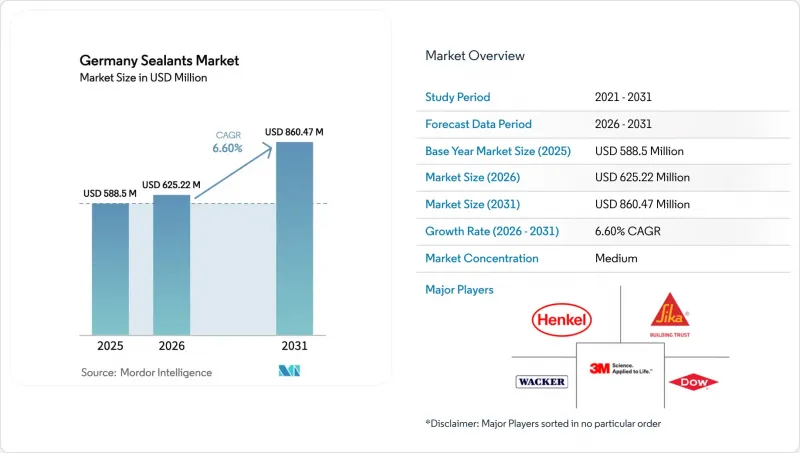
This report is Segmented by Resin Type (Acrylic, Epoxy, Polyurethane, Silicone, and Other Resins) and End-User Industry (Aerospace, Automotive, Building and Construction, Healthcare, and Other End-User Industries). The Market Forecasts are Provided in Terms of Value (USD).
Germany Sealants Market Trends and Insights
Construction Boom in Energy-Efficient Renovations
Germany's renovation-rate gap, 0.67% in 2025 versus the 2% policy target, creates pent-up demand for airtight membranes, window-frame expansion joints and facade seals that survive -20 °C to +80 °C without plasticizer migration. The EUR 500 billion modernization plan earmarks EUR 2 billion a year to 2029 for social-housing upgrades plus EUR 3.25 billion for bridge and tunnel refurbishment, locking in multi-year visibility for infrastructure-grade sealants. BEG subsidies extend to 2029 and now cover photovoltaic penetrations, heat-pump ducts and mechanical-ventilation interfaces, each requiring specialized gaskets. Digital product passports under CPR 2024/3110 start phasing in from 2026, forcing vendors to disclose embodied-carbon and recyclability credentials that already influence public tenders. Sika's low-emission systems on Munich's Marienhof S-Bahn project illustrate how lifecycle reporting is turning sustainability data into a hard-bid differentiator.
Automotive Lightweighting and E-Mobility Gasketing Needs
Battery housings, power-electronics cases and cell-to-pack designs impose dielectric strength above 20 kV/mm and coolant resistance from -40 °C to +105 °C, prompting a switch to isocyanate-free polyurethane and STP chemistries that also meet upcoming PFAS restrictions. Henkel's Dusseldorf Battery Engineering Centre enables rapid prototyping of thermal-interface and sealing compounds customized for multi-material bodies. ElringKlinger's MetaloBond hybrid gasket delivers peel strength over 15 N/mm at 200 °C, supporting high-speed e-motor housings. Germany's Tier-1s increasingly export these solutions to Chinese EV makers, expected to hold one-third of global sales by 2030, amplifying growth beyond domestic vehicle production. Early movers with flame-retardant, voltage-isolation compliant platforms are locking in global design wins that underpin the Germany sealants market long term.
Volatile Isocyanate and Silicone Feedstock Prices
Silicone DMC climbed 28% year-on-year in Q1 2026 as solar-grade demand hit 28% of total silicone output while Dow's Barry, Wales shutdown removed 150 kt of European supply. China provides over 70% of silicon metal, leaving German formulators exposed to Xinjiang and Sichuan power rationing disruptions. Parallel spikes in TDI and MDI, driven by oil volatility and environmental inspections, squeeze polyurethane margins. Firms lacking backward integration are retreating from commodity caulks to focus on the specification-led Germany sealants market, but mid-tier players still face working-capital strain from longer raw-material lead times.
Other drivers and restraints analyzed in the detailed report include:
- Healthcare Single-Use Devices and Pharma Packaging Growth
- Stricter Bauordnungen Pushing Low-VOC / Bio-Based Sealants
- Availability of High-Performance Pressure-Sensitive Tapes as Substitutes
For complete list of drivers and restraints, kindly check the Table Of Contents.
Segment Analysis
Polyurethane formulations are growing at 7.24% CAGR through 2031, anchored by STP hybrids that eliminate isocyanate handling. Silicone maintained a 37.5% Germany sealants market share in 2025 owing to unmatched -60 °C to +250 °C service windows in facade glazing and battery-pack gasketing. Wacker Chemie's new STP-E line at Nunchritz adds 15 kiloton incremental capacity and illustrates a capital pivot into hybrids that bridge silicone UV stability and polyurethane toughness. Epoxy sealants keep a niche in industrial-floor joints and aerospace composite fuel tanks, while acrylics remain preferred for interior trim owing to paintability at low cost. Supplier research and development increasingly merges chemistries, epoxy-polyurethane networks or silane-modified polyethers, blurring hard resin boundaries yet widening application coverage across the Germany sealants market.
List of Companies Covered in this Report:
- 3M
- Arkema
- Dow
- EGO Dichtstoffwerke GmbH & Co. KG
- H.B. Fuller Company
- Henkel AG & Co. KGaA
- MAPEI S.p.A.
- Sika AG
- Soudal NV
- Wacker Chemie AG
- Tremco Illbruck GmbH
- Otto Chemie
- BASF SE (construction chemicals)
- PPG Industries (Sealants Europe)
- DAP Products
- Pecora Corporation
- Selena Group
- Kommerling Chemische Fabrik
- Dymax Europe GmbH
- Soudal (illbruck)
Additional Benefits:
- The market estimate (ME) sheet in Excel format
- 3 months of analyst support
TABLE OF CONTENTS
1 Introduction
- 1.1 Study Assumptions and Market Definition
- 1.2 Scope of the Study
2 Research Methodology
3 Executive Summary
4 Market Landscape
- 4.1 Market Overview
- 4.2 Market Drivers
- 4.2.1 Construction boom in energy-efficient renovations
- 4.2.2 Automotive lightweighting and e-mobility gasketing needs
- 4.2.3 Healthcare single-use devices and pharma packaging growth
- 4.2.4 Stricter Bauordnungen pushing low-VOC / bio-based sealants
- 4.2.5 Offshore wind-turbine blade repair sealants demand
- 4.3 Market Restraints
- 4.3.1 Volatile isocyanate and silicone feedstock prices
- 4.3.2 Availability of high-performance pressure-sensitive tapes as substitutes
- 4.3.3 EU micro-plastic restriction proposals for reactive resins
- 4.3.4 Skilled-labour shortage for correct sealant installation
- 4.4 Value Chain Analysis
- 4.5 Regulatory Landscape
- 4.6 Porter's Five Forces
- 4.6.1 Threat of New Entrants
- 4.6.2 Bargaining Power of Suppliers
- 4.6.3 Bargaining Power of Buyers
- 4.6.4 Threat of Substitutes
- 4.6.5 Competitive Rivalry
5 Market Size and Growth Forecasts (Value)
- 5.1 By Resin Type
- 5.1.1 Acrylic
- 5.1.2 Epoxy
- 5.1.3 Polyurethane
- 5.1.4 Silicone
- 5.1.5 Other Resins
- 5.2 By End-user Industry
- 5.2.1 Aerospace
- 5.2.2 Automotive
- 5.2.3 Building and Construction
- 5.2.4 Healthcare
- 5.2.5 Other End-user Industries
6 Competitive Landscape
- 6.1 Market Concentration
- 6.2 Strategic Moves
- 6.3 Market Share (%)/Ranking Analysis
- 6.4 Company Profiles (includes Global Level Overview, Market Level Overview, Core Segments, Financials as available, Strategic Information, Products and Services, and Recent Developments)
- 6.4.1 3M
- 6.4.2 Arkema
- 6.4.3 Dow
- 6.4.4 EGO Dichtstoffwerke GmbH & Co. KG
- 6.4.5 H.B. Fuller Company
- 6.4.6 Henkel AG & Co. KGaA
- 6.4.7 MAPEI S.p.A.
- 6.4.8 Sika AG
- 6.4.9 Soudal NV
- 6.4.10 Wacker Chemie AG
- 6.4.11 Tremco Illbruck GmbH
- 6.4.12 Otto Chemie
- 6.4.13 BASF SE (construction chemicals)
- 6.4.14 PPG Industries (Sealants Europe)
- 6.4.15 DAP Products
- 6.4.16 Pecora Corporation
- 6.4.17 Selena Group
- 6.4.18 Kommerling Chemische Fabrik
- 6.4.19 Dymax Europe GmbH
- 6.4.20 Soudal (illbruck)
7 Market Opportunities and Future Outlook
- 7.1 White-space and Unmet-Need Assessment

