PUBLISHER: Mordor Intelligence | PRODUCT CODE: 2066686

PUBLISHER: Mordor Intelligence | PRODUCT CODE: 2066686
Japan Sealants - Market Share Analysis, Industry Trends & Statistics, Growth Forecasts (2026 - 2031)
According to Mordor Intelligence, the japan sealants market size is expected to grow from USD 654 million in 2025 to USD 684.40 million in 2026 and is forecast to reach USD 871.30 million by 2031 at 4.95% CAGR over 2026-2031.
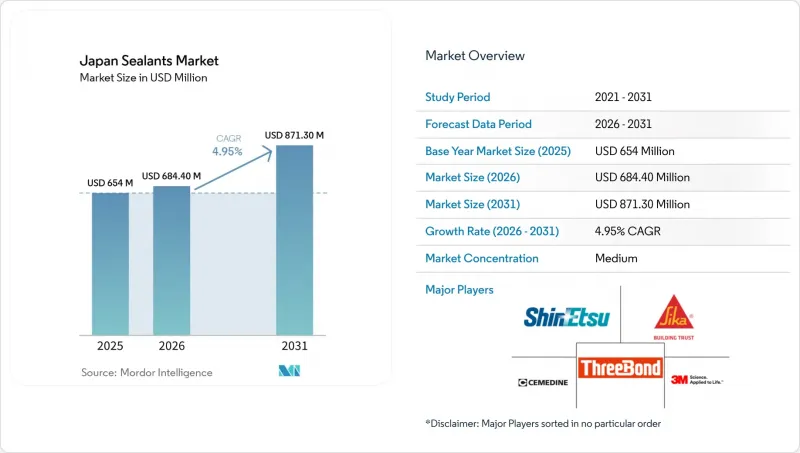
This report is Segmented by Resin Type (Silicone, Polyurethane, Acrylic, Epoxy, Polysulfide, and Other Resins) and End-User Industry (Aerospace, Automotive, Building and Construction, Healthcare, Electronics and Semiconductor, and Other End-User Industries). The Market Forecasts are Provided in Terms of Value (USD).
Japan Sealants Market Trends and Insights
Surging Renovation Spend on Earthquake-Resilient Housing
Japan's Ministry of Land, Infrastructure, Transport and Tourism allocated JPY 112.5 billion (USD 755 million) in FY 2025 to subsidize window and insulation retrofits under the GX ZEH scheme. Seismic upgrades increasingly pair base-isolation systems with high-movement-capacity sealants because rigid joints amplified shear forces during the 2024 Noto Peninsula quake. Cemedine's Scallop Seal polyurethane, launched in 2024 with calcined scallop-shell filler, diverts aquaculture waste and delivers Shore A 30-35 while meeting +-25% joint movement. One-component moisture-cure polyurethanes now dominate retrofit jobs since they eliminate 40% of the mixing errors seen with two-part epoxies. GX ZEH approvals boosted domestic building-sealant shipments 6% year-on-year in Q3 2024.
Light-Weighting Push in Japan's EV and Hybrid Auto Sector
Nagoya University proved in 2025 that nanocellulose-reinforced epoxy delivers 22 times the impact strength of legacy adhesives, enabling aluminum closures that remove 8-12 kg per vehicle. Toyota will raise adhesive-bonded surface area by 30% on its next battery-electric platform, favoring polyurethanes and modified silicones that prevent galvanic corrosion across -40 °C to +120 °C. Sekisui Fuller's EV Protect 4006 SFR adds under 2 kg to a 60 kWh pack while meeting UL 94 V-0. Automotive sealant consumption helped lift Japan's adhesive output 2.7% in 2024, even as emulsion systems fell 6% with the switch to solvent-free reactive hot melts.
Petrochemical Feedstock Price Volatility
Japan's naphtha fell 12.8% year-on-year to JPY 85,800/ton (USD 575/ton) in Aug 2025 but spiked 66% after the March 2026 Strait of Hormuz disruption. Polyurethane sealants track benzene and propylene, so a USD 30 bbl crude move swings costs 15-20%, and smaller producers cannot hedge effectively. Sekisui Fuller lengthened raw-material lead times to 14-16 weeks and rationed shipments to battery customers in Mar 2026. Multinationals are shifting toward bio-based polyols from castor oil, while domestic SMEs pivot to silicones that depend on local silica-sand feedstock.
Other drivers and restraints analyzed in the detailed report include:
- Medical-Grade Sealants Demand from Advanced Device Exports
- Low-VOC Incentives for Net-Zero Energy Houses
- Skilled Applicator Labor Shortage Elevating Installation Costs
For complete list of drivers and restraints, kindly check the Table Of Contents.
Segment Analysis
Silicones captured 38.5% of the Japan sealants market in 2025, reflecting unmatched UV stability and adhesion to glass, metal, and dissimilar substrates. Polyurethanes are expanding at 6.02% annually through 2031, aided by UL 94 V-0 two-component grades for EV battery packs. Acrylics remain favored in interior joinery but rarely exceed a mid-single-digit share because +-7.5% movement capacity fails seismic codes. Epoxies and polysulfides fill chemical-containment niches yet now represent below 5% combined volume.
Silicones keep commanding premium applications such as maglev tunnel joints, semiconductor encapsulation, and photovoltaic module edge-sealing. Polyurethane innovation, typified by Sekisui Fuller EV Protect 4006 SFR, captures lightweighting demand in automobiles that silicones cannot meet economically. The rise of silane-terminated polymers is eroding polysulfide presence by delivering similar chemical resistance without mixing complexity. Overall, resin diversification has not dented silicone leadership; instead, it is expanding total Japan sealants market size by opening new performance windows.
List of Companies Covered in this Report:
- 3M
- Arkema
- CEMEDINE Co.,Ltd.
- Dow
- H.B. Fuller
- Henkel AG & Co. KGaA
- Konishi Co., Ltd.
- Momentive
- Nichiban Co., Ltd.
- Sekisui Fuller
- Sharp Chemical Ind. Co., Ltd.
- Shin-Etsu Chemical Co., Ltd.
- Sika AG
- Sumitomo Bakelite Co., Ltd.
- Taisei Polytech Co., Ltd.
- The Yokohama Rubber Co., Ltd.
- ThreeBond Holdings Co., Ltd.
- Tokuyama Corporation
- Wacker Chemie AG
- Yokohama Industrial Products
Additional Benefits:
- The market estimate (ME) sheet in Excel format
- 3 months of analyst support
TABLE OF CONTENTS
1 Introduction
- 1.1 Study Assumptions and Market Definition
- 1.2 Scope of the Study
2 Research Methodology
3 Executive Summary
4 Market Landscape
- 4.1 Market Overview
- 4.2 End-user Trends
- 4.3 Market Drivers
- 4.3.1 Surging renovation spend on earthquake-resilient housing
- 4.3.2 Light-weighting push in Japan's EV and hybrid auto sector
- 4.3.3 Medical-grade sealants demand from advanced device exports
- 4.3.4 Low-VOC incentives for Net-Zero Energy Houses
- 4.3.5 Silicone demand for Shinkansen and maglev tunnel waterproofing
- 4.4 Market Restraints
- 4.4.1 Petrochemical feedstock price volatility
- 4.4.2 Stringent PRTR and VOC emission norms
- 4.4.3 Skilled applicator labour shortage elevating installation costs
- 4.5 Value Chain Analysis
- 4.6 Porter's Five Forces
- 4.6.1 Threat of New Entrants
- 4.6.2 Bargaining Power of Suppliers
- 4.6.3 Bargaining Power of Buyers
- 4.6.4 Threat of Substitutes
- 4.6.5 Competitive Rivalry
5 Market Size and Growth Forecasts (Value)
- 5.1 By Resin Type
- 5.1.1 Silicone
- 5.1.2 Polyurethane
- 5.1.3 Acrylic
- 5.1.4 Epoxy
- 5.1.5 Polysulfide
- 5.1.6 Other Resins
- 5.2 By End-user Industry
- 5.2.1 Aerospace
- 5.2.2 Automotive
- 5.2.3 Building and Construction
- 5.2.4 Healthcare
- 5.2.5 Electronics and Semiconductor
- 5.2.6 Other End-user Industries
6 Competitive Landscape
- 6.1 Market Concentration
- 6.2 Key Strategic Moves
- 6.3 Market Share(%)/Ranking Analysis
- 6.4 Company Profiles {includes Global level Overview, Market level overview, Core Segments, Financials, Strategic Information, Products and Services, Recent Developments}
- 6.4.1 3M
- 6.4.2 Arkema
- 6.4.3 CEMEDINE Co.,Ltd.
- 6.4.4 Dow
- 6.4.5 H.B. Fuller
- 6.4.6 Henkel AG & Co. KGaA
- 6.4.7 Konishi Co., Ltd.
- 6.4.8 Momentive
- 6.4.9 Nichiban Co., Ltd.
- 6.4.10 Sekisui Fuller
- 6.4.11 Sharp Chemical Ind. Co., Ltd.
- 6.4.12 Shin-Etsu Chemical Co., Ltd.
- 6.4.13 Sika AG
- 6.4.14 Sumitomo Bakelite Co., Ltd.
- 6.4.15 Taisei Polytech Co., Ltd.
- 6.4.16 The Yokohama Rubber Co., Ltd.
- 6.4.17 ThreeBond Holdings Co., Ltd.
- 6.4.18 Tokuyama Corporation
- 6.4.19 Wacker Chemie AG
- 6.4.20 Yokohama Industrial Products
7 Market Opportunities and Future Outlook
- 7.1 White-space and Unmet-Need Assessment

