
PUBLISHER: Mordor Intelligence | PRODUCT CODE: 2066681

PUBLISHER: Mordor Intelligence | PRODUCT CODE: 2066681
Italy Sealants - Market Share Analysis, Industry Trends & Statistics, Growth Forecasts (2026 - 2031)
According to Mordor Intelligence, the italy sealants market size is expected to increase from USD 201.32 million in 2025 to USD 212.89 million in 2026 and reach USD 285.81 million by 2031, growing at a CAGR of 6.07% over 2026-2031.
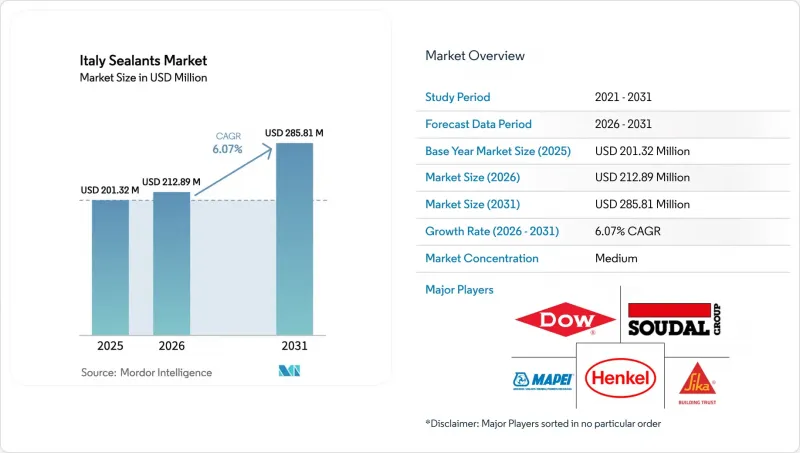
This report is Segmented by Resin Type (Acrylic, Epoxy, Polyurethane, Silicone, and Other Resins) and End-User Industry (Aerospace, Automotive, Building and Construction, Healthcare, and Other End-User Industries). The Market Sizes and Forecasts are Provided in Terms of Value (USD).
Italy Sealants Market Trends and Insights
EU Renovation Wave-Fuelled Retrofit Demand
Planned spending of EUR 13.95 billion under Italy's Recovery and Resilience Plan covers more than 100,000 buildings and 36 million m2 of upgrades, sustaining retrofit momentum for the Italy Sealants market. The 2026 budget continues a 50% tax bonus on primary-residence renovations, guaranteeing steady pull-through for acrylic and low-VOC polyurethane systems. EN 16516 and CDPH v1.2 thresholds (less than or equal to 300 µg/m3 total VOC and less than or equal to 10 µg/m3 formaldehyde at 28 days) tighten qualifying formulations, favoring waterborne products that also mitigate amine-cure odor. Lombardy, Lazio, and Campania together host nearly half of the eligible building stock, concentrating logistics advantages for distributors with dense regional hubs. Demand shifts away from conventional silicone facade joints toward hybrid sealants able to bond mixed legacy substrates without primers, reducing skilled labor hours in a market already short 265,000 workers.
EV-Battery Lightweighting Sealant Needs
Stellantis targets a 50% battery-weight cut by 2030 and has invested USD 40 million in a Turin Battery Technology Center that boosts local demand for thermally conductive and dielectric sealants. Current electric vehicles carry roughly 8 lb of adhesives and sealants; new cell-to-pack designs may lift content toward 12 lb by 2030, supporting long-run volume upside for the Italy Sealants market. Two-component polyurea systems from Collano deliver 30-s fixture times, eliminating mechanical fasteners in modules now entering series production. Dow's VORATRON polyurethane grades add 0.3-3.1 W/mK thermal conductivity, allowing passive cooling that slashes pack weight and volume. These specifications demand service from -40°C to 85°C and dielectric strength more than or equal to 20 kV/mm, steering formulators toward silicone and specialty polyurethane chemistries.
Silicone-Monomer Price Volatility
Wacker Chemie raised silicone prices twice in 2026 after platinum catalysts doubled YoY and Middle-East feedstock disruptions reduced dimethyldichlorosilane supply, squeezing Italian formulators who import 85% of intermediates. Platinum represents up to 20% of silicone sealant COGS, and spot prices climbed from USD 900/oz in 2025 to USD 1,850/oz by March 2026. Dow's announced closure of its Barry, UK, siloxanes unit in mid-2026 removes European capacity, amplifying cost swings that depress margins for regional firms such as Fassa Bortolo and Kerakoll.
Other drivers and restraints analyzed in the detailed report include:
- Stricter VOC Limits Accelerating Water-Based Chemistries
- BIPV Facades Requiring Edge-Seal Longevity
- CE-Mark/CPR Compliance Cost Burden for SMEs
For complete list of drivers and restraints, kindly check the Table Of Contents.
Segment Analysis
Silicone commanded a 40.50% hold on the Italy Sealants market share in 2025, supported by unrivaled UV stability across -60°C to 200°C service windows. The Italy Sealants market size for acrylic formulations is projected to climb at a 7.12% CAGR through 2031, buoyed by BASF's waterborne Acronal 5036 that delivers more than or equal to 40% elastic recovery without amine-cure odor. Hybrid MS polymers and polysulfides together remain below 10% of volume, yet retain footholds in specialty joints such as airport pavements and submerged structures.
Acrylic's rising penetration links directly to Superbonus CAM criteria that cap VOC at 50 g/L, a threshold that solvent-borne polyurethane struggles to meet without primer sacrifices. Polyurethane continues to dominate structural glazing with tensile strengths of more than 2 MPa and Shore A 40-60, crucial to industrial flooring and facade anchor joints. Epoxy holds a niche in pharmaceutical floors and cleanrooms, leveraging chemical impermeability despite mixing complexity.
List of Companies Covered in this Report:
- 3M
- Arkema
- BASF SE
- Dow
- Fassa Bortolo
- General Sealants Inc.
- H.B. Fuller Company
- Henkel AG & Co. KGaA
- Index S.p.A.
- Kerakoll S.p.A.
- MAPEI S.p.A.
- NPT Srl
- Pidilite Industries Ltd.
- RPM International Inc.
- Saint-Gobain Weber
- Sika AG
- Soudal Holding N.V.
- Torggler S.r.l.
- Tremco CPG Italia
- Wacker Chemie AG
Additional Benefits:
- The market estimate (ME) sheet in Excel format
- 3 months of analyst support
TABLE OF CONTENTS
1 Introduction
- 1.1 Study Assumptions and Market Definition
- 1.2 Scope of the Study
2 Research Methodology
3 Executive Summary
4 Market Landscape
- 4.1 Market Overview
- 4.2 End-User Trends
- 4.3 Market Drivers
- 4.3.1 EU "Renovation Wave"-fuelled retrofit demand
- 4.3.2 EV-battery lightweighting sealant needs
- 4.3.3 Stricter VOC limits accelerating water-based chemistries
- 4.3.4 BIPV facades requiring edge-seal longevity
- 4.3.5 Robotic/3-D printed construction compatible hybrid sealants
- 4.4 Market Restraints
- 4.4.1 Silicone-monomer price volatility
- 4.4.2 CE-mark/CPR compliance cost burden for SMEs
- 4.4.3 Trade-skills shortage shifting demand to pre-gasketed systems
- 4.5 Value Chain Analysis
- 4.6 Regulatory Landscape
- 4.7 Porter's Five Forces
- 4.7.1 Threat of New Entrants
- 4.7.2 Bargaining Power of Suppliers
- 4.7.3 Bargaining Power of Buyers
- 4.7.4 Threat of Substitutes
- 4.7.5 Competitive Rivalry
5 Market Size and Growth Forecasts
- 5.1 By Resin Type
- 5.1.1 Acrylic
- 5.1.2 Epoxy
- 5.1.3 Polyurethane
- 5.1.4 Silicone
- 5.1.5 Other Resins
- 5.2 By End-user Industry
- 5.2.1 Aerospace
- 5.2.2 Automotive
- 5.2.3 Building and Construction
- 5.2.4 Healthcare
- 5.2.5 Other End-user Industries
6 Competitive Landscape
- 6.1 Market Concentration
- 6.2 Strategic Moves
- 6.3 Market Share (%)/Ranking Analysis
- 6.4 Company Profiles (includes Global-level Overview, Market-level Overview, Core Segments, Financials as available, Strategic Information, Products and Services, Recent Developments)
- 6.4.1 3M
- 6.4.2 Arkema
- 6.4.3 BASF SE
- 6.4.4 Dow
- 6.4.5 Fassa Bortolo
- 6.4.6 General Sealants Inc.
- 6.4.7 H.B. Fuller Company
- 6.4.8 Henkel AG & Co. KGaA
- 6.4.9 Index S.p.A.
- 6.4.10 Kerakoll S.p.A.
- 6.4.11 MAPEI S.p.A.
- 6.4.12 NPT Srl
- 6.4.13 Pidilite Industries Ltd.
- 6.4.14 RPM International Inc.
- 6.4.15 Saint-Gobain Weber
- 6.4.16 Sika AG
- 6.4.17 Soudal Holding N.V.
- 6.4.18 Torggler S.r.l.
- 6.4.19 Tremco CPG Italia
- 6.4.20 Wacker Chemie AG
7 Market Opportunities and Future Outlook
- 7.1 White-space and Unmet-need Assessment

