
PUBLISHER: Mordor Intelligence | PRODUCT CODE: 2066683

PUBLISHER: Mordor Intelligence | PRODUCT CODE: 2066683
Spain Sealants - Market Share Analysis, Industry Trends & Statistics, Growth Forecasts (2026 - 2031)
According to Mordor Intelligence, the spain sealants market size is projected to be USD 171.84 million in 2025, USD 180.16 million in 2026, and reach USD 231.69 million by 2031, growing at a CAGR of 5.16% from 2026 to 2031.
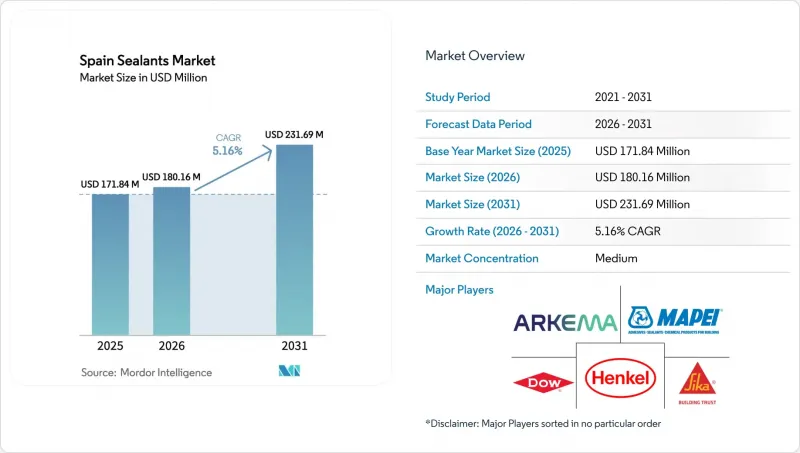
This report is Segmented by Resin Type (Acrylic, Epoxy, Polyurethane, Silicone, and Other Resins) and End-User Industry (Aerospace, Automotive, Building and Construction, Healthcare, and Other End-User Industries). The Market Sizes and Forecasts are Provided in Terms of Value (USD).
Spain Sealants Market Trends and Insights
Renovation-Driven Demand Surge in Spain's Aged Housing Stock
Spain completed 1.85 million home renovations in 2025, and licenses for deep rehabilitation climbed 12.9% year on year. Roughly 80% of dwellings carry poor energy ratings, so fiscal incentives covering up to 100% of retrofit costs are channeling steady volumes toward window-perimeter, expansion-joint, and airtightness sealants. Minimum Energy Performance Standards under the PNRE 2026 require non-residential buildings to outperform the worst 16% of 2020 stock by 2030, creating a predictable multi-year order pipeline. Madrid, Barcelona, and Seville concentrate most subsidy beneficiaries, while a 700,000-worker shortfall in Spanish construction is steering contractors toward factory-applied sealant systems compatible with prefabricated facades. The resulting uplift cements a strong base trajectory for the Spain Sealants market.
Automotive Lightweighting Mandates Boosting Structural Sealant Usage
European End-of-Life Vehicle rules push automakers toward mixed-material bodies that depend on structural adhesives for weight savings. Spain's EV transition is centered on the EUR 4.1 billion CATL-Stellantis battery plant in Aragon, due to supply 50 GWh annually by end-2026. The project elevates local demand for flame-retardant polyurethane and silicone chemistries meeting UL 94 V-0 and IEC 62368-1. High-elongation sealants that debond on command to enable recycling are emerging as preferred solutions, positioning technology leaders to capture premium margins in the Spain Sealants market.
Volatile Isocyanate Prices Squeezing Polyurethane Sealant Margins
European ethylene costs average USD 800 per tons, double United States and quadruple Middle-East benchmarks, exposing up to 40% of regional capacity to closure risk. Spain imports all MDI (methylene diphenyl diisocyanate) and TDI (toluene diisocyanate), so 20-30% quarterly price swings erode margins for small formulators on 30-day terms. Absent domestic crackers, raw-material volatility remains a structural drag on polyurethane sales inside the Spain Sealants market.
Other drivers and restraints analyzed in the detailed report include:
- EU Fit-for-55 Energy-Efficiency Rules Raising Demand for Low-VOC Sealants
- Rapid Growth of On-Shore Wind-Blade Refurbishments
- Rising Substitution by Mechanical Fasteners in Low-Rise Construction
For complete list of drivers and restraints, kindly check the Table Of Contents.
Segment Analysis
Silicone sealants held 38.15% of Spain Sealants market share in 2025, anchored by facade and sanitary applications that benefit from UV stability and mildew resistance. Wacker's ELASTOSIL eco 7770 P adds biomass-offset content and EC1 plus certification, illustrating the premium end of this category. Polyurethane volumes are smaller today yet forecast to climb at 6.96% CAGR, propelled by EV battery sealing at the new Aragon gigafactory and high-elongation joints in wind-blade repairs. Sika's Purform series, already REACH-compliant and low-monomer, positions the firm to capture this uplift.
Epoxy chemistries remain niche, serving aerospace and industrial flooring, while acrylics face price pressure and partial substitution from mechanical fasteners. Hybrid silyl-modified polymers (SMP) and emerging bio-based blends, such as Bostik's 46% bio-carbon formulation, are carving out opportunities in public projects that weigh environmental classes under CPR 2024. Overall, commodity silicones and acrylics will track or trail the Spain Sealants market, whereas specialty polyurethane and certified hybrid systems are primed for above-trend gains.
List of Companies Covered in this Report:
- 3M
- Adhesivas Centro
- Adhesivos del Segura
- Arkema
- Comercial Quimica Masso
- Dow
- Fischer Iberica
- Grupa Selena
- H.B. Fuller Company
- Henkel AG & Co. KGaA
- Industrias Quimicas del Adhesivo
- MAPEI S.p.A.
- Novasil SL
- Orbafoam
- QS Adhesives & Sealants SL
- RPM International Inc.
- Saint-Gobain Weber
- Sika AG
- Soudal Group
- Tremco Illbruck
- Wacker Chemie AG
Additional Benefits:
- The market estimate (ME) sheet in Excel format
- 3 months of analyst support
TABLE OF CONTENTS
1 Introduction
- 1.1 Study Assumptions and Market Definition
- 1.2 Scope of the Study
2 Research Methodology
3 Executive Summary
4 Market Landscape
- 4.1 Market Overview
- 4.2 Market Drivers
- 4.2.1 Renovation-driven demand surge in Spain's aged housing stock
- 4.2.2 Automotive lightweighting mandates boosting structural sealant usage
- 4.2.3 EU "Fit-for-55" energy-efficiency rules raising demand for low-VOC sealants
- 4.2.4 Rapid growth of on-shore wind-blade refurbishments
- 4.2.5 Niche demand from Spanish EV gigafactories
- 4.2.6 Self-healing polymer RandD clusters in Catalonia attracting investors
- 4.3 Market Restraints
- 4.3.1 Volatile isocyanate prices squeezing polyurethane sealant margins
- 4.3.2 Rising substitution by mechanical fasteners in low-rise construction
- 4.3.3 Strict REACH restrictions on tin-catalyzed silicones
- 4.3.4 Limited domestic feedstock base
- 4.4 Value Chain Analysis
- 4.5 Porter's Five Forces
- 4.5.1 Threat of New Entrants
- 4.5.2 Bargaining Power of Suppliers
- 4.5.3 Bargaining Power of Buyers
- 4.5.4 Threat of Substitutes
- 4.5.5 Competitive Rivalry
5 Market Size and Growth Forecasts (Value and Volume)
- 5.1 By Resin Type
- 5.1.1 Acrylic
- 5.1.2 Epoxy
- 5.1.3 Polyurethane
- 5.1.4 Silicone
- 5.1.5 Other Resins
- 5.2 By End-user Industry
- 5.2.1 Aerospace
- 5.2.2 Automotive
- 5.2.3 Building and Construction
- 5.2.4 Healthcare
- 5.2.5 Other End-user Industries
6 Competitive Landscape
- 6.1 Market Concentration
- 6.2 Key Strategic Moves
- 6.3 Market Share (%)/Ranking Analysis
- 6.4 Company Profiles (includes Global level Overview, Market level overview, Core Segments, Financials as available, Strategic Information, Products and Services, and Recent Developments)
- 6.4.1 3M
- 6.4.2 Adhesivas Centro
- 6.4.3 Adhesivos del Segura
- 6.4.4 Arkema
- 6.4.5 Comercial Quimica Masso
- 6.4.6 Dow
- 6.4.7 Fischer Iberica
- 6.4.8 Grupa Selena
- 6.4.9 H.B. Fuller Company
- 6.4.10 Henkel AG & Co. KGaA
- 6.4.11 Industrias Quimicas del Adhesivo
- 6.4.12 MAPEI S.p.A.
- 6.4.13 Novasil SL
- 6.4.14 Orbafoam
- 6.4.15 QS Adhesives & Sealants SL
- 6.4.16 RPM International Inc.
- 6.4.17 Saint-Gobain Weber
- 6.4.18 Sika AG
- 6.4.19 Soudal Group
- 6.4.20 Tremco Illbruck
- 6.4.21 Wacker Chemie AG
7 Market Opportunities and Future Outlook
- 7.1 White-space and Unmet-need Assessment

