PUBLISHER: Mordor Intelligence | PRODUCT CODE: 2097208

PUBLISHER: Mordor Intelligence | PRODUCT CODE: 2097208
Asia-Pacific Automotive Engine Oils - Market Share Analysis, Industry Trends & Statistics, Growth Forecasts (2026 - 2031)
According to Mordor Intelligence, the Asia-Pacific automotive engine oils market size is expected to grow from 6.24 Billion Liters in 2025 to 6.29 Billion Liters in 2026 and is forecast to reach 6.56 Billion Liters by 2031 at 0.84% CAGR over 2026-2031.
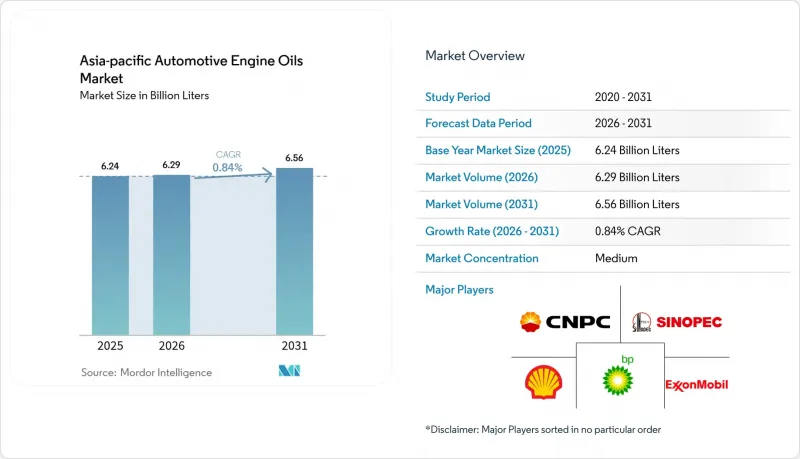
This report is Segmented by Product Type (Passenger Car Motor Oil, Heavy Duty Motor Oil, and Motorcycle Engine Oil), Base Stock (Mineral, Synthetic, Semi-Synthetic, and Bio-Based), and Geography (China, India, Pakistan, Bangladesh, Japan, South Korea, Taiwan, Australia, Malaysia, Indonesia, and Rest of Asia-Pacific). The Market Forecasts are Provided in Terms of Volume (Litres).
Asia-Pacific Automotive Engine Oils Market Trends and Insights
ICE parc still expanding in emerging ASEAN
Rapid vehicle fleet growth in Vietnam, Indonesia, Thailand, and Malaysia continues to drive positive conventional lubricant demand, even as electrification advances. Vietnam's automotive roadmap aims for 1 million annual vehicle sales by 2030, implying double-digit growth and stronger factory-fill volumes for local assemblers. Indonesia's 125.31 million motorcycle fleet similarly sustains high consumption of Motorcycle Engine Oil as commuting remains two-wheeler-centric. Localization rules that mandate 55-60% domestic content by 2030 stimulate regional blending plants, which lower logistics costs and enable customized formulations for tropical duty cycles. Across these markets, the Asia-Pacific Automotive Engine Oils Market benefits from aftermarket demand tied to small-engine maintenance intervals common in congested urban traffic. Suppliers capitalizing on this upside deploy dealer-education programs and branded service chains to secure repeat purchases.
OEM factory-fill partnerships drive premium segment growth
Automakers increasingly embed lubricant brands into their warranty propositions, channeling purchases toward approved suppliers. Recent agreements between Shell and several Japanese manufacturers demonstrate how the co-development of 0W-20 and 5W-30 blends, tailored for hybrid engines, supports extended drain intervals of up to 10,000 km. TotalEnergies' collaboration with Kia also ties lubrication recommendations to OEM telematics that prompt service visits, thereby increasing customer stickiness. These programs shift the competitive arena from retail shelves to design centers, rewarding formulators with additive chemistry that balances fuel economy, low-temperature start-up, and catalytic-converter durability. As hybrid sales rise, factory-fill volumes act as gateways to profitable dealership aftermarkets, reinforcing brand equity and accelerating the premiumization trajectory of the Asia-Pacific Automotive Engine Oils Market.
Electronic vehicle penetration constrains traditional demand growth
China's accelerating shift toward battery electric cars removes engine lubrication requirements entirely and influences ASEAN policy road maps. EV share in the region reached 13% in 2024 and is on track for 8.5 million units by 2035. While hybrids moderate the decline by retaining small engines, overall per-vehicle lubricant volumes contract, forcing suppliers to hedge through EV thermal-management fluids and gear oils. Distribution models must also adapt as charging ecosystems reshape service-station economics, compressing conventional oil-change revenue streams across the Asia-Pacific Automotive Engine Oils Market.
Other drivers and restraints analyzed in the detailed report include:
- Tightening fuel-economy standards accelerate low-viscosity adoption
- Ride-hailing expansion intensifies commercial lubricant demand
- Extended drain intervals reduce service frequency requirements
For complete list of drivers and restraints, kindly check the Table Of Contents.
Segment Analysis
Passenger Car Motor Oil generated the largest slice of the Asia-Pacific Automotive Engine Oils Market in 2025 at 48.92%, benefiting from the region's still-dominant passenger-vehicle parc. Motorcycle Engine Oil, however, is the fastest riser, with a 0.93% CAGR to 2031, driven by the predominance of two-wheelers in ASEAN megacities and the emergence of range-extender hybrid scooters. Heavy-duty motor oil remains stable, reflecting steady infrastructure investment and regional freight expansion.
MCO growth also aligns with OEM experimentation in small-capacity hybrid engines that run at steady RPM for generator duties, demanding thermally robust lubricants. Suppliers attuned to this niche develop shear-stable 10W-30 grades that are compatible with the wet-clutch systems commonly found in Asia's motorcycle designs. As urban congestion increases, ride-share scooter usage rises, and service chains that market fast oil swaps at roadside kiosks deepen consumer loyalty. Overall, diversified product portfolios enable vendors to cushion slowing PCMO volumes while capitalizing on the faster-growing MCO segment of the Asia-Pacific Automotive Engine Oils Market.
Complete Report Scope:
- by Product Type
- Passenger Car Motor Oil (PCMO)
- 0W-XX
- 5W-XX
- 10W-XX
- 15W-XX
- Monogrades
- Other Grades
- Heavy Duty Motor Oil (HDMO)
- 0W-XX
- 5W-XX
- 10W-XX
- 15W-XX
- Monogrades
- Other Grades
- Motorcycle Engine Oil (MCO)
- 0W-XX
- 5W-XX
- 10W-XX
- 15W-XX
- Monogrades
- Other Grades
- Passenger Car Motor Oil (PCMO)
- By Base Stock
- Mineral
- Synthetic
- Semi-Synthetic
- Bio-Based
- By Geography
- China
- India
- Pakistan
- Bangladesh
- Japan
- South Korea
- Taiwan
- Australia
- Malaysia
- Indonesia
- Thailand
- Vietnam
- Rest of Asia-Pacific
List of Companies Covered in this Report:
- Shell plc
- Exxon Mobil Corporation
- BP Plc
- TotalEnergies
- Chevron Corporation
- China Petrochemical Corporation
- CNPC
- Indian Oil Corporation Limited
- ENEOS Corporation
- FUCHS
- Motul
- PT Pertamina
- PTT LUBRICANTS
- Idemitsu Kosan Co.
- Gulf Oil International
- Repsol
- Lukoil Lubricants
- SK Enmove co.Ltd.
- Bharat Petroleum Corporation
Additional Benefits:
- The market estimate (ME) sheet in Excel format
- 3 months of analyst support
TABLE OF CONTENTS
1 Introduction
- 1.1 Study Assumptions and Market Definition
- 1.2 Scope of the Study
2 Research Methodology
3 Executive Summary
4 Market Landscape
- 4.1 Market Overview
- 4.2 Market Drivers
- 4.2.1 ICE (Internal Combustion Engine) parc still expanding in emerging ASEAN
- 4.2.2 OEM factory-fill tie-ups with lube majors
- 4.2.3 Tightening APAC fuel-economy standards
- 4.2.4 Surge in ride-hailing motor-hours
- 4.2.5 Electrified two-wheeler range-extender hybrids
- 4.3 Market Restraints
- 4.3.1 Electronic Vehicle penetration in China passenger cars
- 4.3.2 Longer OEM drain-interval specifications
- 4.3.3 Government push for bio-lubricants
- 4.4 Value Chain and Distribution Channel Analysis
- 4.5 Porter's Five Forces
- 4.5.1 Threat of New Entrants
- 4.5.2 Bargaining Power of Suppliers
- 4.5.3 Bargaining Power of Buyers
- 4.5.4 Threat of Substitutes
- 4.5.5 Industry Rivalry
- 4.6 Regulatory Framework
- 4.7 Automotive Industry Trends
5 Market Size and Growth Forecasts (Volume)
- 5.1 by Product Type
- 5.1.1 Passenger Car Motor Oil (PCMO)
- 5.1.1.1 0W-XX
- 5.1.1.2 5W-XX
- 5.1.1.3 10W-XX
- 5.1.1.4 15W-XX
- 5.1.1.5 Monogrades
- 5.1.1.6 Other Grades
- 5.1.2 Heavy Duty Motor Oil (HDMO)
- 5.1.2.1 0W-XX
- 5.1.2.2 5W-XX
- 5.1.2.3 10W-XX
- 5.1.2.4 15W-XX
- 5.1.2.5 Monogrades
- 5.1.2.6 Other Grades
- 5.1.3 Motorcycle Engine Oil (MCO)
- 5.1.3.1 0W-XX
- 5.1.3.2 5W-XX
- 5.1.3.3 10W-XX
- 5.1.3.4 15W-XX
- 5.1.3.5 Monogrades
- 5.1.3.6 Other Grades
- 5.1.1 Passenger Car Motor Oil (PCMO)
- 5.2 By Base Stock
- 5.2.1 Mineral
- 5.2.2 Synthetic
- 5.2.3 Semi-Synthetic
- 5.2.4 Bio-Based
- 5.3 By Geography
- 5.3.1 China
- 5.3.2 India
- 5.3.3 Pakistan
- 5.3.4 Bangladesh
- 5.3.5 Japan
- 5.3.6 South Korea
- 5.3.7 Taiwan
- 5.3.8 Australia
- 5.3.9 Malaysia
- 5.3.10 Indonesia
- 5.3.11 Thailand
- 5.3.12 Vietnam
- 5.3.13 Rest of Asia-Pacific
6 Competitive Landscape
- 6.1 Market Concentration
- 6.2 Strategic Moves
- 6.3 Market Share (%)**/Ranking Analysis
- 6.4 Company Profiles (includes Global level Overview, Market level overview, Core Segments, Financials as available, Production Capacity, Strategic Information, Market Rank/Share for key companies, Products and Services, and Recent Developments)
- 6.4.1 Shell plc
- 6.4.2 Exxon Mobil Corporation
- 6.4.3 BP Plc
- 6.4.4 TotalEnergies
- 6.4.5 Chevron Corporation
- 6.4.6 China Petrochemical Corporation
- 6.4.7 CNPC
- 6.4.8 Indian Oil Corporation Limited
- 6.4.9 ENEOS Corporation
- 6.4.10 FUCHS
- 6.4.11 Motul
- 6.4.12 PT Pertamina
- 6.4.13 PTT LUBRICANTS
- 6.4.14 Idemitsu Kosan Co.
- 6.4.15 Gulf Oil International
- 6.4.16 Repsol
- 6.4.17 Lukoil Lubricants
- 6.4.18 SK Enmove co.Ltd.
- 6.4.19 Bharat Petroleum Corporation
7 Market Opportunities and Future Outlook
- 7.1 White-space and Unmet-need Assessment
8 Key Strategic Questions for CEOs

