PUBLISHER: Mordor Intelligence | PRODUCT CODE: 2121380

PUBLISHER: Mordor Intelligence | PRODUCT CODE: 2121380
West Africa Oil And Gas Upstream - Market Share Analysis, Industry Trends & Statistics, Growth Forecasts (2026 - 2031)
According to Mordor Intelligence, the West Africa oil and gas upstream market size is projected to be USD 10.22 billion in 2025, USD 10.62 billion in 2026, and reach USD 13.08 billion by 2031, growing at a CAGR of 4.25% from 2026 to 2031.
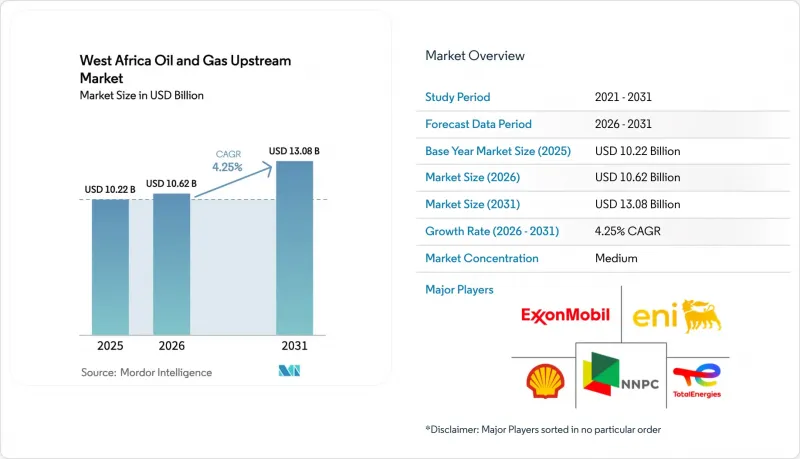
This report is Segmented by Location of Deployment (Onshore and Offshore), Resource Type (Crude Oil and Natural Gas), Well Type (Conventional and Unconventional), Service (Exploration, Development and Production, and Decommissioning), and Geography (Nigeria, Ghana, Benin, Burkina Faso, Niger, Mali, and Rest of West Africa). The Market Sizes and Forecasts are Provided in Terms of Value (USD).
West Africa Oil And Gas Upstream Market Trends and Insights
Deep-Water Discoveries Unlocking Low-Breakeven Barrels
Senegal's Sangomar achieved first oil in June 2024 and climbed to 100,000 barrels per day in early 2025, delivering a 25% internal rate of return at USD 60 Brent after sidestepping standalone FPSO costs through subsea tie-backs. Nigeria's Bonga Southwest, sanctioned in December 2024, mirrors the architecture by tying 20 wells into the existing Bonga FPSO, lowering breakeven to USD 35 per barrel and shortening payback to four years. Mauritania's Greater Tortue Ahmeyim Phase 2 will add 2.5 million t pa of LNG by sharing floating infrastructure with Senegal, halving per-ton capital intensity relative to greenfield schemes. These unit-cost wins attract fresh liquidity, such as Afreximbank's USD 5 billion facility dedicated to gas monetization and subsea packages announced in 2024. As a result, deep-water projects now rival U.S. shale on cost curves, repositioning West Africa within global supply stacks.
Fiscal Reforms Lifting Investment Attractiveness
Nigeria's Petroleum Industry Act replaced opaque joint-venture terms with production-sharing contracts and a progressive 7.5-10% royalty ladder that rewards deeper, smaller fields. The inaugural 2024 licensing round raised USD 1.8 billion in signature bonuses and committed to 8,500 km2 of new 3D seismic. Lower fiscal risk shaved the project's weighted-average cost of capital to 12-14%, down from 18-20% pre-PIA, according to independent operator models. Ghana launched a digital licensing portal in January 2025, broadcasting reserve and production histories that previously circulated only in closed data rooms. Early evidence shows bid-preparation times falling from 18 months to six, broadening the investor base beyond traditional IOCs.
Militancy, Theft & Sabotage Along Niger-Delta Pipelines
Nigeria lost USD 3.3 billion to crude theft between 2023-2024, cutting flows 200,000 bpd below its OPEC cap until military interventions restored volumes late 2024. A March 2025 sabotage of a Bonny Island feed-gas line forced a 20% NLNG output cut, spotlighting continued vulnerability. Operators now budget USD 50-80 million yearly for private security, drones, and community programs that double as protection payments. Rising costs erode margins for onshore producers and accelerate IOC divestments. Persistent vandalism, therefore, drags drilling sentiment and redirects capital to offshore basins that bypass onshore pipelines entirely.
Other drivers and restraints analyzed in the detailed report include:
- LNG Export Build-Out Spurring Gas Developments
- Rise of Pan-African Energy Banks Filling Capital Gap
- OPEC Quotas & Price Volatility Dampening Drilling Plans
For complete list of drivers and restraints, kindly check the Table Of Contents.
Segment Analysis
Offshore projects captured 65.5% of West Africa's oil and gas upstream market share in 2025 and are set to expand at a 6.5% CAGR to 2031. The West Africa oil and gas upstream market size related to offshore activity is forecast to climb in tandem as tie-back economics unlock breakevens below USD 40 per barrel. Nigeria's Bonga Southwest employs existing FPSO infrastructure to cut upfront costs, whereas Senegal's Sangomar leverages leased units to deliver 25% internal rates of return. Modularity stands out; Ghana's 80,000 bpd Agogo FPSO, scheduled for 2026 first oil, can be redeployed if reserves fall short.
Onshore output remains material yet structurally challenged. Niger-Delta security premiums add USD 5-8 per-barrel logistics and security costs, compelling some producers to bypass vandalized lines with barges. Shell's USD 2.4 billion divestment to Renaissance underscores the widening risk-adjusted returns gap. Frontier onshore plays, such as Niger's Agadem, stay viable by using dedicated export lines isolated from Delta risks. Even so, capital gravitates offshore where political and logistical hurdles are comparatively lighter and digital monitoring lowers non-technical risk.
Crude oil generated 62.1% of 2025 revenue, but natural gas will grow at a 7.1% CAGR, propelled by LNG projects and domestic supply mandates. The West Africa oil and gas upstream market size tied to gas is slated to expand sharply once Nigeria LNG Train 7's 8 million t pa module and Greater Tortue Ahmeyim Phase 2 come on-stream. Domestic obligations guarantee a regulated floor price: Nigeria targets 5 GW of new gas power by 2028, absorbing 1.2 bcf/d at steady-state.
Crude retains primacy because refining bottlenecks force an export orientation. Nigeria's 650,000 bpd Dangote plant, online in 2024, covers only a fraction of national output. Geological endowment also matters; 25 tcf of proven gas pales beside 37 billion barrels of oil on an energy-equivalent basis. Still, improved flaring penalties and multi-market outlets are tipping drilling schedules toward gas, tightening the crude-gas revenue gap year over year.
Complete Report Scope:
- By Location of Deployment
- Onshore
- Offshore
- By Resource Type
- Crude Oil
- Natural Gas
- By Well Type
- Conventional
- Unconventional
- By Service
- Exploration
- Development and Production
- Decomissioning
- By Geography
- Nigeria
- Ghana
- Benin
- Burkina Faso
- Niger
- Mali
- Rest of West Africa
List of Companies Covered in this Report:
- Shell plc
- TotalEnergies SE
- Eni SpA
- Exxon Mobil Corporation
- Nigerian National Petroleum Company Ltd
- Ghana National Petroleum Corporation
- BP plc
- Chevron Corporation
- Seplat Energy plc
- Kosmos Energy Ltd
- Tullow Oil plc
- Woodside Energy Group Ltd
- Azule Energy
- Vaalco Energy Inc
- Perenco SA
- Savannah Energy plc
- Panoro Energy ASA
- BW Energy ASA
- Africa Oil Corporation
- Cairn (Capricorn) Energy plc
- Petrofac Ltd (services)
Additional Benefits:
- The market estimate (ME) sheet in Excel format
- 3 months of analyst support
TABLE OF CONTENTS
1 Introduction
- 1.1 Study Assumptions & Market Definition
- 1.2 Scope of the Study
2 Research Methodology
3 Executive Summary
4 Market Landscape
- 4.1 Market Overview
- 4.2 Market Drivers
- 4.2.1 Deep-water discoveries unlocking low-breakeven barrels
- 4.2.2 Fiscal reforms (e.g., Nigeria PIA) lifting investment attractiveness
- 4.2.3 LNG export build-out (GTA, NLNG 7) spurring gas developments
- 4.2.4 Rise of pan-African energy banks filling capital gap
- 4.2.5 Digital subsurface data hubs and open licensing platforms
- 4.2.6 IOC divestments creating brown-field upside for independents
- 4.3 Market Restraints
- 4.3.1 Militancy, theft & sabotage along Niger-Delta pipelines
- 4.3.2 OPEC quotas and price volatility dampening drilling plans
- 4.3.3 Western-bank ESG pull-back tightening project finance
- 4.3.4 EU methane-fee regime raising compliance costs
- 4.4 Supply-Chain Analysis
- 4.5 Regulatory Landscape
- 4.6 Technological Outlook
- 4.7 Crude-Oil Production & Consumption Outlook
- 4.8 Natural-Gas Production & Consumption Outlook
- 4.9 Unconventional Resources CAPEX Outlook (tight oil, oil sands, deep-water)
- 4.10 Porter's Five Forces
- 4.10.1 Bargaining Power of Suppliers
- 4.10.2 Bargaining Power of Consumers
- 4.10.3 Threat of New Entrants
- 4.10.4 Threat of Substitutes
- 4.10.5 Intensity of Competitive Rivalry
5 Market Size & Growth Forecasts
- 5.1 By Location of Deployment
- 5.1.1 Onshore
- 5.1.2 Offshore
- 5.2 By Resource Type
- 5.2.1 Crude Oil
- 5.2.2 Natural Gas
- 5.3 By Well Type
- 5.3.1 Conventional
- 5.3.2 Unconventional
- 5.4 By Service
- 5.4.1 Exploration
- 5.4.2 Development and Production
- 5.4.3 Decomissioning
- 5.5 By Geography
- 5.5.1 Nigeria
- 5.5.2 Ghana
- 5.5.3 Benin
- 5.5.4 Burkina Faso
- 5.5.5 Niger
- 5.5.6 Mali
- 5.5.7 Rest of West Africa
6 Competitive Landscape
- 6.1 Market Concentration
- 6.2 Strategic Moves (M&A, Partnerships, PPAs)
- 6.3 Market Share Analysis (Market Rank/Share for key companies)
- 6.4 Company Profiles (includes Global level Overview, Market level overview, Core Segments, Financials as available, Strategic Information, Products & Services, and Recent Developments)
- 6.4.1 Shell plc
- 6.4.2 TotalEnergies SE
- 6.4.3 Eni SpA
- 6.4.4 Exxon Mobil Corporation
- 6.4.5 Nigerian National Petroleum Company Ltd
- 6.4.6 Ghana National Petroleum Corporation
- 6.4.7 BP plc
- 6.4.8 Chevron Corporation
- 6.4.9 Seplat Energy plc
- 6.4.10 Kosmos Energy Ltd
- 6.4.11 Tullow Oil plc
- 6.4.12 Woodside Energy Group Ltd
- 6.4.13 Azule Energy
- 6.4.14 Vaalco Energy Inc
- 6.4.15 Perenco SA
- 6.4.16 Savannah Energy plc
- 6.4.17 Panoro Energy ASA
- 6.4.18 BW Energy ASA
- 6.4.19 Africa Oil Corporation
- 6.4.20 Cairn (Capricorn) Energy plc
- 6.4.21 Petrofac Ltd (services)
7 Market Opportunities & Future Outlook
- 7.1 White-space & Unmet-Need Assessment

