PUBLISHER: Mordor Intelligence | PRODUCT CODE: 2117374

PUBLISHER: Mordor Intelligence | PRODUCT CODE: 2117374
Japan Mining Equipment - Market Share Analysis, Industry Trends & Statistics, Growth Forecasts (2026 - 2031)
According to Mordor Intelligence, the Japan mining equipment market size was valued at USD 6.57 billion in 2025 and is estimated to grow from USD 6.92 billion in 2026 to reach USD 9.01 billion by 2031, at a CAGR of 5.40% during the forecast period (2026-2031), growing at a CAGR of 5.40% over 2026-2031.
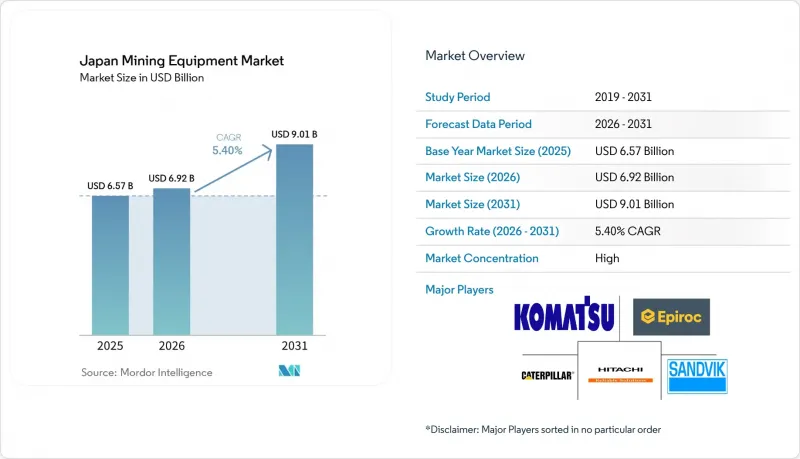
This report is Segmented by Equipment Type (Surface Mining Equipment, Underground Mining Equipment, and More), Automation Level (Manual Equipment, and More), Powertrain Type (Internal-Combustion Engine Vehicles, and More), Power Output (Less Than 500 HP, and More), and Application (Metal Mining and More). The Market Forecasts are Provided in Terms of Value (USD).
Japan Mining Equipment Market Trends and Insights
Government Incentives for Critical-Mineral Self-Sufficiency
Japan's Economic Security Promotion Act has designated key metals and mining equipment as "critical," paving the way for preferential financing, tax relief, and expedited permitting. The act mandates supply-chain resilience, guaranteeing multi-year purchasing pipelines for essential equipment like loaders, crushing circuits, and offshore robotics. This initiative aims to reduce dependency on imports and bolster domestic production capabilities . Additionally, fiscal support and swift regulatory processes provide a stable outlook for brownfield upgrades and new greenfield projects, fostering long-term growth in the mining sector.
Surging EV-Battery Metal Demand
Japan's electric-vehicle production experienced significant growth, driven by Toyota's expansion into solid-state batteries and Panasonic's ambitious gigafactory development. As demand for cathode materials accelerates, there's a surge in the procurement of high-throughput crushers and flotation cells, steering Japan's mining equipment market towards more advanced mineral-processing lines. Sumitomo Metal Mining, leveraging a 5G underground network, is remotely operating Sandvik AutoMine fleets to achieve a substantial productivity boost. Trials of Hitachi's ABB-powered battery-electric haul truck in Hokkaido achieved a notable reduction in diesel consumption. On the geopolitical front, China's export restrictions on gallium and germanium led to a spike in drilling-component costs, underscoring the strategic importance of domestic extraction investments.
Environmental Permitting Challenges Constrain Project Timelines
Environmental Impact Assessment law imposes sequential studies on biodiversity, water quality, and cultural heritage, extending the timeline for risk assessment for both onshore and offshore mines. Deep-sea schemes face heightened scrutiny due to limited baselines for benthic ecosystems. Mining promoters must show rehabilitation funding at financial close, raising up-front capex. These conditions push equipment orders into later project phases and incentivize modular, redeployable plants that minimize permanent seabed alteration. The additional compliance workload raises soft-cost ratios and tempers the velocity of new fleet installations.
Other drivers and restraints analyzed in the detailed report include:
- Tech Advances in AI-Enabled Exploration Rigs
- National Push for Methane-Hydrate and Deep-Sea Resources
- Commodity Price Volatility Impacts Investment Decisions
For complete list of drivers and restraints, kindly check the Table Of Contents.
Segment Analysis
Surface mining equipment accounted for 37.22% of 2025 revenues in the Japan mining equipment market, with operations anchored in Hokkaido and Kyushu. As several coal sites shuttered, underground units have found newfound significance. These closures have opened tunnels for the extraction of rare-earth elements, a process now heavily reliant on compact loaders and advanced ventilation equipment. The mineral-processing systems segment is witnessing the swiftest growth. This surge is driven by the need for enhanced crushing and flotation capacities to handle low-grade ores. Notably, Sumitomo's upgrade to its Hishikari line achieved a remarkable reduction in cost-per-tonne.
Drills and breakers are poised for an 8.24% CAGR to 2031 as operators pursue narrow-vein deposits where bulk excavation is unviable. Komatsu's FrontRunner haulage boosts autonomous haul performance, significantly reducing labor costs. Meanwhile, Hi ROBOROCK's jumbos lead in tunnel expansion, leveraging predictive-maintenance IoT. Ongoing retrofits aimed at sidestepping carbon taxes are driving both new and replacement orders in Japan's mining equipment market.
Manual rigs still account for 54.07% of installed units, yet labor scarcity and safety rules are catalyzing a shift toward semi- and fully autonomous platforms. Caterpillar's Command for Hauling allows a single controller to oversee multiple trucks, delivering a workable bridge solution in environments with strict CAPEX discipline.
Fully autonomous systems post a 9.22% CAGR, the highest among all categories, as the i-Construction tax credit reimburses up to 30% of purchase costs. Under the Mine Safety Act, certification mandates the use of dual-redundant sensors and fail-safe logic. This requirement introduces a lengthy validation cycle, solidifying Komatsu, Sandvik, and Epiroc's positions as trusted suppliers in Japan's mining equipment market. In artisanal operations, manual rigs continue to dominate, especially when annual throughput is low, making autonomy economically unfeasible.
Complete Report Scope:
- By Equipment Type
- Surface Mining Equipment
- Underground Mining Equipment
- Mineral Processing Equipment
- Drills and Breakers
- Crushing, Pulverizing and Screening
- Loaders and Haul Trucks
- By Automation Level
- Manual Equipment
- Semi-Autonomous Equipment
- Fully Autonomous Equipment
- By Powertrain Type
- Internal-Combustion Engine Vehicles
- Battery-Electric Vehicles
- Hybrid Vehicles
- By Power Output
- Less than 500 HP
- 500 to 1,000 HP
- Above 1,000 HP
- By Application
- Metal Mining
- Mineral Mining
- Coal Mining
List of Companies Covered in this Report:
- Epiroc AB
- Sandvik AB
- Caterpillar Inc.
- Komatsu Ltd.
- Hitachi Construction Machinery
- Sumitomo Metal Mining Exploration Tech
- Boart Longyear
- Atlas Copco
- Furukawa Rock Drill
- Mitsui Mining and Smelting Tech
- JFE Engineering Geo-Services
- Yokogawa Electric (GeoSolutions)
- Tokyo Seimitsu (Accretech)
- GeoScan Technologies
- Geometrics Inc.
- Teledyne Reson
- Deep-Ocean Vision
- DJI Enterprise
- Skycatch Japan
- Terra Drone Corp.
Additional Benefits:
- The market estimate (ME) sheet in Excel format
- 3 months of analyst support
TABLE OF CONTENTS
1 Introduction
- 1.1 Study Assumptions and Market Definition
- 1.2 Scope of the Study
2 Research Methodology
3 Executive Summary
4 Market Landscape
- 4.1 Market Overview
- 4.2 Market Drivers
- 4.2.1 Gov. Incentives for Critical-mineral Self-sufficiency
- 4.2.2 Surging EV-battery Metal Demand
- 4.2.3 Tech Advances in AI-enabled Exploration Rigs
- 4.2.4 Push for Methane-hydrate and Deep-sea Resources
- 4.2.5 Ageing Workforce
- 4.2.6 Carbon-neutral Targets Favouring BEV Rigs
- 4.3 Market Restraints
- 4.3.1 Stringent Environmental Permitting
- 4.3.2 Commodity-price Volatility
- 4.3.3 Land Scarcity vs Urban Development
- 4.3.4 High-Precision Component Supply Chain Fragility
- 4.4 Value/Supply-Chain Analysis
- 4.5 Regulatory Landscape
- 4.6 Technological Outlook
- 4.7 Porter's Five Forces
- 4.7.1 Threat of New Entrants
- 4.7.2 Bargaining Power of Suppliers
- 4.7.3 Bargaining Power of Buyers
- 4.7.4 Threat of Substitutes
- 4.7.5 Competitive Rivalry
5 Market Size and Growth Forecasts (Value (USD))
- 5.1 By Equipment Type
- 5.1.1 Surface Mining Equipment
- 5.1.2 Underground Mining Equipment
- 5.1.3 Mineral Processing Equipment
- 5.1.4 Drills and Breakers
- 5.1.5 Crushing, Pulverizing and Screening
- 5.1.6 Loaders and Haul Trucks
- 5.2 By Automation Level
- 5.2.1 Manual Equipment
- 5.2.2 Semi-Autonomous Equipment
- 5.2.3 Fully Autonomous Equipment
- 5.3 By Powertrain Type
- 5.3.1 Internal-Combustion Engine Vehicles
- 5.3.2 Battery-Electric Vehicles
- 5.3.3 Hybrid Vehicles
- 5.4 By Power Output
- 5.4.1 Less than 500 HP
- 5.4.2 500 to 1,000 HP
- 5.4.3 Above 1,000 HP
- 5.5 By Application
- 5.5.1 Metal Mining
- 5.5.2 Mineral Mining
- 5.5.3 Coal Mining
6 Competitive Landscape
- 6.1 Market Concentration
- 6.2 Strategic Moves
- 6.3 Market Share Analysis
- 6.4 Company Profiles (Includes Global-level Overview, Market-level Overview, Core Segments, Financials as available, Strategic Information, Market Rank/Share, Products and Services, Recent Developments)
- 6.4.1 Epiroc AB
- 6.4.2 Sandvik AB
- 6.4.3 Caterpillar Inc.
- 6.4.4 Komatsu Ltd.
- 6.4.5 Hitachi Construction Machinery
- 6.4.6 Sumitomo Metal Mining Exploration Tech
- 6.4.7 Boart Longyear
- 6.4.8 Atlas Copco
- 6.4.9 Furukawa Rock Drill
- 6.4.10 Mitsui Mining and Smelting Tech
- 6.4.11 JFE Engineering Geo-Services
- 6.4.12 Yokogawa Electric (GeoSolutions)
- 6.4.13 Tokyo Seimitsu (Accretech)
- 6.4.14 GeoScan Technologies
- 6.4.15 Geometrics Inc.
- 6.4.16 Teledyne Reson
- 6.4.17 Deep-Ocean Vision
- 6.4.18 DJI Enterprise
- 6.4.19 Skycatch Japan
- 6.4.20 Terra Drone Corp.
7 Market Opportunities and Future Outlook
- 7.1 White-space and Unmet-Need Assessment

