PUBLISHER: Mordor Intelligence | PRODUCT CODE: 2117418

PUBLISHER: Mordor Intelligence | PRODUCT CODE: 2117418
France Mining Equipment - Market Share Analysis, Industry Trends & Statistics, Growth Forecasts (2026 - 2031)
According to Mordor Intelligence, the France mining equipment market size is expected to increase from USD 0.94 billion in 2025 to USD 0.97 billion in 2026 and reach USD 1.13 billion by 2031, growing at a CAGR of 3.16% over 2026-2031.
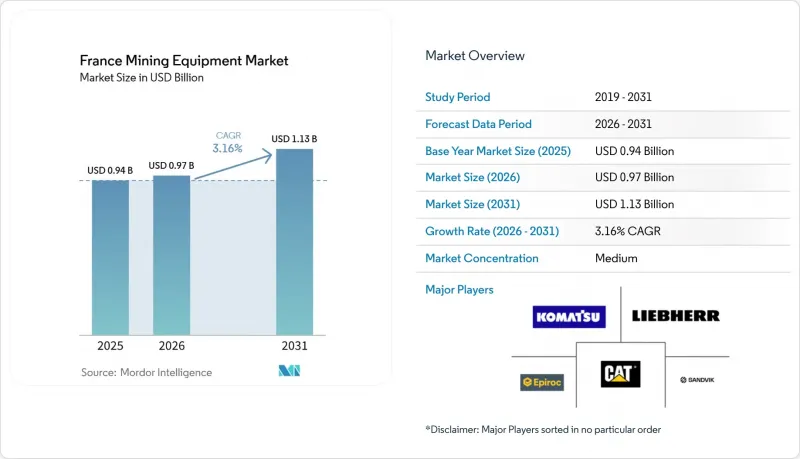
This report is Segmented by Equipment Type (Surface Mining Equipment, Underground Mining Equipment, and More), Automation Level (Manual Equipment, Semi-Autonomous Equipment, and More), Powertrain Type (Internal-Combustion Engine Vehicles and More), Power Output (Less Than 500 HP and More), and Application (Metal Mining and More). The Market Forecasts are Provided in Terms of Value (USD).
France Mining Equipment Market Trends and Insights
EU Critical Raw Materials Act Accelerates Domestic Mining Investment
The Act mandates 10% domestic extraction capacity by 2030, cutting permitting times by up to 50% and compressing equipment procurement cycles. Equipment suppliers that meet traceability and low-emission criteria are gaining an edge, as operators increasingly align with EU sustainability disclosures. This alignment is driven by the growing emphasis on environmental, social, and governance (ESG) standards, which are becoming critical for businesses to maintain compliance and competitiveness in the market. Furthermore, the legislation spurs regional workforce programs to enhance local employment opportunities and skill development. These initiatives, in turn, are boosting the demand for after-sales services, as a skilled workforce is essential for maintaining and servicing equipment effectively, ensuring operational efficiency and customer satisfaction.
France 2030 Fund Spurs Critical-Minerals Projects
Imerys' EMILI lithium project has received an initial boost from a larger allocation. This funding marks the unlocking of the first tranche in a broader capital expenditure plan. The plan encompasses a comprehensive array of equipment, including jumbos, battery-electric loaders, and automated trucks. By choosing equity stakes over traditional grants, the project aligns its incentives more effectively. This strategic move reduces risk premiums and accelerates procurement cycles. Furthermore, private entities, like InfraVia's critical-minerals fund, are broadening the scope of investment. They are focusing on a diverse array of small- to mid-scale projects, which often favor compact modular equipment.
High CAPEX and Long ROI for Autonomous / BEV Fleets
Battery-electric loaders, priced notably higher than diesel models, see their costs surge further with the addition of autonomous features. These higher upfront costs, combined with operational challenges, extend the payback periods for mid-tier mines, making it difficult for them to justify the investment. Broader adoption remains hindered by financial risks, notably from unpredictable secondary-market values and battery degradation, which raise concerns about long-term economic viability.
Other drivers and restraints analyzed in the detailed report include:
- Automation and Electrification Boost Safety-Productivity Economics
- Tight NRMM / Euro-VI Emissions Rules Drive Fleet Renewal
- Domestic Coal Decline Curbs Demand for Certain Machinery
For complete list of drivers and restraints, kindly check the Table Of Contents.
Segment Analysis
Surface mining equipment accounted for 41.87% of the France mining equipment market share in 2025. Underground equipment, while smaller in current value, is projected to record a 6.46% CAGR during 2026-2031, the fastest within the category. This differential stems from municipal resistance to new open pits and the need to protect rural landscapes above lithium and tungsten deposits.
As a result, operators are channeling capex into loaders, jumbos, and autonomous haul trucks designed for confined stopes, a shift that front-loads orders into the 2026-2028 window. Surface fleets remain essential for aggregates, yet their growth plateaus as quarry production levels off.
Manual fleets commanded 64.12% of the France mining equipment market share in 2025. Fully autonomous machines, however, are set to expand at a 7.43% CAGR through 2031, outpacing all other automation tiers. Large underground projects justify their higher upfront integration costs through significant improvements in asset utilization and notable labor savings.
Mid-tier operators favor semi-autonomous kits that deliver collision avoidance and tele-operation without requiring mine-wide 5G coverage. Ongoing government digital-skills programs are expected to ease the current technician bottleneck, smoothing adoption curves after 2027.
Complete Report Scope:
- By Equipment Type
- Surface Mining Equipment
- Underground Mining Equipment
- Mineral Processing Equipment
- Drills and Breakers
- Crushing, Pulverizing and Screening
- Loaders
- Mining Trucks
- By Automation Level
- Manual Equipment
- Semi-Autonomous Equipment
- Fully Autonomous Equipment
- By Powertrain Type
- Internal-Combustion Engine Vehicles
- Battery-Electric Vehicles
- Hybrid Vehicles
- By Power Output
- Less than 500 HP
- 500 - 1,000 HP
- Above 1,000 HP
- By Application
- Metal Mining
- Mineral Mining
- Coal Mining
List of Companies Covered in this Report:
- Caterpillar Inc.
- Komatsu Ltd.
- Sandvik AB
- Epiroc AB
- Liebherr-International AG
- Volvo Construction Equipment AB
- Hitachi Construction Machinery Co., Ltd.
- Atlas Copco AB
- Doosan Infracore (HD Hyundai)
- Metso Corporation
- Terex Corporation
- Wirtgen Group
- Thyssenkrupp Industrial Solutions AG
- Aramine SAS
- Manitou Group
- SANY Heavy Industry
- XCMG Group
- Fives Group
- Normet Oy
Additional Benefits:
- The market estimate (ME) sheet in Excel format
- 3 months of analyst support
TABLE OF CONTENTS
1 Introduction
- 1.1 Study Assumptions & Market Definition
- 1.2 Scope of the Study
2 Research Methodology
3 Executive Summary
4 Market Landscape
- 4.1 Market Overview
- 4.2 Market Drivers
- 4.2.1 EU Critical Raw Materials Act Accelerates Domestic Mining Investment
- 4.2.2 Automation and Electrification Boost Safety-Productivity Economics
- 4.2.3 France 2030 Fund Spurs Critical-Minerals Projects
- 4.2.4 Tight NRMM / Euro-VI Emissions Rules Drive Fleet Renewal
- 4.2.5 BRGM National Subsurface Inventory Increases Exploration Spend
- 4.2.6 Copper and Lithium Revival Projects Require Specialized Equipment
- 4.3 Market Restraints
- 4.3.1 Domestic Coal Decline Curbs Demand for Certain Machinery
- 4.3.2 High Capex and Long ROI For Autonomous / BEV Fleets
- 4.3.3 Lengthy Public Consultations Under Re-Formed Mining Code
- 4.3.4 Shortage of Skilled Technicians for Advanced Systems
- 4.4 Value / Supply-Chain Analysis
- 4.5 Regulatory Landscape
- 4.6 Technological Outlook
- 4.7 Porter's Five Forces
- 4.7.1 Threat of New Entrants
- 4.7.2 Bargaining Power of Suppliers
- 4.7.3 Bargaining Power of Buyers
- 4.7.4 Threat of Substitutes
- 4.7.5 Competitive Rivalry
5 Market Size & Growth Forecasts (Value (USD))
- 5.1 By Equipment Type
- 5.1.1 Surface Mining Equipment
- 5.1.2 Underground Mining Equipment
- 5.1.3 Mineral Processing Equipment
- 5.1.4 Drills and Breakers
- 5.1.5 Crushing, Pulverizing and Screening
- 5.1.6 Loaders
- 5.1.7 Mining Trucks
- 5.2 By Automation Level
- 5.2.1 Manual Equipment
- 5.2.2 Semi-Autonomous Equipment
- 5.2.3 Fully Autonomous Equipment
- 5.3 By Powertrain Type
- 5.3.1 Internal-Combustion Engine Vehicles
- 5.3.2 Battery-Electric Vehicles
- 5.3.3 Hybrid Vehicles
- 5.4 By Power Output
- 5.4.1 Less than 500 HP
- 5.4.2 500 - 1,000 HP
- 5.4.3 Above 1,000 HP
- 5.5 By Application
- 5.5.1 Metal Mining
- 5.5.2 Mineral Mining
- 5.5.3 Coal Mining
6 Competitive Landscape
- 6.1 Market Concentration
- 6.2 Strategic Moves
- 6.3 Market Share Analysis
- 6.4 Company Profiles (Includes Global level Overview, Market level overview, Core Segments, Financials as available, Strategic Information, Market Rank/Share for key companies, Products & Services, and Recent Developments)
- 6.4.1 Caterpillar Inc.
- 6.4.2 Komatsu Ltd.
- 6.4.3 Sandvik AB
- 6.4.4 Epiroc AB
- 6.4.5 Liebherr-International AG
- 6.4.6 Volvo Construction Equipment AB
- 6.4.7 Hitachi Construction Machinery Co., Ltd.
- 6.4.8 Atlas Copco AB
- 6.4.9 Doosan Infracore (HD Hyundai)
- 6.4.10 Metso Corporation
- 6.4.11 Terex Corporation
- 6.4.12 Wirtgen Group
- 6.4.13 Thyssenkrupp Industrial Solutions AG
- 6.4.14 Aramine SAS
- 6.4.15 Manitou Group
- 6.4.16 SANY Heavy Industry
- 6.4.17 XCMG Group
- 6.4.18 Fives Group
- 6.4.19 Normet Oy
7 Market Opportunities & Future Outlook

