PUBLISHER: Mordor Intelligence | PRODUCT CODE: 2122921

PUBLISHER: Mordor Intelligence | PRODUCT CODE: 2122921
Containerboard - Market Share Analysis, Industry Trends & Statistics, Growth Forecasts (2026 - 2031)
According to Mordor Intelligence, the containerboard market size is expected to grow from USD 149.79 billion in 2025 to USD 152.01 billion in 2026 and is forecast to reach USD 172.17 billion by 2031 at a 2.52% CAGR over 2026-2031.
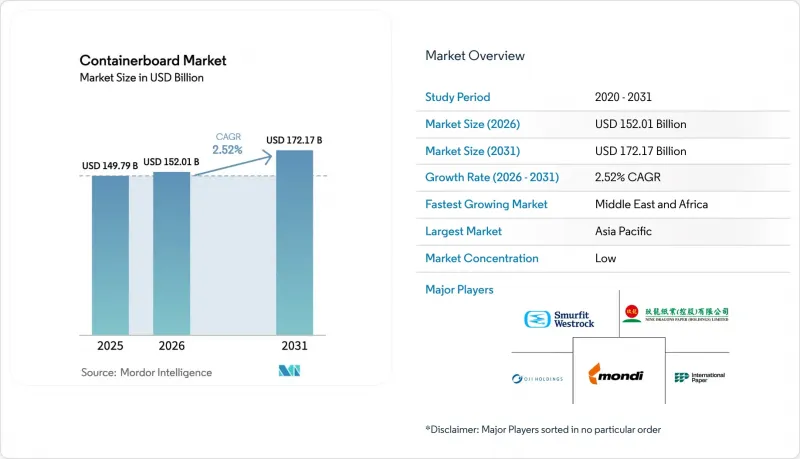
This report is Segmented by Material (Virgin Fibers, Recycled Fibers, and Blended Fibers), Type (Kraftliners, Testliners, Flutings, and More), Basis Weight (Below 150 Gsm, 150-300 Gsm, and Above 300 Gsm), End User (Food and Beverage, Consumer Goods, Industrial, and More), and Geography (North America, Europe, Asia-Pacific, South America, and More ). The Market Forecasts are Provided in Terms of Value (USD).
Global Containerboard Market Trends and Insights
Rising E-commerce Shipping Volumes
Explosive parcel growth is reshaping linerboard specifications as automated sortation and last-mile fulfillment subject shippers to higher drop and compression stresses. Integrated majors now combine 24 million tons of containerboard capacity with more than 2,000 box plants, enabling on-demand formats that achieve cube utilization within 5 millimeters of product dimensions. The result is elevated demand for kraftliners delivering burst strength above 1,100 kPa, a threshold that recycled testliners often miss without virgin reinforcement.
Growth in Processed Food and Beverage Packaging
Urbanizing middle-class consumers in Asia-Pacific and South America continue to favor shelf-stable foods packed in corrugated cases. Converters respond with moisture-resistant coatings and rapid-cooling liners that maintain board integrity through cold-chain logistics. The surge is most visible in single-serve beverage multipacks, where redesigned flute profiles cut weight yet uphold stacking strength, allowing retailers to run higher pallet heights.
Volatility in Recovered Paper Prices
Spot prices for old corrugated containers fell 16% in one quarter of 2025, compressing recycled-fiber mill margins by roughly 250 basis points. Such swings push independent producers toward vertical integration or long-term supply contracts, as quarterly fiber costs can otherwise fluctuate 20-30%. This trend highlights the importance of cost management strategies in maintaining profitability.
Other drivers and restraints analyzed in the detailed report include:
- Shift Toward Sustainable and Recyclable Packaging Solutions
- Lightweight Containerboard Innovations Reducing Shipping Costs
- Availability of Alternative Flexible Packaging Solutions
For complete list of drivers and restraints, kindly check the Table Of Contents.
Segment Analysis
Recycled fibers represented 58.32% of market share in 2025, anchored by mature collection loops in Europe and North America, where recovery rates exceed 90%. The containerboard market for blended grades is projected to outpace all others, with a 3.43% CAGR through 2031, as converters balance cost with burst strength. A multilayer concept pairing chemithermomechanical pulp with kraft fibers showcases how mills are engineering stiffness at lower grammages.
Blended formulations allow real-time adjustment to price shifts in recovered paper, smoothing margin swings for mills exposed to spot procurement. Regulatory minimums on recycled content compel virgin-fiber producers to integrate recovered furnish, further accelerating blend adoption. In application terms, blended liners increasingly ship fresh produce and export containers that require moisture resistance without full virgin composition.
Kraftliners held a 46.43% revenue share in 2025 as the favored outer liner for high-graphics retail and e-commerce cartons. Flutings, however, are forecast to grow 4.32% annually, the swiftest pace in the containerboard market. Lightweight semi-chemical flutings at 73 gsm are replacing 80-85 gsm recycled mediums, saving up to 16% material while keeping edge-crush values above 4.0 kN/m.
The uplift in fluting demand mirrors converter migration from C-flute to thinner B- and E-flute structures that trim board consumption yet uphold stacking performance. Kraftliner producers counter by launching 72-92 gsm grades that satisfy e-commerce burst requirements and reduce freight costs, reinforcing their dominance in premium outer facings of the containerboard market.
Complete Report Scope:
- By Material
- Virgin Fibers
- Recycled Fibers
- Blended Fibers
- By Type
- Kraftliners
- Testliners
- Flutings
- Other Types
- By Basis Weight
- Below 150 gsm
- 150 - 300 gsm
- Above 300 gsm
- By End User
- Food and Beverage
- Consumer Goods
- Industrial
- Other End Users
- By Geography
- North America
- United States
- Canada
- Mexico
- Europe
- Germany
- France
- United Kingdom
- Italy
- Spain
- Rest of Europe
- Asia-Pacific
- China
- Japan
- India
- South Korea
- Australia and New Zealand
- Rest of Asia-Pacific
- South America
- Brazil
- Argentina
- Rest of South America
- Middle East
- Saudi Arabia
- United Arab Emirates
- Turkey
- Rest of Middle East
- Africa
- South Africa
- Egypt
- Nigeria
- Rest of Africa
- North America
Geography Analysis
Asia-Pacific controlled 40.32% of 2025 output, anchored by China's 120 million-ton capacity. Nevertheless, maturation in China and relocations to Southeast Asia are moderating regional growth. India, Vietnam, and Thailand draw greenfield corrugators that cut lead times from 45-60 days to under 10 days for local brand owners. Water scarcity in northern China and parts of India is prompting investment in closed-loop effluent systems or coastal desalination tie-ins.
The Middle East and Africa comprise the fastest-growing bloc at 4.76% CAGR through 2031, propelled by Saudi Vision 2030 infrastructure and Egypt's industrial diversification. A 450,000-ton capacity increment in Saudi Arabia leverages low domestic gas prices and port proximity to broaden regional supply. Sub-Saharan demand is constrained by weak collection networks, necessitating virgin fiber imports from South America and Europe until domestic loops mature.
Europe and North America are rationalizing high-cost mills while upgrading integrated sites with biomass cogeneration. Two mill closures in the United States removed a combined 250,000 tons, but recycled capacity additions via acquisitions offset the cuts. In Europe, minimum recycled-content rules are nudging mills toward lighter, higher-recovered grades, though subdued industrial output keeps overall tonnage growth modest.
South America remains buoyed by Brazil's vertically integrated forestry assets that supply containerboard for food and beverage cases linked to urbanization and rapid grocery delivery. Currency volatility continues to influence export competitiveness, but local demand remains resilient.
- International Paper Company
- Smurfit WestRock
- Nine Dragons Paper Holdings
- Mondi plc
- Oji Holdings Corporation
- Cascades Inc.
- Stora Enso Oyj
- Sappi Limited
- Georgia-Pacific LLC
- Svenska Cellulosa Aktiebolaget SCA
- Lee and Man Paper Manufacturing
- Pratt Industries
- Klabin SA
- Rengo Co., Ltd.
- Packaging Corporation of America
- Asia Pulp and Paper (APP)
- Shanying International
- Visy Industries
Additional Benefits:
- The market estimate (ME) sheet in Excel format
- 3 months of analyst support
TABLE OF CONTENTS
1 INTRODUCTION
- 1.1 Study Assumptions and Market Definition
- 1.2 Scope of the Study
2 RESEARCH METHODOLOGY
3 EXECUTIVE SUMMARY
4 MARKET LANDSCAPE
- 4.1 Market Overview
- 4.2 Market Drivers
- 4.2.1 Rising E-commerce Shipping Volumes
- 4.2.2 Growth in Processed Food and Beverage Packaging
- 4.2.3 Shift Toward Sustainable and Recyclable Packaging Solutions
- 4.2.4 Expansion of Corrugated Box Plants in Emerging Markets
- 4.2.5 Lightweight Containerboard Innovations Reducing Shipping Costs
- 4.2.6 Increase in Intercontinental Trade Requiring Durable Packaging
- 4.3 Market Restraints
- 4.3.1 Availability of Alternative Flexible Packaging Solutions
- 4.3.2 Volatility in Recovered Paper Prices
- 4.3.3 Escalating Energy and Carbon Compliance Costs
- 4.3.4 Water Scarcity Constraints on Mill Operations
- 4.4 Industry Value Chain Analysis
- 4.5 Impact of Macroeconomic Factors on the Market
- 4.6 Regulatory Landscape
- 4.7 Technological Outlook
- 4.8 Porter's Five Forces Analysis
- 4.8.1 Bargaining Power of Suppliers
- 4.8.2 Bargaining Power of Consumers
- 4.8.3 Threat of New Entrants
- 4.8.4 Intensity of Competitive Rivalry
- 4.8.5 Threat of Substitutes
- 4.9 Investment Analysis
5 MARKET SIZE AND GROWTH FORECASTS(VALUE)
- 5.1 By Material
- 5.1.1 Virgin Fibers
- 5.1.2 Recycled Fibers
- 5.1.3 Blended Fibers
- 5.2 By Type
- 5.2.1 Kraftliners
- 5.2.2 Testliners
- 5.2.3 Flutings
- 5.2.4 Other Types
- 5.3 By Basis Weight
- 5.3.1 Below 150 gsm
- 5.3.2 150 - 300 gsm
- 5.3.3 Above 300 gsm
- 5.4 By End User
- 5.4.1 Food and Beverage
- 5.4.2 Consumer Goods
- 5.4.3 Industrial
- 5.4.4 Other End Users
- 5.5 By Geography
- 5.5.1 North America
- 5.5.1.1 United States
- 5.5.1.2 Canada
- 5.5.1.3 Mexico
- 5.5.2 Europe
- 5.5.2.1 Germany
- 5.5.2.2 France
- 5.5.2.3 United Kingdom
- 5.5.2.4 Italy
- 5.5.2.5 Spain
- 5.5.2.6 Rest of Europe
- 5.5.3 Asia-Pacific
- 5.5.3.1 China
- 5.5.3.2 Japan
- 5.5.3.3 India
- 5.5.3.4 South Korea
- 5.5.3.5 Australia and New Zealand
- 5.5.3.6 Rest of Asia-Pacific
- 5.5.4 South America
- 5.5.4.1 Brazil
- 5.5.4.2 Argentina
- 5.5.4.3 Rest of South America
- 5.5.5 Middle East
- 5.5.5.1 Saudi Arabia
- 5.5.5.2 United Arab Emirates
- 5.5.5.3 Turkey
- 5.5.5.4 Rest of Middle East
- 5.5.6 Africa
- 5.5.6.1 South Africa
- 5.5.6.2 Egypt
- 5.5.6.3 Nigeria
- 5.5.6.4 Rest of Africa
- 5.5.1 North America
6 COMPETITIVE LANDSCAPE
- 6.1 Market Concentration
- 6.2 Strategic Moves
- 6.3 Market Share Analysis
- 6.4 Company Profiles (Includes Global Level Overview, Market Level Overview, Core Segments, Financials as Available, Strategic Information, Market Rank/Share, Products and Services, and Recent Developments)
- 6.4.1 International Paper Company
- 6.4.2 Smurfit WestRock
- 6.4.3 Nine Dragons Paper Holdings
- 6.4.4 Mondi plc
- 6.4.5 Oji Holdings Corporation
- 6.4.6 Cascades Inc.
- 6.4.7 Stora Enso Oyj
- 6.4.8 Sappi Limited
- 6.4.9 Georgia-Pacific LLC
- 6.4.10 Svenska Cellulosa Aktiebolaget SCA
- 6.4.11 Lee and Man Paper Manufacturing
- 6.4.12 Pratt Industries
- 6.4.13 Klabin SA
- 6.4.14 Rengo Co., Ltd.
- 6.4.15 Packaging Corporation of America
- 6.4.16 Asia Pulp and Paper (APP)
- 6.4.17 Shanying International
- 6.4.18 Visy Industries
7 MARKET OPPORTUNITIES AND FUTURE OUTLOOK
- 7.1 White-space and Unmet-Need Assessment

