PUBLISHER: Mordor Intelligence | PRODUCT CODE: 2064385

PUBLISHER: Mordor Intelligence | PRODUCT CODE: 2064385
Italy Containerboard - Market Share Analysis, Industry Trends & Statistics, Growth Forecasts (2026 - 2031)
According to Mordor Intelligence, the italy containerboard market size is expected to increase from USD 3.10 billion in 2025 to USD 3.18 billion in 2026 and reach USD 3.62 billion by 2031, growing at a CAGR of 2.63% over 2026-2031.
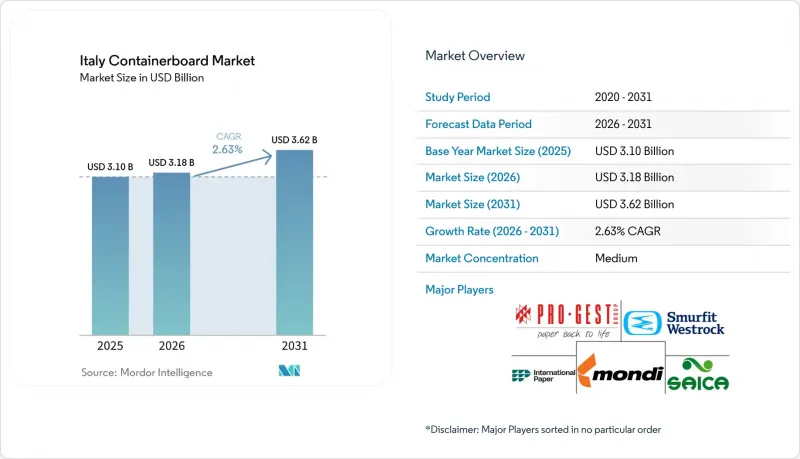
This report is Segmented by Material (Virgin Fibers, and Recycled Fibers), Product Type (Kraftliners, Testliners, and Flutings), and End-User Industry (Food and Beverage, Consumer Goods, Industrial, and More). The Market Forecasts are Provided in Terms of Value (USD).
Italy Containerboard Market Trends and Insights
E-Commerce and Omnichannel Corrugated Demand
The Italian containerboard market is receiving steady support from parcel growth, as B2C e-commerce continued to expand in 2025 and online penetration rose across product categories. Italy's B2C e-commerce product segment reached EUR 40 billion (USD 45.1 billion) in 2025, while online penetration of retail product sales rose to 11.2% from 10.7% in the prior year. Single-item shipment formats use 30% to 50% more board per unit than consolidated pallet formats, allowing board demand to rise faster than the merchandise base itself. Demand is also spreading geographically, as daily online use in southern regions and the islands reached 60.6% of adults in 2026, narrowing the long-standing digital divide with the north. Research presented in early 2026 also showed that 75% of Italian consumers viewed the parcel receipt as their primary physical point of contact with corrugated cardboard, keeping paper-based shipping formats central to last-mile retail.
Plastic-to-Paperboard Substitution in Secondary Packaging
The Italy containerboard market is also benefiting from a broader switch away from plastic in secondary and transit packaging, especially where easier recycling and simpler reverse logistics matter to buyers. Research released in January 2026 showed that 51% of Italian user companies had replaced flexible plastics with corrugated cardboard, while 55% of consumers said corrugated had become more common than bubble wrap and rigid plastic components in delivered packages. This change is not tied solely to regulation, because corrugated packaging also reduces sorting friction and fits more easily into the paper recycling stream after use. Secondary packaging substitution often requires heavier, stronger board grades that support value growth in testliner and other specifications that can handle higher stacking loads. The policy backdrop is becoming more favorable as well, as the European Commission's PPWR guidance establishes a framework that favors easily recyclable packaging and will apply in Italy from August 2026.
Elevated Electricity And Gas Cost Burden
The Italy containerboard market still faces a structural cost burden from energy, and that pressure is stronger than in the main competing paper-producing countries in Europe. Confindustria reported that Italian industrial electricity prices in 2025 were around 30% above the EU average and remained higher than those in Germany, France, and Spain. This matters deeply for paper mills because energy has historically accounted for more than 40% of operating costs in Italian paper production. The sector also depends on natural gas for more than 95% of its heat requirements, so producers cannot easily absorb wide differences in national power and fuel pricing. Industry representatives warned in early 2025 that this gap threatened competitiveness across a supply chain employing 700,000 workers, underscoring that the issue extends beyond individual mills.
Other drivers and restraints analyzed in the detailed report include:
- High Recovered Fiber Collection and Recovery Rates in Italy
- Food and Beverage Export and Fresh Produce Logistics Demand
- Recovered Paper Price And Quality Volatility
For complete list of drivers and restraints, kindly check the Table Of Contents.
Segment Analysis
Recycled fibers held 61.13% of Italy's containerboard market share in 2025, reflecting infrastructure depth more than simple price preference. Italy used recycled paper for 63% of its fiber mix in paper production, ranking second in Europe for total recovered fiber consumption after Germany. This supply base helps the Italy containerboard market keep a strong domestic position in recycled grades, because furnishes can be sourced through a mature national collection and sorting system. Mondi's EUR 200 million (USD 214 million) conversion of the Duino mill to 420,000 tonnes per year of recycled containerboard, completed in April 2025, showed that a major producer viewed the Italian recovered fiber chain as dependable enough for a flagship project.
Virgin fibers are forecast to grow at a CAGR of 2.94% between 2026 and 2031, which makes them the fastest-expanding material base, even from a smaller starting point. The Italy containerboard market is seeing this pull from exporters of fresh produce and premium consumer goods that need stronger burst performance, better printability, and a more uniform surface quality than recycled grades can consistently deliver at lighter weights. Italy also remained highly exposed to imported virgin kraft paper, indicating that this part of the supply chain still has a structural domestic gap. Certification standards already appear well established, because 90% of virgin fibers used in Italian mills carried FSC or PEFC certification in 2024, which supports procurement transparency for larger buyers.
List of Companies Covered in this Report:
- Pro-Gest S.p.A.
- Smurfit Westrock plc
- Mondi plc
- International Paper Italia S.r.l.
- Sociedad Anonima Industrias Celulosa Aragonesa, S.A.
- VPK Group NV
- Progroup Board S.r.l.
- Ghelfi Ondulati S.p.A.
- Ondulati Santerno S.p.A.
- LIC Packaging S.p.A.
- Ondapack Sud S.p.A.
- Box Marche S.p.A.
- Sada S.p.A.
- Antonio Sada & Figli S.p.A.
- Burgo Group S.p.A.
Additional Benefits:
- The market estimate (ME) sheet in Excel format
- 3 months of analyst support
TABLE OF CONTENTS
1 INTRODUCTION
- 1.1 Study Assumptions and Market Definition
- 1.2 Scope of the Study
2 RESEARCH METHODOLOGY
3 EXECUTIVE SUMMARY
4 MARKET LANDSCAPE
- 4.1 Market Overview
- 4.2 Market Drivers
- 4.2.1 E-commerce and Omnichannel Corrugated Demand
- 4.2.2 Plastic-to-Paperboard Substitution in Secondary Packaging
- 4.2.3 High Recovered Fiber Collection and Recovery Rates in Italy
- 4.2.4 Food and Beverage Export and Fresh Produce Logistics Demand
- 4.2.5 PPWR Readiness Favoring Recyclable Mono-Material Packs
- 4.2.6 Lightweighting Economics After New Recycled Capacity Start-Ups
- 4.3 Market Restraints
- 4.3.1 Elevated Electricity and Gas Cost Burden
- 4.3.2 Recovered Paper Price and Quality Volatility
- 4.3.3 PPWR Compliance and Documentation Costs for Smaller Converters
- 4.3.4 Imported Kraftliner Pressure in High-Performance Grades
- 4.4 Impact of Macroeconomic Factors on the Market
- 4.5 Industry Value Chain Analysis
- 4.6 Regulatory Landscape
- 4.7 Technological Outlook
- 4.8 Porter's Five Forces Analysis
- 4.8.1 Bargaining Power of Suppliers
- 4.8.2 Bargaining Power of Buyers
- 4.8.3 Threat of New Entrants
- 4.8.4 Threat of Substitutes
- 4.8.5 Intensity of Rivalry
5 MARKET SIZE AND GROWTH FORECASTS (VALUE)
- 5.1 By Material
- 5.1.1 Virgin Fibers
- 5.1.2 Recycled Fibers
- 5.2 By Product Type
- 5.2.1 Kraftliners
- 5.2.2 Testliners
- 5.2.3 Flutings
- 5.3 By End-User Industry
- 5.3.1 Food and Beverage
- 5.3.2 Consumer Goods
- 5.3.3 Industrial
- 5.3.4 Other End-User Industries
6 COMPETITIVE LANDSCAPE
- 6.1 Market Concentration
- 6.2 Strategic Moves
- 6.3 Market Share Analysis
- 6.4 Company Profiles (includes Global Level Overview, Market Level Overview, Core Segments, Financials as available, Strategic Information, Market Rank/Share, Products and Services, Recent Developments)
- 6.4.1 Pro-Gest S.p.A.
- 6.4.2 Smurfit Westrock plc
- 6.4.3 Mondi plc
- 6.4.4 International Paper Italia S.r.l.
- 6.4.5 Sociedad Anonima Industrias Celulosa Aragonesa, S.A.
- 6.4.6 VPK Group NV
- 6.4.7 Progroup Board S.r.l.
- 6.4.8 Ghelfi Ondulati S.p.A.
- 6.4.9 Ondulati Santerno S.p.A.
- 6.4.10 LIC Packaging S.p.A.
- 6.4.11 Ondapack Sud S.p.A.
- 6.4.12 Box Marche S.p.A.
- 6.4.13 Sada S.p.A.
- 6.4.14 Antonio Sada & Figli S.p.A.
- 6.4.15 Burgo Group S.p.A.
7 MARKET OPPORTUNITIES AND FUTURE OUTLOOK
- 7.1 White-Space and Unmet-Need Assessment

