PUBLISHER: Mordor Intelligence | PRODUCT CODE: 2065480

PUBLISHER: Mordor Intelligence | PRODUCT CODE: 2065480
Philippines Containerboard - Market Share Analysis, Industry Trends & Statistics, Growth Forecasts (2026 - 2031)
According to Mordor Intelligence, the philippines containerboard market size is projected to expand from USD 2.12 billion in 2025 and USD 2.21 billion in 2026 to USD 2.77 billion by 2031, registering a CAGR of 4.62% between 2026 to 2031.
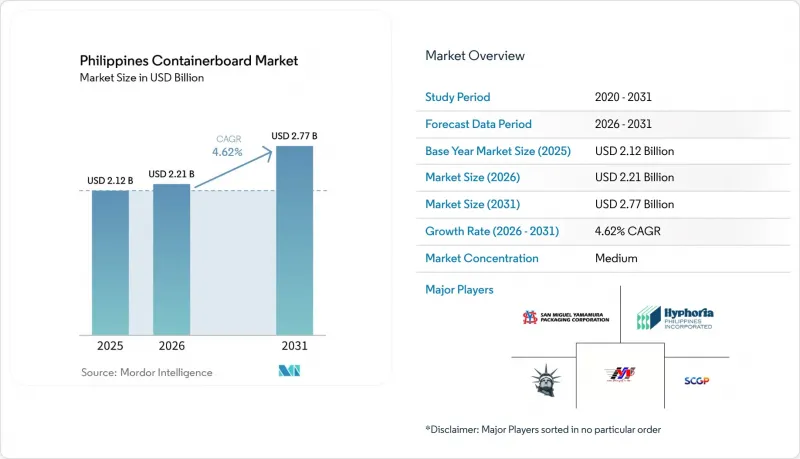
This report is Segmented by Material (Virgin Fibers, and Recycled Fibers), Product Type (Kraftliners, Testliners, and Flutings), and End-User Industry (Food and Beverage, Consumer Goods, Industrial, and More). The Market Forecasts are Provided in Terms of Value (USD).
Philippines Containerboard Market Trends and Insights
Packaged Food And Beverage Output Expansion
Packaged food and beverage production remains the strongest demand anchor for the Philippines containerboard market because it creates recurring shipping needs across urban, provincial, and inter-island distribution channels. The Philippine Statistics Authority reported that the volume of production index for food products rose 15.7% year over year in May 2025, then increased 3.4% in February 2026 even as wider industrial activity stayed less even, which shows that food manufacturing has been more defensive than many other factory categories. The USDA Foreign Agricultural Service also projected continued expansion in 2026 and linked part of that support to government efforts aimed at reducing logistics friction for food processors. The barangay-led retail model adds another layer of box demand because goods often move in smaller shipment formats and more frequent replenishment cycles than in supermarket-heavy systems, which raises box conversion intensity per unit of product sold. That pattern helps explain why the Philippines containerboard market draws durable support from food applications even when headline industrial production softens and why converters tied to everyday consumer staples tend to operate with a steadier order base than firms exposed mainly to discretionary categories.
E-Commerce Parcel Volume Growth
E-commerce continues to reshape the Philippines containerboard market by shifting more packaging demand toward single-trip corrugated formats used in parcel delivery and return handling. Online retail flows differ from traditional wholesale movement because orders are broken into smaller shipments, which changes box specifications, increases the number of units handled, and creates repeat demand for light but consistent corrugated grades. This has supported demand for recycled testliners and lighter fluting structures that suit parcel shipping without requiring export-grade board in every application. The benefit is strongest for local converters that can handle short production runs, varied dimensions, and quick turnaround times for merchants serving social commerce and marketplace channels. The result is a broader customer base for the Philippines containerboard market because packaging demand is spreading beyond large contract buyers and into a wider pool of domestic sellers, fulfillment operators, and courier-linked accounts.
Imported Board Price Pressure On Local Mills
Imported containerboard remains a serious constraint on the Philippines containerboard market because local mills compete against suppliers from larger regional production systems with better economies of scale and lower operating costs. The Board of Investments noted that the domestic paper sector includes 22 non-integrated mills with combined capacity of 1.65 million metric tons per year, which is sizable for the local market but still fragmented compared with regional heavyweights. Trade policy support also weakened after the Tariff Commission's January 2026 finding that Indonesian corrugating medium imports did not cause serious injury, and the Department of Trade and Industry later rejected the petition for definitive safeguard duties and ordered cash bond refunds to importers. That outcome reopened room for foreign board to compete more freely in commodity grades, especially where domestic producers rely on older machines or face higher operating costs. The pressure is especially relevant in the Philippines containerboard market because converters can use imports as a negotiating check on local mill pricing, which compresses domestic margins even when end-user demand remains healthy.
Other drivers and restraints analyzed in the detailed report include:
- Electronics And Industrial Export Packaging Demand
- Better Domestic Wastepaper Recovery And Reuse
- High Electricity Costs Versus ASEAN Peers
For complete list of drivers and restraints, kindly check the Table Of Contents.
Segment Analysis
Recycled fibers held 67.83% of the market in 2025, which shows how deeply the Philippines containerboard market depends on OCC and mixed wastepaper as its operating base. The Board of Investments PAPELS study stated that recycled fiber content in Philippine paper production runs at 95-100%, which means this position reflects infrastructure reality more than a simple commercial preference. In practice, the Philippines containerboard industry is built around a feedstock model where local mills work with recovered paper because commercial-scale virgin pulp plantations are not available in the country. That gives recycled board a stable volume role and keeps its demand closely linked to collection efficiency, municipal recovery systems, and the quality of domestically sourced wastepaper rather than only to shifts in end-user packaging choice.
Virgin fibers are projected to grow at a 5.37% CAGR from 2026 to 2031, which makes them the fastest-moving material niche even from a small base. The opportunity comes from applications where recycled content is less favored, including select pharmaceutical packaging, premium consumer goods, and food uses that require cleaner or certified fiber grades. Imports from established virgin kraft suppliers give converters access to these substrates, which means value-added demand can grow even without domestic pulp integration. This creates a two-speed structure in the Philippines containerboard industry, where recycled inputs remain dominant in tonnage while virgin-fiber applications capture incremental value in narrower, specification-driven segments. SCGP's 2026 investment plan of THB 13,000 million, or USD 354 million, for fiber packaging upgrades across Southeast Asia reinforces that higher-value positioning is becoming more important for regional players that include the Philippines in their network strategy.
List of Companies Covered in this Report:
- United Pulp and Paper Co., Inc.
- San Miguel Yamamura Packaging Corporation
- Valenzuela Packaging Container Corporation
- Hyphoria Philippines Inc.
- Papercon (Phils.) Inc.
- 3D Container and Packaging Phils. Corp.
- Total Packaging Solutions and Manufacturing, Inc.
- Mina Moto Packaging Corp.
- Corbox Corporation
- Liberty Corrugated Boxes Mfg. Corp.
- Davao Fibreboard Packaging Plant Inc.
- Duraboard Packaging Corp.
- Goldrich Industrial Packaging Corporation
- Malinta Corrugated Boxes Manufacturing Corporation
- Tenaga Pack Solution Inc.
- Cr8tive Boxes and Labels Corporation
- SBC Packaging OPC
- GagMax Packaging Solutions Inc.
- STC Paper and Plastic Packaging Solutions
- SuperPack Enterprises
Additional Benefits:
- The market estimate (ME) sheet in Excel format
- 3 months of analyst support
TABLE OF CONTENTS
1 INTRODUCTION
- 1.1 Study Assumptions and Market Definition
- 1.2 Scope of the Study
2 RESEARCH METHODOLOGY
3 EXECUTIVE SUMMARY
4 MARKET LANDSCAPE
- 4.1 Market Overview
- 4.2 Impact of Macroeconomic Factors on the Market
- 4.3 Market Drivers
- 4.3.1 Packaged Food and Beverage Output Expansion
- 4.3.2 E-Commerce Parcel Volume Growth
- 4.3.3 Electronics and Industrial Export Packaging Demand
- 4.3.4 Better Domestic Wastepaper Recovery and Reuse
- 4.3.5 Corrugating Medium Safeguard Action Supporting Local Utilization
- 4.3.6 ISO 14001:2026 Adoption Favoring Traceable Fiber Packaging
- 4.4 Market Restraints
- 4.4.1 Imported Board Price Pressure on Local Mills
- 4.4.2 High Electricity Costs Versus ASEAN Peers
- 4.4.3 Recycling-Center Scarcity Outside Major Urban Hubs
- 4.4.4 Port Congestion and Elevated Container Freight Costs
- 4.5 Industry Value Chain Analysis
- 4.6 Supply Chain Analysis
- 4.7 Regulatory Landscape
- 4.8 Technological Outlook
- 4.9 Porter's Five Forces Analysis
- 4.9.1 Threat of New Entrants
- 4.9.2 Bargaining Power of Suppliers
- 4.9.3 Bargaining Power of Buyers
- 4.9.4 Threat of Substitutes
- 4.9.5 Intensity of Competitive Rivalry
5 MARKET SIZE AND GROWTH FORECASTS (VALUE)
- 5.1 By Material
- 5.1.1 Virgin Fibers
- 5.1.2 Recycled Fibers
- 5.2 By Product Type
- 5.2.1 Kraftliners
- 5.2.2 Testliners
- 5.2.3 Flutings
- 5.3 By End-User Industry
- 5.3.1 Food and Beverage
- 5.3.2 Consumer Goods
- 5.3.3 Industrial
- 5.3.4 Other End-User Industries
6 COMPETITIVE LANDSCAPE
- 6.1 Market Concentration
- 6.2 Strategic Moves
- 6.3 Market Share Analysis
- 6.4 Company Profiles (includes Global Level Overview, Market Level Overview, Core Segments, Financials as available, Strategic Information, Market Rank/Share, Products and Services, Recent Developments)
- 6.4.1 United Pulp and Paper Co., Inc.
- 6.4.2 San Miguel Yamamura Packaging Corporation
- 6.4.3 Valenzuela Packaging Container Corporation
- 6.4.4 Hyphoria Philippines Inc.
- 6.4.5 Papercon (Phils.) Inc.
- 6.4.6 3D Container and Packaging Phils. Corp.
- 6.4.7 Total Packaging Solutions and Manufacturing, Inc.
- 6.4.8 Mina Moto Packaging Corp.
- 6.4.9 Corbox Corporation
- 6.4.10 Liberty Corrugated Boxes Mfg. Corp.
- 6.4.11 Davao Fibreboard Packaging Plant Inc.
- 6.4.12 Duraboard Packaging Corp.
- 6.4.13 Goldrich Industrial Packaging Corporation
- 6.4.14 Malinta Corrugated Boxes Manufacturing Corporation
- 6.4.15 Tenaga Pack Solution Inc.
- 6.4.16 Cr8tive Boxes and Labels Corporation
- 6.4.17 SBC Packaging OPC
- 6.4.18 GagMax Packaging Solutions Inc.
- 6.4.19 STC Paper and Plastic Packaging Solutions
- 6.4.20 SuperPack Enterprises
7 MARKET OPPORTUNITIES AND FUTURE OUTLOOK
- 7.1 White-Space and Unmet-Need Assessment
- 7.2 Future Outlook

