PUBLISHER: Mordor Intelligence | PRODUCT CODE: 2064393

PUBLISHER: Mordor Intelligence | PRODUCT CODE: 2064393
Japan Containerboard - Market Share Analysis, Industry Trends & Statistics, Growth Forecasts (2026 - 2031)
According to Mordor Intelligence, the japan containerboard market size is expected to increase from USD 6.62 billion in 2025 to USD 6.86 billion in 2026 and reach USD 8.01 billion by 2031, growing at a CAGR of 3.15% over 2026-2031.
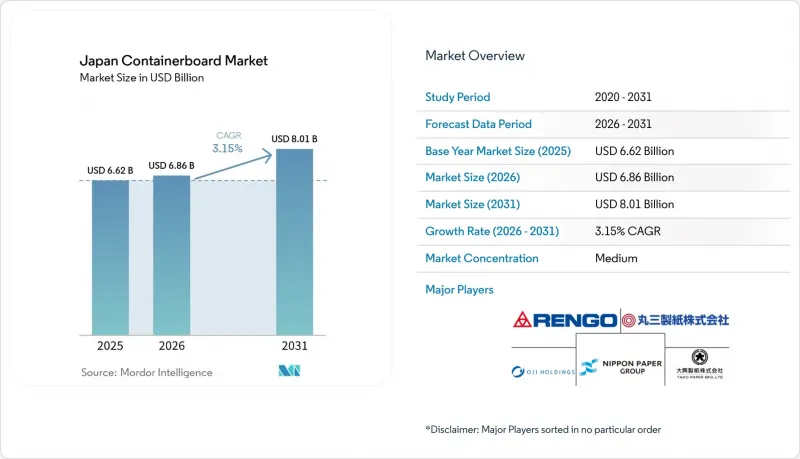
This report is Segmented by Material (Virgin Fibers, and Recycled Fibers), Product Type (Kraftliners, Testliners, and Flutings), and End-User Industry (Food and Beverage, Consumer Goods, Industrial, and More). The Market Forecasts are Provided in Terms of Value (USD).
Japan Containerboard Market Trends and Insights
Plastic Substitution And Recyclability Preferences
Japan's mandated move away from fossil-derived plastics is widening the addressable demand base for the Japan containerboard market. The positive-list system for synthetic food-contact packaging became fully effective on June 1, 2025, raising compliance requirements for non-paper formats in food-related applications. Recycling obligations under the Container and Packaging Recycling Law also improve the relative cost position of mono-material corrugated formats when compared with more complex plastic structures. This means packaging users can move toward paper even when end buyers are not actively selecting sustainable formats, because the economics and compliance burden are shifting upstream. Oji has already quantified that direction by targeting a reduction of 5,000 tonnes of plastic annually through sustainable packaging substitution by FY2030, up from 3,000 tonnes achieved in FY2024. This gives the Japan containerboard market a policy-backed demand channel that does not rely on short-term consumer sentiment and is likely to remain relevant across food, retail, and transport packaging decisions.
E-Commerce And Parcel Delivery Demand
Japan's digital retail economy is changing both how much board is used and what box specifications are needed in the Japanese containerboard market. Japan's B2C e-commerce market reached JPY 26.1 trillion (USD 186.4 billion) in FY2024, up 5.1% year on year, and cross-border purchases of Japanese products totaled JPY 5.78 trillion (USD 41.3 billion). Food and beverage e-commerce reached JPY 3.12 trillion (USD 20.6 billion), driving demand for insulated, moisture-resistant corrugated shippers used in cold and fresh delivery formats. The 2024 overtime cap for truck drivers is also pushing fulfillment operators toward thinner and more exact-fit boxes that reduce dimensional-weight charges and improve loading efficiency. Rengo's J-RexS automatic packaging machine, launched in January 2025, shows how equipment innovation is helping distribution centers produce right-sized corrugated cases at scale. Together, these shifts show that the Japan containerboard market is benefiting not only from more parcels but also from a redesign of packaging around speed, cube efficiency, and automated fulfillment.
OCC, Energy, And Fuel Cost Volatility
Input cost swings remain the most direct earnings pressure for producers in the Japan containerboard market. Japanese OCC export prices to Southeast Asia moved from USD 195-205 per tonne in August 2024 to USD 145-150 per tonne in January 2026, which shows how quickly regional recovered-paper values can shift. Domestic recovered-paper inventories also rose 61% year on year by the end of December 2025, which temporarily eased feedstock pressure but also signaled unstable supply-demand conditions. Energy adds a second layer of risk because mills are heavy fuel users, and Rengo completed its coal-to-LNG conversion at Kanazu Mill in FY2025 as part of a broader cost and emissions transition. Even when long-term efficiency improves, these swings in raw materials and fuel prices can compress margins before selling prices fully catch up. This makes procurement discipline and price pass-through a persistent issue across the Japan containerboard market, especially for producers exposed to inland transport and volatile export-linked recovered-paper flows.
Other drivers and restraints analyzed in the detailed report include:
- Stable Food And Beverage Corrugated Consumption
- Electronics, Semiconductor, And Industrial Export Packaging Demand
- Competition From Reusable Plastic Crates And Alternative Packaging Formats
For complete list of drivers and restraints, kindly check the Table Of Contents.
Segment Analysis
Recycled fibers held 67.48% of the Japan containerboard market share in 2025, making them the clear base material across the market. That lead reflects Japan's long-established preference for recovered paper in standard shipping, retail transit, and everyday distribution formats where availability and cost control matter most. Domestic mills rely heavily on recycled inputs for testliners and recycled fluting because these grades fit the needs of broad domestic box demand without requiring premium fiber costs. Established collection habits and disciplined sorting also help keep recycled inputs usable at scale, which supports stable output for mass-market packaging applications. As a result, recycled fibers remain the default choice where price stability, local availability, and predictable performance matter more than the absolute highest strength profile.
Virgin fibers are projected to expand at a 4.32% CAGR from 2026 to 2031, indicating that a portion of the Japan containerboard market is shifting toward higher-performance packaging. This growth is tied to export-grade industrial packaging and electronics shipments that require better ring-crush strength and burst resistance than recycled liners can consistently deliver in demanding applications. Daio started operations at its commercial cellulose nanofiber plant in Mishima in July 2025, with an annual capacity of 2,000 tonnes, 20 times its earlier scale. That investment suggests the material gap may narrow over time as producers develop thinner but stronger board structures for logistics and packaging uses. The direction of travel is clear in the Japan containerboard market; recycled fibers still anchor broad volume demand, while virgin-fiber growth is being pulled by applications where technical performance justifies a higher input profile.
List of Companies Covered in this Report:
- Oji Holdings Corporation
- Morishigyo Co., Ltd.
- Rengo Co., Ltd.
- Marusan Paper Mfg. Co., Ltd.
- Taiko Paper Mfg., Ltd.
- Osaka Paper Co., Ltd.
- Nippon Paper Industries Co., Ltd.
- Daio Paper Corporation
- Iwaki Daio Paper Corporation
- OTSU PAPER BOARD CO. LTD.
- Uemura Shiko Corporation
- Yoshizawa Kogyo Corporation
- Hokuetsu Corporation
- Tokushu Tokai Paper Co., Ltd.
- Shin Tokai Paper Co., Ltd.
- Mitsubishi Corporation Packaging Ltd.
Additional Benefits:
- The market estimate (ME) sheet in Excel format
- 3 months of analyst support
TABLE OF CONTENTS
1 INTRODUCTION
- 1.1 Study Assumptions and Market Definition
- 1.2 Scope of the Study
2 RESEARCH METHODOLOGY
3 EXECUTIVE SUMMARY
4 MARKET LANDSCAPE
- 4.1 Market Overview
- 4.2 Market Drivers
- 4.2.1 Plastic Substitution and Recyclability Preferences
- 4.2.2 E-Commerce and Parcel Delivery Demand
- 4.2.3 Stable Food and Beverage Corrugated Consumption
- 4.2.4 Electronics, Semiconductor, and Industrial Export Packaging Demand
- 4.2.5 Cardboard Cushioning Replacing EPS in Protective Packaging
- 4.2.6 Lightweight and Automation-Ready Board Demand From Logistics Reform
- 4.3 Market Restraints
- 4.3.1 OCC, Energy, and Fuel Cost Volatility
- 4.3.2 Competition From Reusable Plastic Crates and Alternative Packaging Formats
- 4.3.3 Logistics 2024 Rule Changes Raising Delivered-Cost Pressure
- 4.3.4 Recovered-Paper Quality Ceiling and Contamination Limits
- 4.4 Industry Value Chain Analysis
- 4.5 Impact of Macroeconomic Factors on the Market
- 4.6 Supply-Chain Analysis
- 4.7 Regulatory Landscape
- 4.8 Technological Outlook
- 4.9 Porter's Five Forces Analysis
- 4.9.1 Threat of New Entrants
- 4.9.2 Bargaining Power of Suppliers
- 4.9.3 Bargaining Power of Buyers
- 4.9.4 Threat of Substitutes
- 4.9.5 Competitive Rivalry
5 MARKET SIZE AND GROWTH FORECASTS (VALUE)
- 5.1 By Material
- 5.1.1 Virgin Fibers
- 5.1.2 Recycled Fibers
- 5.2 By Product Type
- 5.2.1 Kraftliners
- 5.2.2 Testliners
- 5.2.3 Flutings
- 5.3 By End-User Industry
- 5.3.1 Food and Beverage
- 5.3.2 Consumer Goods
- 5.3.3 Industrial
- 5.3.4 Other End-User Industries
6 COMPETITIVE LANDSCAPE
- 6.1 Market Concentration
- 6.2 Strategic Moves
- 6.3 Market Share Analysis
- 6.4 Company Profiles (includes Global Level Overview, Market Level Overview, Core Segments, Financials as available, Strategic Information, Market Rank/Share, Products and Services, Recent Developments)
- 6.4.1 Oji Holdings Corporation
- 6.4.2 Morishigyo Co., Ltd.
- 6.4.3 Rengo Co., Ltd.
- 6.4.4 Marusan Paper Mfg. Co., Ltd.
- 6.4.5 Taiko Paper Mfg., Ltd.
- 6.4.6 Osaka Paper Co., Ltd.
- 6.4.7 Nippon Paper Industries Co., Ltd.
- 6.4.8 Daio Paper Corporation
- 6.4.9 Iwaki Daio Paper Corporation
- 6.4.10 OTSU PAPER BOARD CO. LTD.
- 6.4.11 Uemura Shiko Corporation
- 6.4.12 Yoshizawa Kogyo Corporation
- 6.4.13 Hokuetsu Corporation
- 6.4.14 Tokushu Tokai Paper Co., Ltd.
- 6.4.15 Shin Tokai Paper Co., Ltd.
- 6.4.16 Mitsubishi Corporation Packaging Ltd.
7 MARKET OPPORTUNITIES AND FUTURE OUTLOOK
- 7.1 White-Space and Unmet-Need Assessment

